Photo: Jeremy Klaszus
The case for doing good work on a small scale
It’s human — and we need that right now.

Last weekend I was in Toronto with my son to see some Blue Jays games.
We hadn't been to the SkyDome together since the summer of 2015. Being there again got me thinking about a project I launched that year. It was a newsletter about baseball, and I sent the first one to maybe 30 people.
By the end of the run, a year later, the list had grown to maybe 100 people? I don't remember exactly. But it wasn't a lot.
The small reach didn't matter. Or maybe it did, in that the small scale made it fun. It was low stakes. And it felt human.
In the first dispatch I wrote: "If you're getting this email, it's because you are family or friend (or Twitter person who seems friend-ish) who falls into one of two categories: a) you like baseball and know it, or b) you haven't yet discovered that you like baseball."
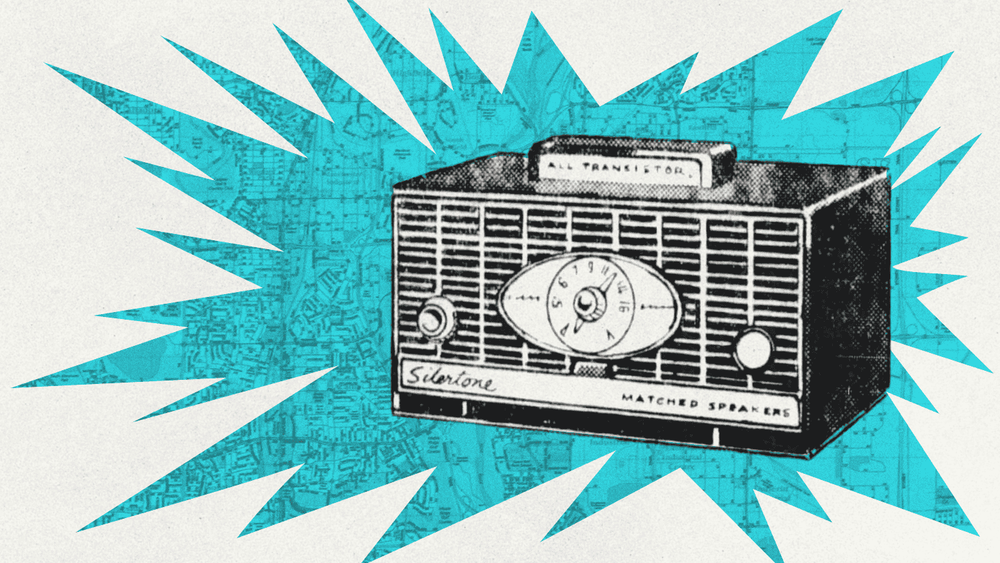
In retrospect, I can see how this project helped lay the groundwork for The Sprawl. I spent time digging for archival photos and finding neat bits of writing to include. One dispatch was about baseball on the radio. It included excerpts from Annie Dillard and Marilynne Robinson.
My grandmother also wrote something for that one, recalling her father listening to Milwaukee Braves games when she was growing up in Wisconsin.
"Because the radio was turned up to full volume, the rest of the family had to listen too," she wrote. "Every baseball game seemed to be one long, stretched-out blaring of announcers with my father passionately trying to out-yell them. I dreaded it."
Another dispatch was all about the rhubarb—a term popularized by Brooklyn Dodgers broadcaster Red Barber.
"In Mr. Barber's lexicon a rhubarb was a noisy altercation, a broil, a violent emotional upheaval brought on by epical dispute—such as whether one grown man had touched another grown man on the body with a ball the size of a smallish orange," wrote H. Allen Smith in his 1946 novel Rhubarb.
I included, at the end of that dispatch, a recipe for a rhubarb dessert from one of my mom's old cookbooks.
In all, I sent just nine of these newsletters. The platform I used to send them, TinyLetter, is kaput. It was owned by Mailchimp, the platform I use to send this newsletter, which shuttered it.
I went back recently to look at these emails. And felt a pit in my stomach. The photos are gone. And the photos were a crucial part of those dispatches, carefully chosen.
I never printed out those newsletters. I figured—they are in my email and that's enough. Besides, I can always print them out later.
Wrong.
Now all the photos are replaced by a broken image icon. Which feels like an appropriate metaphor for the internet in 2026.
(On a side note, it often occurs to me that I should stop everything I'm doing—everything!—and take a month or however long and properly archive The Sprawl so it doesn't get similarly lost. But I digress.)
The small scale of my baseball newsletter was one of the best things about it. It wasn't trying to reach everyone everywhere, but it brought me joy to make it, and did the same for my (few!) readers. And that was enough.
Lately I find myself drawn to that similar scale. Obviously I still appreciate if a Sprawl story gets lots of traction online, like our recent coverage of the CTrain free fare zone. These stories are our bread and butter.
But what is most generative to me, at this point, is not the article that goes viral or the odd Instagram reel that satisfies the algorithm (which, when it takes off and I am checking its numbers compulsively, leaves me feeling more hollow than anything).
It is gathering in a room to discuss an issue together.
It is going to City Hall School and exploring the role of journalism with 25 or so students.
It is taking out the Pop-Up Press, putting paper and ink into people's hands and having some good conversations at the same time.
In short, it's the stuff that happens on a human scale.
What is most generative to me, at this point, is not the article that goes viral or the odd Instagram reel that satisfies the algorithm.
I can remember, weeks before launching The Sprawl in 2017, listening to CBC Radio in the dark. One of my favourite shows, Laurie Brown's The Signal, was signing off. And for her final show Brown was broadcasting from Signal Hill, overlooking St. John's Harbour.
Her parting words from that night still resonate. Maybe even more so today than when she said them.
"This is a confounding time," Brown said. "We are poised on the edge of changes in the world so massive, we don’t know where to look. We’ve spent enough time looking away. It’s time to turn towards the noise. How to respond? When the going gets this weird, it’s time to turn human. Make a move to undo the unkindness of centuries in a hundred small ways. Do it with curiosity and joy and revel in this mystery."
"This is not an end. This is a point of departure. Where are you headed? What will you do? You are not alone."
With all of this in mind, join us on Sunday, June 14, for a printing pop-up with local cartoonist and author Teresa Wong! We will be meeting at Sien Lok Park at 2 p.m.
She has created a new piece of local artwork specifically for the Pop-Up Press—meant to be printed by hand, in person. Come print a piece of Chinatown!
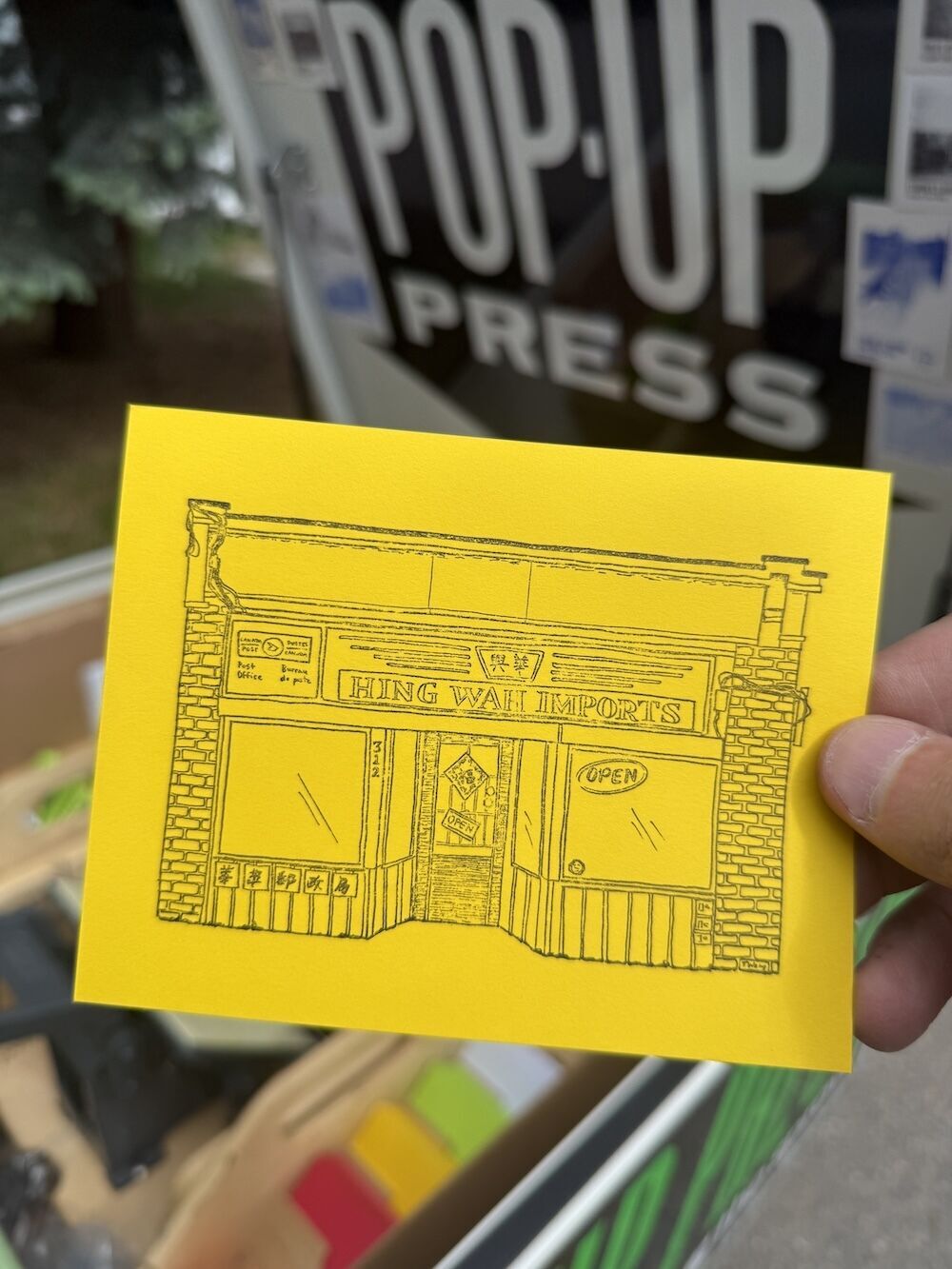
There is no cost. We'd love to see you there! It's right by the river west of Centre Street.
Thanks for reading—and remember to support The Sprawl's small-scale journalism if you value it!
Jeremy Klaszus is founder and editor of The Sprawl.
Support independent Calgary journalism!
Sign Me Up!The Sprawl connects Calgarians with their city through in-depth, curiosity-driven journalism. But we can't do it alone. If you value our work, support The Sprawl so we can keep digging into municipal issues in Calgary!