Photo illustration by The Sprawl. Source: City of Calgary
How ‘strategic amnesia’ led to Calgary’s water pipe disasters
A costly example of a common pattern.

Support independent Calgary journalism!
Sign Me Up!The Sprawl connects Calgarians with their city through in-depth, curiosity-driven journalism. But we can't do it alone. If you value our work, support The Sprawl so we can keep digging into municipal issues in Calgary!
City hall knew this water pipe could blow.
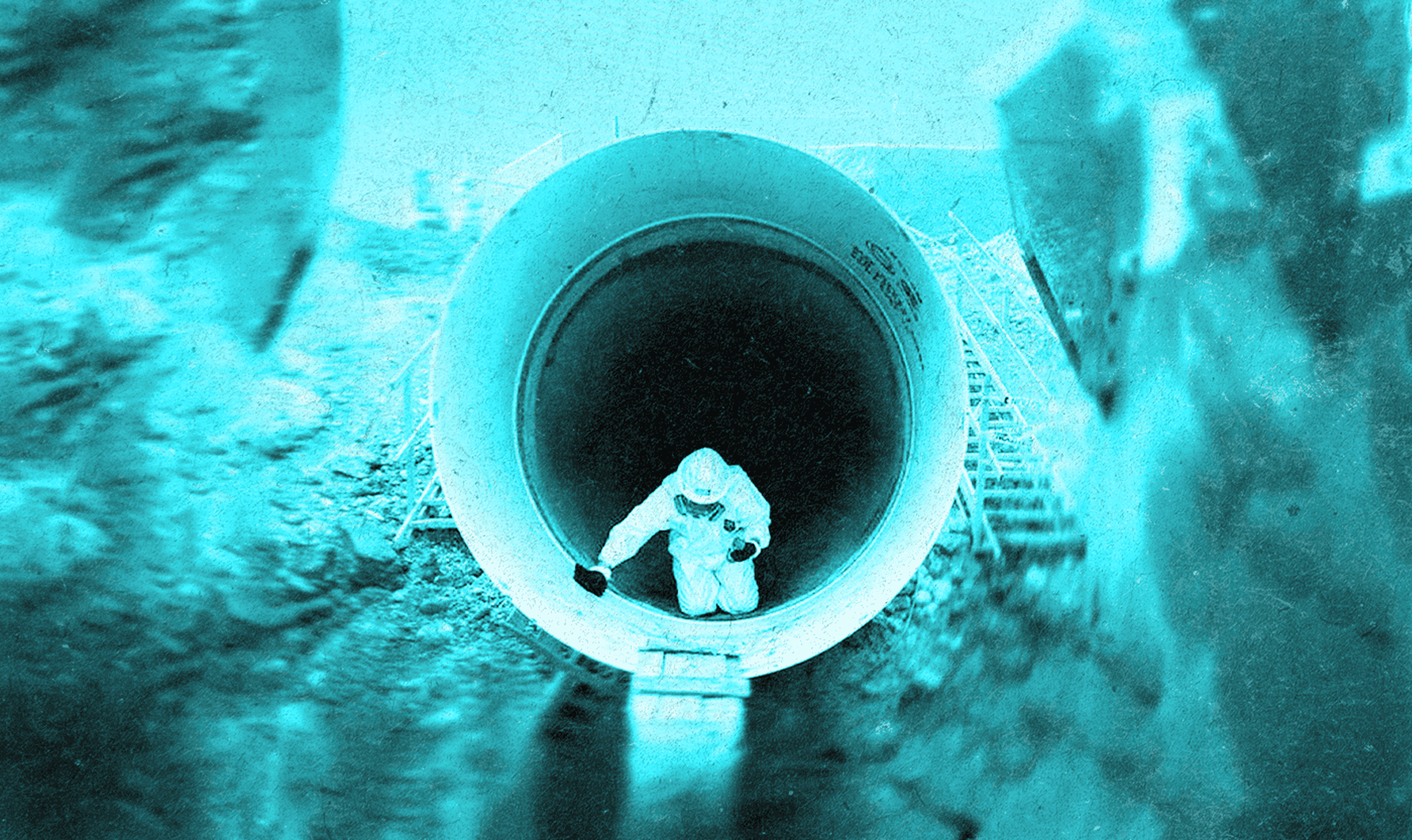
That is one takeaway from the independent report on the 2024 Bearspaw south feeder main break that came out this week, as city crews scrambled to fix a second catastrophic break in the deteriorating concrete pipe.
But the ways in which city hall didn’t know—or kept itself from knowing with clarity—are perhaps more telling.
Earlier this month, Cosimo Pacciani and Laurence B. Mussio wrote in The Globe and Mail about a phenomenon they call “strategic amnesia.” They describe it as “modern institutions’ most sophisticated pathology,” one that follows a universal pattern.
“Three interlocking failures produce catastrophe: the fragmentation of knowledge across silos until no single authority possesses the complete picture; the absence of accountability for synthesis, ensuring that warnings are recorded but never compel action; and economic incentives that make proceeding more profitable than pausing,” they write.
The repeated failure of this feeder main, which carries up to 60% of Calgary's drinking water, checks all three of these boxes.
The city prioritized other critical needs and initiatives, repeatedly deferring [the pipe’s] inspection, monitoring and risk mitigation.
The risks to the Bearspaw pipe “were identified twenty years prior during internal assessments” after a similar concrete pipe, the McKnight feeder main, ruptured in 2004, the panel states in its report. “Repeated internal reviews, external studies, and condition assessments confirmed” the Bearspaw feeder main's vulnerability.
But city hall had “systemic gaps” that kept administration from taking action—gaps that persist today. Calgary’s water utility “is split across multiple city departments leaving no single leader accountable for end-to-end outcomes.” Updates to elected officials were “periodic and high-level” and “many critical decisions were never surfaced to council.”
Knowledge was fragmented. Responsibility was murky. And the pressures of growth eclipsed all else.
“What had crept into the city's management culture was an acceptance of—or a tolerance of, I'm going to say—too high a risk level for an essential service utility operation,” said former ATCO executive Siegfried Kiefer, who chaired the review panel that investigated the 2024 break.
“Projects that were essential to reducing the dependence on Bearspaw south feeder main have been delayed repeatedly, and as a result, we find ourselves now with that pipeline failing without having good alternate routing mechanisms in the network.”
Knowledge was fragmented. Responsibility was murky. And the pressures of growth eclipsed all else.
A “consensus culture” among city staff was also cited as a factor.
“Often what would happen is they would escalate and they would be directed that the optimum way to proceed with this is to go back and gain consensus,” Nancy Foster, a former Nexen and Husky Energy exec on the review panel, told council.
“So this would cause deferrals on key decisions, and this meant that key decisions were being made at a more of a mid management level. They weren't being escalated to executive or council.”
Then there were the economic pressures.
Infrastructure neglect is common across Canada; some 27% of water mains nationwide need repair. But Calgary's sprawling footprint and high rate of population growth exacerbated the problem.
“It remains a low-density municipality, resulting in more kilometres of pipe per resident than any other large Canadian peer city,” states the report, pegging Calgary's metres of pipe per capita at 4.2, compared to 4.0 in Edmonton, 2.7 in Montreal, 1.7 in Toronto and 0.6 in Vancouver. “These factors have stretched capacity and added maintenance and asset integrity costs for the water utility.”
Basically, it paid not to deal with pipe maintenance over the past two decades. Or seemed to.
“Accommodating growth has been done by, in effect, robbing monies from some of the sustainment work that should have been ongoing,” Kiefer told council.
Add it all up, and you get Pacciani’s and Mussio’s “strategic amnesia.”
“This is not merely forgetting but the deliberate fragmentation of knowledge to diffuse accountability while preserving plausible deniability,” they write. “When everyone knows something, but no one is responsible for that knowledge, institutional blindness becomes structural.”
Hence the situation we’re in now, where it’s unclear, precisely, who is to blame. Current chief administrative officer David Duckworth? The previous six city councils between 2004 and 2025? Former mayor Naheed Nenshi? Everyone? No one?
“I would not lay blame at the foot of any one individual or any one era of council,” Kiefer said. “This problem existed. It repeated itself. It did not surface to the right level of decision-making.”
Accommodating growth has been done by, in effect, robbing monies from some of the sustainment work that should have been ongoing.
“What this report says is that there's not one smoking gun... It's successive decisions that were made across the City of Calgary over the past 20-plus years that contributed to the situation that we're in now,” said Mayor Jeromy Farkas.
“So the question becomes, what does city council choose to do here and now?”
Farkas has said city hall needs to act on all of the panel's recommendations—“we cannot cherry pick”—and will “spare no expense” in fixing this, getting a steel pipe built ASAP to replace the six kilometres of bad pipe “faster than anything we have ever done before.” The panel says it needs to be done within 12 to 14 months.
Costs remain a question mark. But Calgary's current water precarity is unsettlingly clear, as the city relies heavily on the Glenmore treatment plant and a limited winter water supply in the Glenmore Reservoir while the Bearspaw south line is down. The reservoir is being drawn down and does not get replenished until springtime.
In the meantime everyone is emphatic: the Bearspaw south pipe is deteriorating, increasingly fragile with each rupture, and could easily blow again—perhaps as soon as this week as the city refills the pipe with water and re-pressurizes it.
“This is very much the new reality that we are facing,” said Farkas. "We have a ticking time bomb underneath our streets.”
Speaking to city council about what went wrong for two decades, Kiefer said the same thing many different ways. “I don't know how much more emphasis we could put on the precarious state we're in with that particular pipe being as unreliable as it is today.”
CORRECTION 2026/01/10: This story originally stated that "the entire city" is relying on the Glenmore water treatment plant while the Bearspaw south feeder main is down. This is inaccurate. It has been updated to clarify that the city is relying heavily, but not entirely, on the Glenmore plant, as there are two smaller feeder mains from the Bearspaw plant—north and northwest—that are still operational. The Sprawl regrets the error.
Jeremy Klaszus is founder and editor of The Sprawl.
Support independent Calgary journalism!
Sign Me Up!The Sprawl connects Calgarians with their city through in-depth, curiosity-driven journalism. But we can't do it alone. If you value our work, support The Sprawl so we can keep digging into municipal issues in Calgary!