My frustration at covering Calgary city hall as a journalist
I want some basic facts. Is that so hard?

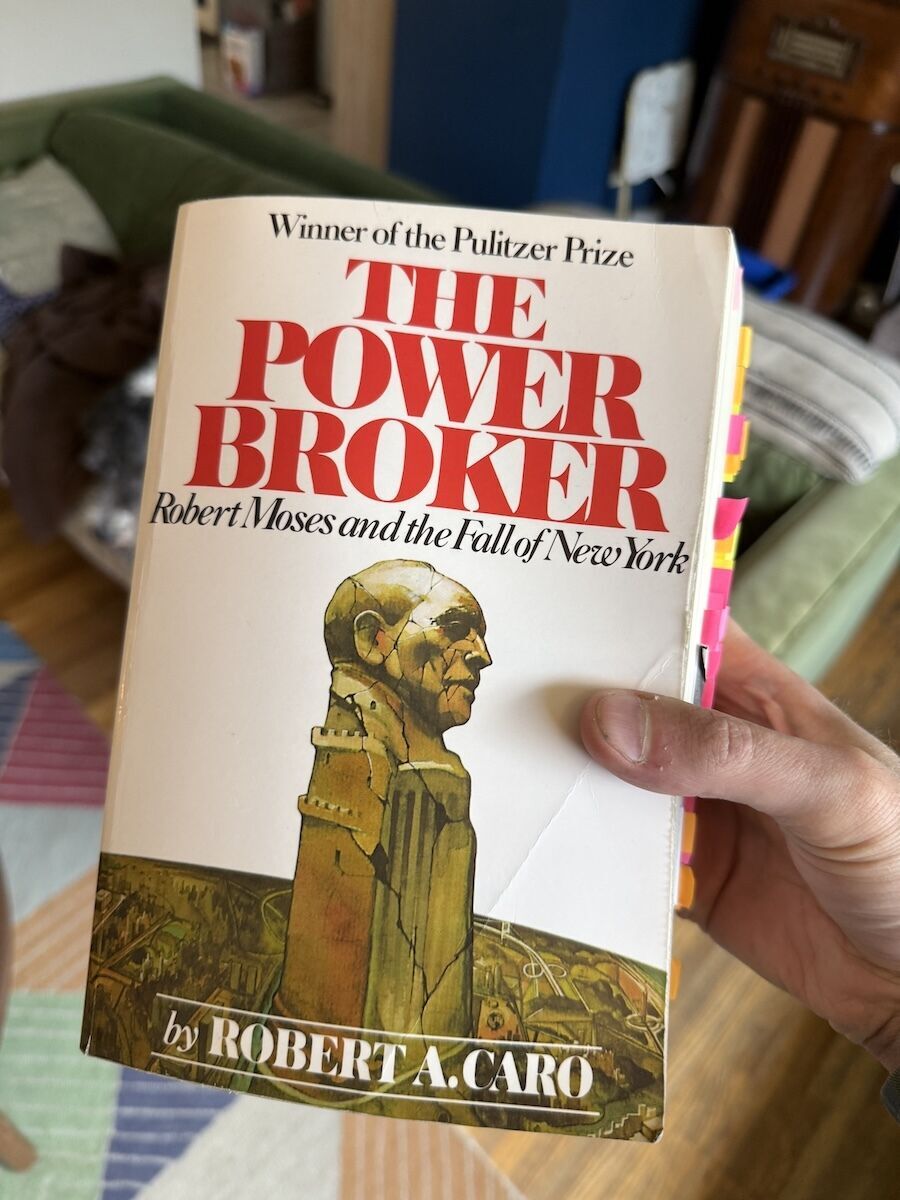
On the weekend, I finally finished reading The Power Broker.
Robert A. Caro’s 1974 biography of New York megabuilder Robert Moses clocks in at 1,162 pages. These are not breezy pages with lots of white space. They are dense with type and facts and stats. The Power Broker is, I’m pretty sure, the longest book I’ve read—and also one of the best.
It’s the story of how Moses built New York City’s 20th-century highway and parks systems while also using his power over public works to decimate poor neighbourhoods and block public transit.
As a work of investigative journalism, it is staggering. Caro interviewed 522 people for the book (some more than once) and took seven years to write it.
Before writing The Power Broker, Caro worked for Newsday. “As a newspaper reporter, he came to hate having to write a story while there were still questions, still documents he hadn’t checked,” wrote Harold Evans about Caro in the New York Times.
But writing biographies, Caro could really dig in: “He slowed down. Thought takes time. Truth takes time.”
Caro chafed in 2012 when a magazine writer suggested he was obsessive. “This is reporting,” Caro replied. “This is what you’re supposed to do. You’re supposed to turn every page.”
This got me thinking. While I obviously can’t take seven years to work on a single project, The Sprawl’s “slow journalism” approach means we can go deep one story at a time, freed from the daily news pressures of having to crank out stories constantly.
But this comes with its own frustrations. Let me give you an example.
This is reporting. This is what you’re supposed to do. You’re supposed to turn every page.
The challenge of getting answers
Last week I was working on a story about bike lanes in the city. By Friday night, I had the story ready to go, or so I thought. “Admin said” this, “the mayor said” that, and so on. They did say those things. Technically I could publish.
But something wasn’t right. I use AI for all my stories: alleged intelligence. My own, that is! And the thing about human intelligence, about the process of understanding, is that it can take a bit to kick in. It is not instant. (“Thought takes time…”)
On Friday night, hours after I’d closed my laptop, something was bugging me. My bike lane story that was “ready” for publication did not add up. At all.
In discussing the cost of bike lanes, city project development director Sarah Huber told council on October 27 that city hall has spent $48 million on multi-use pathways, bike infrastructure and safety improvements over the past four years—and of that, only $10 million was specifically for “wheeling and bike infrastructure.”
This struck me as odd. The city spent up to $28 million on pathways and only $10 million on bike infrastructure? We must have a ton of new pathways then.
On Friday morning I asked the city’s communications department: How many kilometres of multi-use pathways does Calgary have?
From my research, I knew that in 2010, Calgary had 712 kilometres. In 2020, city hall announced that it had paved its 1,000th kilometre. A year later, in 2021, a city report stated that off-street pathway kilometres jumped from 1,022 to 1,289.
On Friday afternoon I got an answer from city comms on how many multi-use pathways we have now: approximately 1,200.
But that made no sense.
There is no way we have less than we had in 2021, given the growth and spending. (“Why are you waiting for city hall to tell you how many kilometres there are?” a friend wisecracked on the weekend. “Get out there and count yourself!”)
My first solution was to append a line at the end of the story: “To be honest, my reporting here raises more questions than answers.” Then I realized that I didn’t need to publish right away—and that I shouldn’t.
The value of The Sprawl is that we can take time and find answers while everyone else has to hurry on to the next big story.
So I held off. Yesterday morning, I told media relations that the stat they sent on Friday can’t be correct. I asked to interview Huber to clarify this and other aspects of my story.
I am still waiting for an answer and for that interview.
This is not unusual. My requests go into city hall and rattle around the bureaucracy and are sent up and down the chain of command and who knows where else. At the end of all that—days, a week, more than a week—I usually get information spit back to me in the form of an email.
This is, unfortunately, how it works these days as the public relations apparatus has grown and journalism has shrunk. I am old enough to remember when you could phone up a city director and do an interview—yes, on the record. Now it’s harder to get interviews and what reporters mostly get is emailed statements that have gone through who knows how many revisions and approvals.
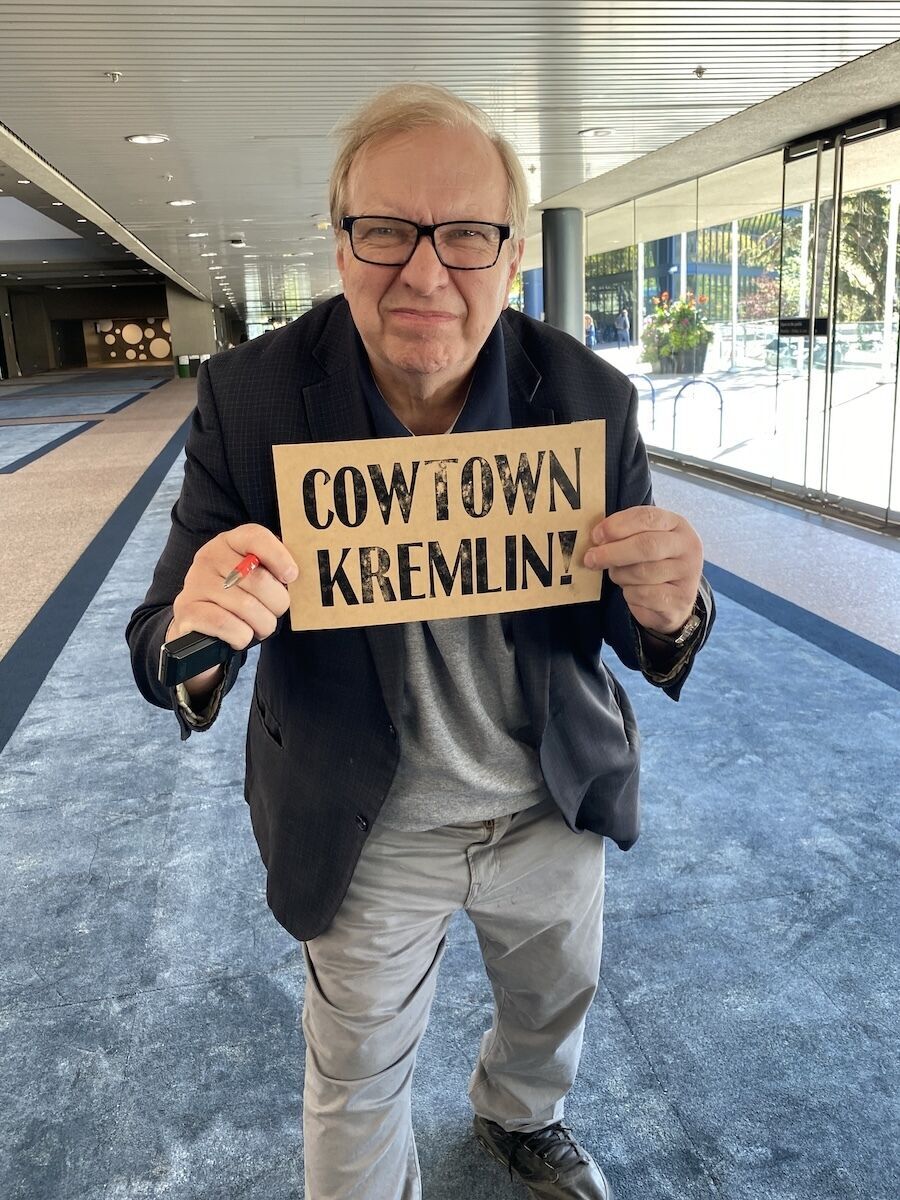
While I wait, I get increasingly agitated. I curse the delay. I vow, for the zillionth time, that I am going to quit journalism—telling myself that anyone with half a brain got out of this a long time ago. And I shake my fist at the paranoia of the Cowtown Kremlin.
“Cowtown Kremlin” is a term coined by Calgary Sun columnist Rick Bell.
A few years ago, for fun, I set COWTOWN KREMLIN in wood type, cranked out a few letterpress prints and gave one to Rick. I pinned up another in the media area above city council chambers.
Such amusements keep me (somewhat!) sane in this work.
But jokes aside, the default posture of Calgary city hall is one of defensiveness and obstruction—and it makes my job incredibly frustrating.
Accountability at city hall gets buried and forgotten
Here is a list that I sent to city hall’s media relations team on Friday morning. I wanted to know:
- How many km of multi-use pathways Calgary has
- How many km of separated cycle tracks Calgary has
- % of capital transportation budget that goes to bike infrastructure
- How many leading pedestrian intervals Calgary has
These are not trick questions. I am still waiting for all that information.
The question on leading pedestrian intervals is a follow up to The Sprawl’s recent investigation on pedestrian safety (Why are Calgary streets so deadly for pedestrians?).
That’s another story I kicked ahead repeatedly, week after week, because it needed more research. (Caro: “Turn every page…”)
As I dug, after a record year for pedestrian deaths in Calgary in 2025, I realized that city hall stopped tracking key targets from its own pedestrian strategy years ago. City administration had said it would not only track such information but also publicly report on it because “this demonstrates accountability to the public.”
But that accountability was buried and forgotten, as it often is at city hall.
It gets worse. The city’s transportation department told councillors in September that streets in new communities are being built that almost immediately need “costly” retrofitting to make them safer. This is a damning revelation, or should be.
City hall flagged this as an issue a decade ago. One of the 49 actions in the pedestrian strategy was to fix it. But now a new crop of city councillors were being told about this same problem as if that never happened.
Meanwhile, the city identified leading pedestrian intervals, which give pedestrians a head start before the light turns green, as a key tool for street safety a decade ago—but by 2026 had only installed just over 50.
“Leading pedestrian intervals is easy and it’s cheap,” former councillor Druh Farrell told me. Why wasn’t it implemented?”
Farrell was scathing about the (non) implementation of the pedestrian strategy when I interviewed her: “Administration made each step difficult when it should have been easy.”
Farrell was my final interview for that story, one I added at the last minute. I spoke with her on a Saturday, with the rest of my story ready to go, and planned to plug in her quotes and publish Sunday.
But now I had to delay publication again to get city hall’s response to what she said. I’d interviewed city traffic manager Anthony El-araj, but he wasn’t a leader in the department for much of this time.
Why wasn’t it implemented? Who I really needed to speak with was mobility director Troy McLeod.
That Monday, I explained the situation to the city’s media relations team and asked for an interview with McLeod that day.
“He has been roads director since 2014 which means he's been there, and leading the roads department, through the whole time period I'm writing about (2016 onward),” I wrote. “I interviewed Anthony El-araj but he wasn't able to speak to, for example, why developers are still building new streets that need retrofits soon after for pedestrian safety.”
McLeod was away and unavailable that day, city comms told me. “We need more time. We could potentially do tomorrow morning.”
Me: “How early tomorrow morning? First thing? If it’s first thing I can potentially make it work.”
Now city comms told me he wasn’t available until the day after tomorrow—two days out.
Enough. Time to publish.
In the story I included this paragraph: “The Sprawl requested to speak with McLeod for this story, as he has been Calgary’s roads director since 2014, but the city’s communications department said he was unavailable for an interview.”
As newsrooms shrink, city hall holds the upper hand
I am frustrated that every media request, whether for interviews or information, takes days. Not always, but usually.
Zooming out, my sense is that leaders in city administration feel less and less of a need to be responsive to journalists as newsrooms wither away. The news media no longer holds the clout it once did—and city hall knows it.
This, of course, is not unique to city hall. This is happening in institutions everywhere, from corporations to universities to governments, as journalism jobs plummet. Don’t get me started on the Calgary Board of Education, which is even more paranoid than city hall, if that’s possible!
But sometimes I do get solid and timely information. The Sprawl’s recent deep dive on suburban growth is an example (Calgary city council to decide on 7 new neighbourhoods).
For this story, we were building a set of infographics and had to make sure we were portraying all of the information accurately.
For three days in a row, I sent city hall questions in the morning and each afternoon, got good answers—useful information for my story. (Shoutout to Nadine Sander-Green in the planning department!)
This is how it’s done. Or should be. Unfortunately it’s the exception rather than the rule.
Jose Rodriguez, the former Calgary Sun editor-in-chief who leads media relations at the city, recently told me, over coffee as I shared my gripes, that The Sprawl puts in “big asks.” And I suppose that’s true. I can be demanding, asking for facts and interviews on short timelines as I try to fill in gaps in my stories after lots of research. (On a side note, I like the ring of that: BIG-ASK JOURNALISM.)
Apparently when city staff get media training, The Sprawl is given as an example of independent publishing. A staffer in another department recently told me what they say in those sessions: “The Sprawl does good in-depth work—but Jeremy can be a lot to deal with.”
I cannot deny it. My wife, truth be told, says the same thing.
My request to interview city director Sarah Huber about bike lanes is still pending. Stay tuned.
Jeremy Klaszus is The Sprawl's founder and editor. The Sprawl is fully independent, receiving no government subsidies, and is fully reliant on our readers and listeners to fund our journalism. Support our independent journalism today!
Support independent Calgary journalism!
Sign Me Up!The Sprawl connects Calgarians with their city through in-depth, curiosity-driven journalism. But we can't do it alone. If you value our work, support The Sprawl so we can keep digging into municipal issues in Calgary!