
More and more bread: Calgary city council to decide on 7 new neighbourhoods
Developers to cover less costs under new UCP rules.

Support independent Calgary journalism!
Sign Me Up!The Sprawl connects Calgarians with their city through in-depth, curiosity-driven journalism. But we can't do it alone. If you value our work, support The Sprawl so we can keep digging into municipal issues in Calgary!
After repealing blanket rezoning and reverting most of Calgary’s residential land parcels back to low density, city council is set to decide in the coming weeks whether to approve seven new neighbourhoods on the city’s outskirts.
City hall is also bracing for less revenue from suburban developers due to new restrictions from the Alberta government on what is eligible for municipal off-site levies. Transit buses and fire trucks will no longer be eligible—a change introduced by the UCP after years of industry lobbying.
City administration warned in a July report that city hall’s “ability to responsibly fund new community infrastructure” is under “increasing strain” due to rising construction costs, high demand for off-site levy funds and the province’s looming changes.
“These shifts pose risks for Calgary’s ability to ensure that ‘growth pays for growth,’” stated the report.
So far in 2026, council has approved six new neighbourhoods. They are relatively small, ranging from 225 anticipated homes to 1,110.
Four more will be part of budget deliberations in November because they require $377 million for infrastructure in the upcoming four-year budget cycle. These are larger and include the big Providence application for 9,590 homes on the western edge of the city, which The Sprawl reported on in March (Paying for it: Calgary suburban developers face new scrutiny from councillors).
And three more neighbourhoods are going to council for a decision on October 27.
If council approves them all, it would add up to 13 growth applications approved in 2026. Council approved eight in 2025.
Calgary currently has an excess of serviced land supply (ready with infrastructure) well beyond what city policy calls for—and housing starts have started to cool this year after record highs in 2024 and 2025.
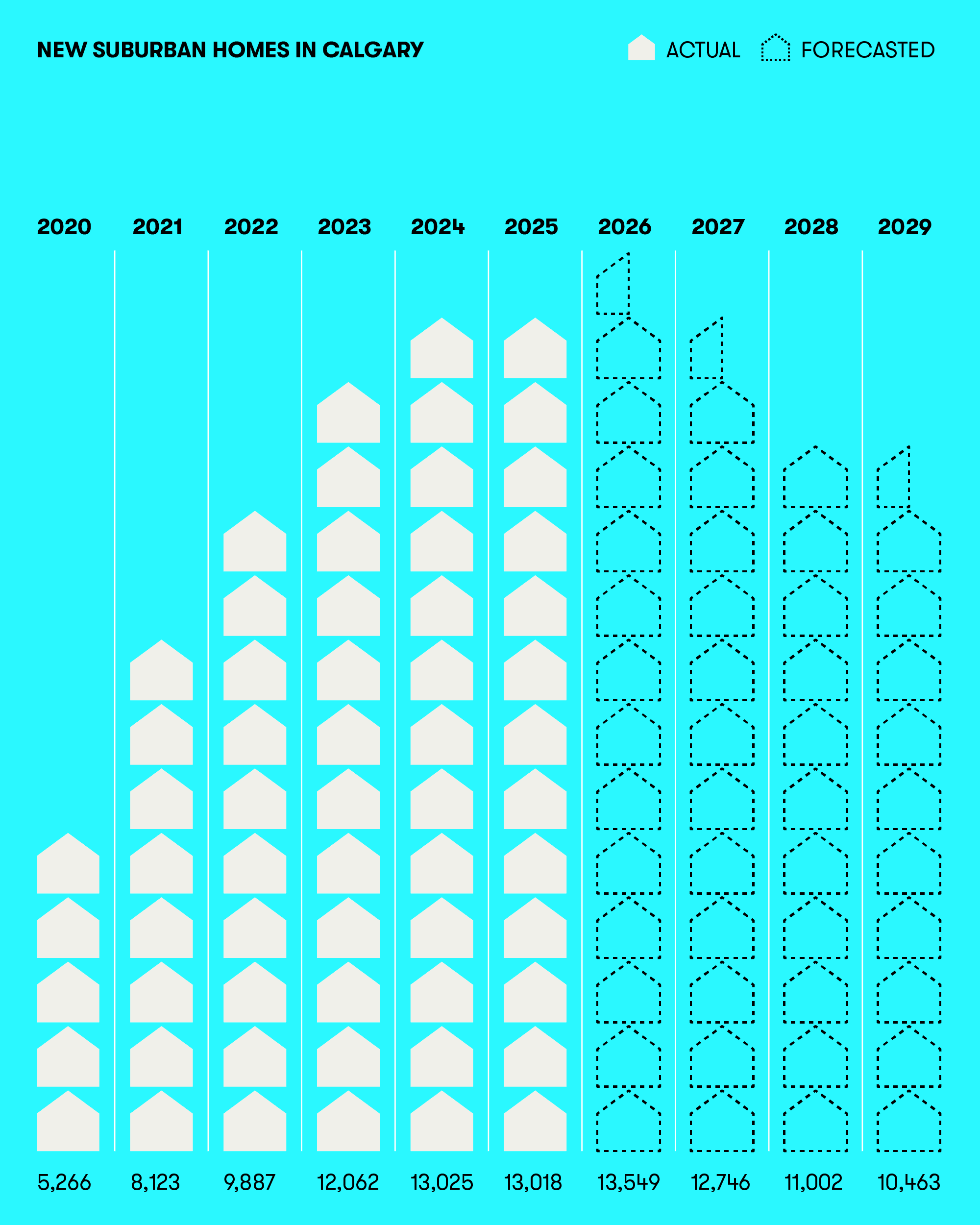
In all, Calgary has 39 new communities in the works around the city.
Ideally communities pay for themselves—and then some—after residents move in and tax revenue flows to the city. The growth applications going to council are predicted to generate tens of millions in revenue “at full buildout.”
But that can take years and even decades, and the city has to pay for infrastructure in the meantime, along with maintenance costs in the long run.
“We are in a riskier situation when it comes to land supply,” city growth strategy coordinator Dale Calkins told council’s infrastructure and planning committee October 14.
“We have more and more bread, and still the same amount of butter—and potentially a declining amount.”
The Municipal Development Plan calls for three to five years of serviced land supply. Keeping it within that range is meant to contribute to “balanced compact growth.” But Calgary currently has seven to nine years worth, enough for 246,202 more Calgarians, according to admin.
“The risk of the too-much-bread situation is that you have multiple areas building out slower individually, and that is less efficient and more costly for the city to service,” said Calkins. “And you don't get as much of the tax generation to cover those costs. It delays the payback... We end up kind of holding a bit of a financial bag.”
This has happened before.
In 2018, city council approved 14 new communities. But housing starts cooled and by 2019, admin warned of a $57 million budget shortfall because off-site levies weren’t covering infrastructure costs for these new areas.
In the following years, housing starts surged as the city struggled to keep up with unprecedented population growth. Now that they’re starting to cool again, council has some big decisions to make.
The risk of the too-much-bread situation is that you have multiple areas building out slower.
Red flags about more car-dependent neighbourhoods
Under Mayor Jyoti Gondek, city hall changed its process so that growth applications no longer come to council in a big headline-grabbing batch, but on a rolling basis instead. Developers can apply anytime.
Gondek said she wanted to de-politicize the growth approval process and avoid a “beauty contest” between developer applications.
Under the current process, growth applications that need new capital funding go to council for final approval in November as part of budget deliberations. Applications that don’t need immediate capital funding can be approved at any time of year.
The three going to council on October 27 can be approved immediately, and range in size from 1,110 to 1,527 homes each. While they don’t need immediate capital funding, all three are expected to require small amounts of operating funds starting in 2028—but would also require hundreds of millions of capital funds in future budget cycles.
The timing is a problem, said Councillor Myke Atkinson at committee.
“We shouldn’t be making allocations on 2028 [budget] adjustments when we haven’t even had the discussions about the 2027 budget plan,” Atkinson said.
Two of the communities are on the northern edge of the city, in Glacier Ridge. Admin has raised numerous red flags about both applications but is still recommending that council approve them.
Both are flagged as “not favourable” on supply and demand, as the north sector of the city already has nine to 12 years of serviced land supply.
One of the applications, submitted by Highfield Land Management, is also flagged as “not favourable” in its alignment with city policy because it’s so far from amenities, jobs and services.
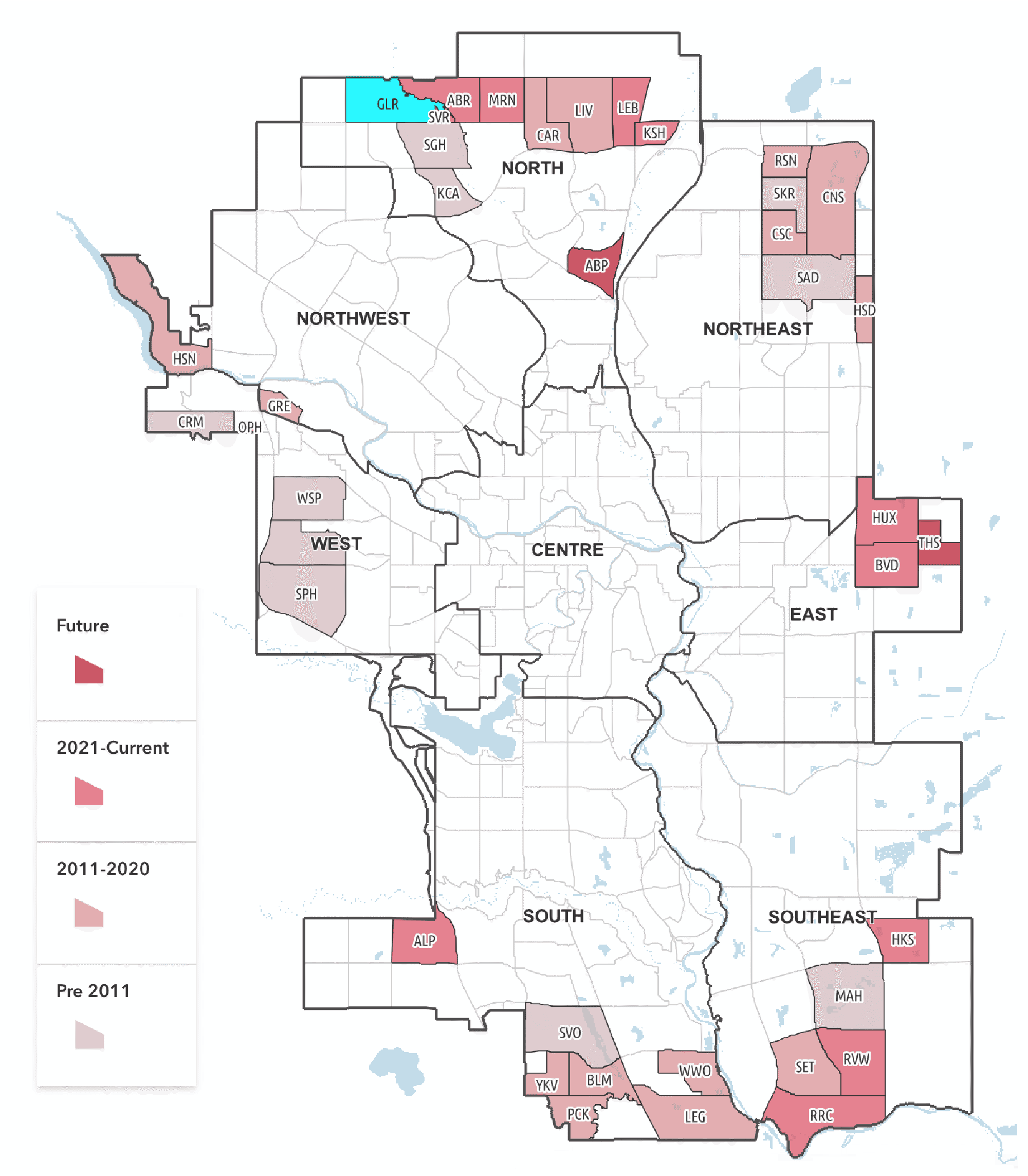
Highfield says its proposed development will help “create a self-sustaining ‘mini-city’” in the area. But city admin highlighted that the land, which is north of the ring road, is more than five kilometres from the nearest transit hub and more than three kilometres from a public school.
Calgary Transit already struggles to reach outlying areas with bare-bones transit service. (For more see the 2025 Sprawlcast episode: Spread thin: How urban sprawl is stretching Calgary Transit to the max.)
“We really wrestled with our recommendation on these applications because on their own they don’t score super well,” Calkins said.
But during budget deliberations in November 2025, council fast-tracked a larger Glacier Ridge development, this one from Qualico for 2,544 homes, north of these lands. The city planning department recommended against it. “This area is premature,” said planning director Kathy Davies Murphy at the time. Council approved it 9 - 6 along with $24 million for a new fire hall.
“Because that fire hall is approved, and because that area for growth is approved, we felt it would be unreasonable, on balance, to hold back growth in these two pockets of land,” said Calkins. “We’ve already committed to the infrastructure in this area. We should be trying to make the most efficient use of the investments we’ve already made.”
We shouldn’t be making allocations on 2028 [budget] adjustments when we haven’t even had the discussions about the 2027 budget plan.
Council debate on the issue: ‘Sprawl does not come without a cost’
When city council repealed blanket rezoning in April, it was following through on a campaign promise made by numerous council members, including Mayor Jeromy Farkas, during the municipal election campaign a year ago.
“Many Calgarians felt that something as significant as this had happened too quickly and without the communities feeling fully part of the conversation,” said Farkas in April, adding that city hall needs to enable “density and growth in a more thoughtful and targeted way,” particularly near transit stations and major corridors.
The repeal means about 68% of residential parcels are zoned for single-detached homes. Admin warned that this would “increase pressure to expand outward,” compromising access to transit and hampering efforts to reduce greenhouse gas emissions.
“It would not be aligned with the city’s Municipal Development Plan, which guides 50% of new residential growth into existing communities and 50% into new communities,” stated admin in a March report, adding that repeal “directly contradicts” the city’s housing strategy.
It would, however, “provide greater certainty for residents who prefer single-detached development patterns.”
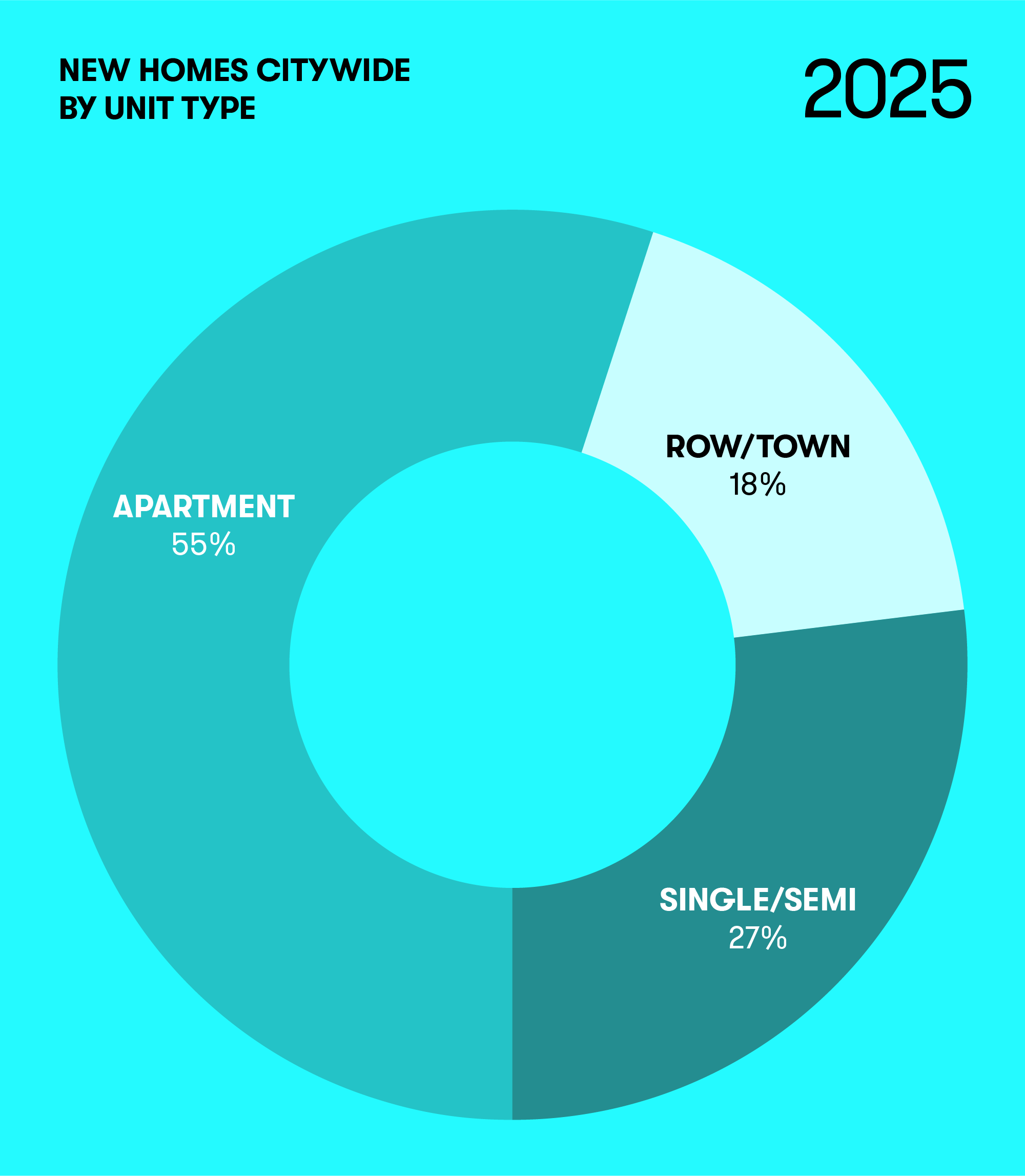
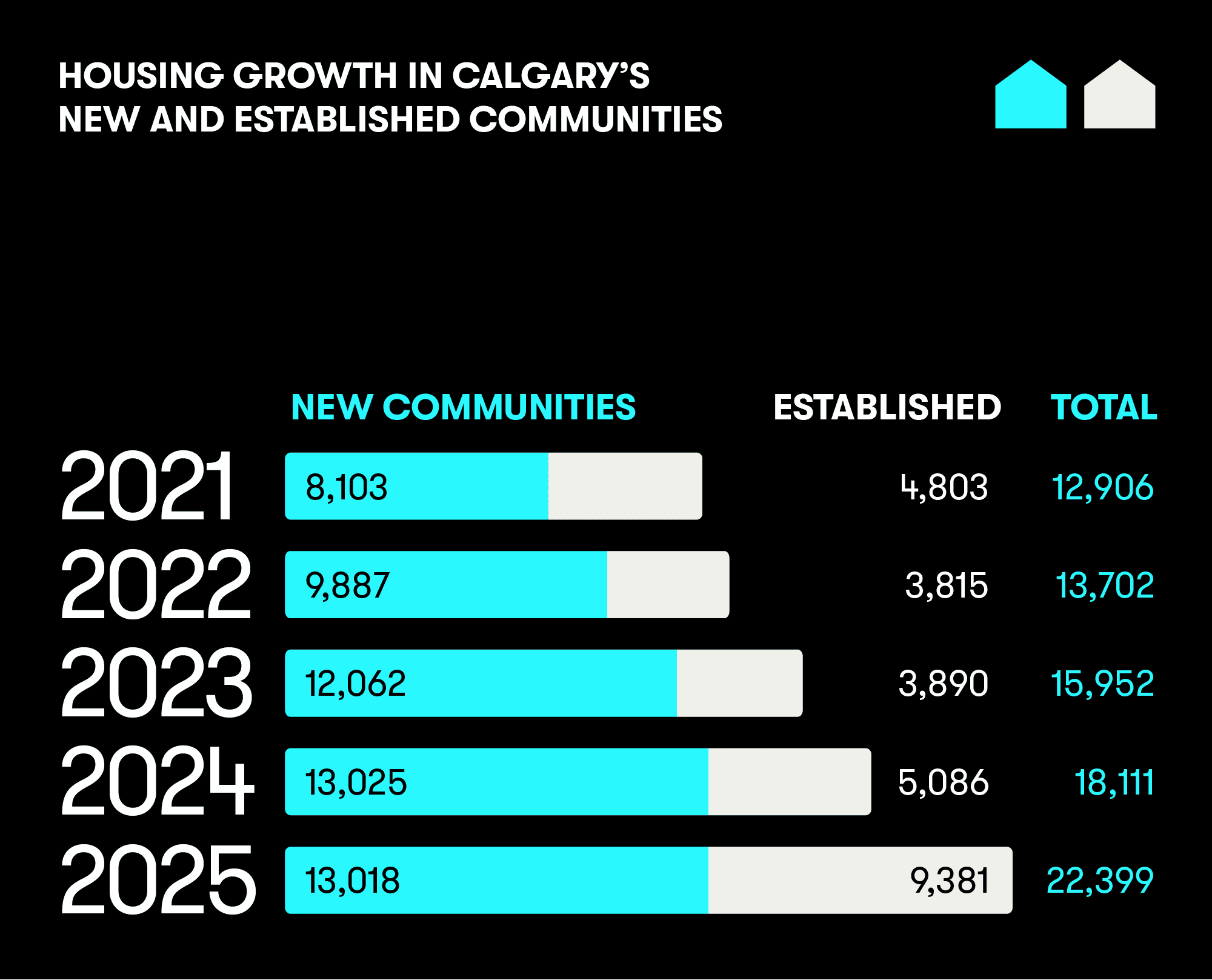
Over the past five years, one-third of housing growth in Calgary has gone to established communities. This jumped to 42% in 2025, although most of the increase wasn’t from blanket rezoning but an increase in apartments.
Council voted 12 - 3 to repeal blanket rezoning, with Councillors Andrew Yule, Myke Atkinson and Nathaniel Schmidt voting against. “Sprawl does not come without a cost,” said Yule at the time, adding that “if we are unable to grow evenly across the city, the fringes of our city” will require more tax dollars.
During the committee debate on the Glacier Ridge applications October 14, Councillor Schmidt alluded to the blanket rezoning decision, which requires individual rowhousing (R-CG) projects to once again go before council for approval.
“I think we need to… ask ourselves why we have put in place other policy changes that have stopped growth in other areas of the city,” said Schmidt. “So why are we full speed ahead on these things? Density is good here, fourplexes are fine here—then why have we said consistently as a council... that actually it’s bad in other places?”
“A single R-CG application receives more scrutiny and more opposition from this council than something like this, which has much more significant effects on our entire city’s ability to operate. So I have an issue with that because it is not consistent.”
Councillor Atkinson ran with the bread analogy.
“The bread just keeps getting bigger—the bread’s getting stale,” said Atkinson. “That's where we’re at. We're making really stale toast is where we’re heading with the amount that we’ve approved. We are talking about multiple budget cycles worth of continuous buildout currently approved.”
“Stale bread?” countered Councillor Dan McLean. “Our bread is rising. Our province’s economy is booming. Alberta’s booming. Calgary’s booming… [If] we don’t build here somebody else is going to eat our lunch. Let’s build in Calgary.”
“Stopping growth is just not an option.”
I think we need to… ask ourselves why we have put in place other policy changes that have stopped growth in other areas of the city.
Councillor John Pantazopoulos suggested that the situation in Glacier Ridge calls for a slowdown since the north already has so much land supply and the applications are underwhelming.
“We’re a long ways away from putting a bus up here when there’s areas in Calgary that have 60-minute transit,” said Pantazopoulos, adding that city hall will be “pushed to our limits” on debt, water rates and capital spending in the upcoming budget cycle.
“We are going to have to make the best decisions, and if that means slowing down or cutting back, so be it,” said Pantazopoulos.
Councillor Jennifer Wyness, who represents the area, suggested councillors elected in 2025 don’t understand the full context.
“You're forced to just pick up a file and not really know the full background and debate and analysis of previous councils on it,” said Wyness. “And so, when you see a small chunk, you think there hasn’t been lots of debate on it—and there has in this area.”
“When I see the established area not even willing to absorb a 15-storey condo because of the amount of pushback—we have to put it somewhere, and it’s going into my community,” Wyness added.
Pantazopoulos challenged the idea that because previous councils approved growth in an area, the current council needs to keep its foot on the gas. “It almost becomes a foregone conclusion... It just never ends,” he said. “It snowballs and there’s never an ending point to say this is an off-ramp.”
The third neighbourhood up for a vote on October 27 is on the east edge of the city, just north of 17th Avenue S.E., in Belvedere.
This one anticipates an extension of the MAX Purple BRT line, which council will also decide on at budget time. Admin ranked this application more highly. “It's a natural extension that makes a lot of sense,” said Pantazopoulos. “Let's keep that ball rolling.”
“The BRT is is running in a somewhat limited capacity right now, and the more homes and people we put in there, the more justification we have to increase the frequency of that route,” said Councillor Andre Chabot.
All three applications were approved at committee, with Councillors Atkinson and Schmidt opposing all of them.
When I see the established area not even willing to absorb a 15-storey condo because of the amount of pushback — we have to put it somewhere.
UCP changes mean developers will pay less for growth
Meanwhile, city hall is waiting for more specifics on the Alberta government’s changes to offsite levies.
Municipal Affairs Minister Dan Williams announced the changes in April as part of Bill 28, which was passed in May, and mostly received attention for its restrictions on sexual content in library books.
But the sprawling legislation also limits municipal off-site levies from developers, which are a major revenue source for cities to help pay for infrastructure in new areas. Charter and private schools will also be newly exempt from paying off-site levies, as The Sprawl reported in April (UCP to make public land available to charter schools with Bill 28).
Transit buses and fire trucks will no longer be eligible for off-site levies, nor will portions of fire halls.
The Building Industry and Land Development Association of Alberta (BILD Alberta), which has been lobbying the Alberta government on this for years, announced the changes with Williams.
“Changes to offsite levies will prevent municipalities from imposing development charges for items such as rolling stock, public art and enhanced architectural or energy efficiency features that go beyond building code and infrastructure needs,” said BILD Alberta CEO Scott Fash.
This, he said, “will help ensure the infrastructure costs borne by new homebuyers are reasonable and cost effective.”
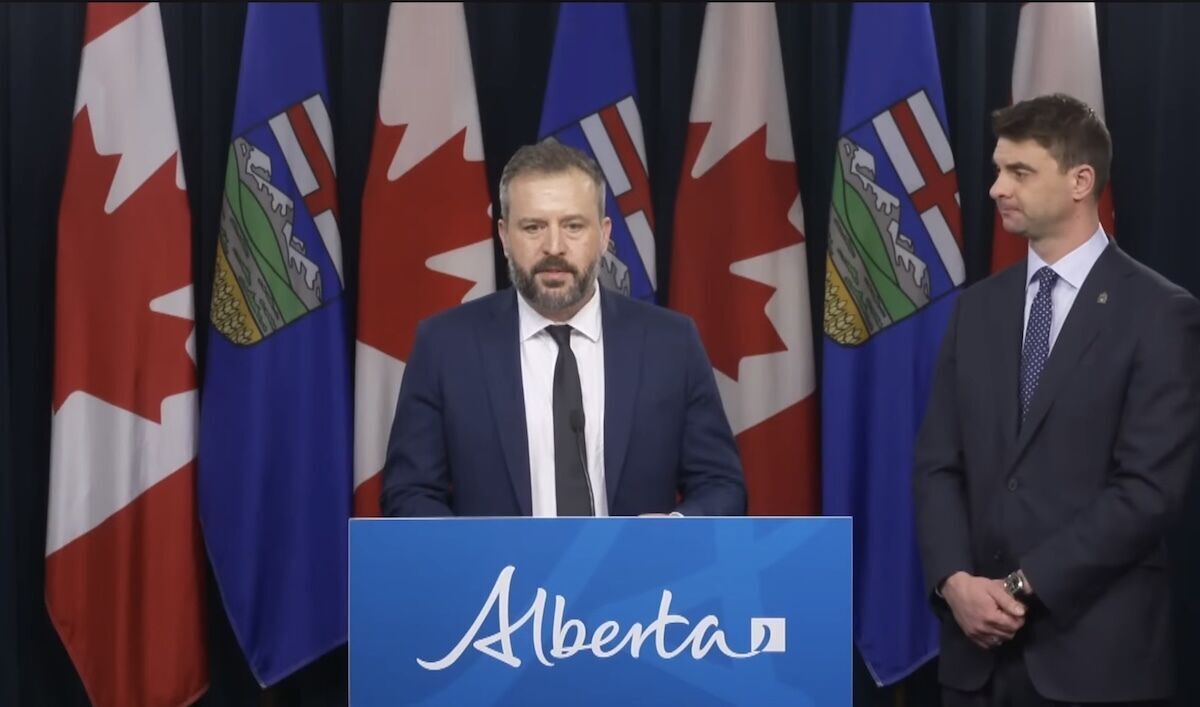
“The piece that we have the least clarity on right now is costs of facilities that are above the building code,” city planning director Kathy Davies Murphy told committee October 14. “And so we're really waiting for the regulations to describe what that means.”
For transit buses, city hall was expecting more than $10 million annually in off-site levy revenue, based on existing development agreements. The city will need to find a new way to cover these and other costs.
However, Davies Murphy told committee that “we do have a healthy balance in the off-site levy reserves, and so we’re not concerned at this point of whether or not we have sufficient levy funding for the capital infrastructure” in the upcoming four-year budget.
City hall plans to update its off-site levy bylaw in early 2027.
More details are expected at council’s executive committee November 3. The proposed four-year budget will be released November 10. Calgarians can speak to council about it the week of November 23, when council will debate the budget and make its decisions.
Jeremy Klaszus is founder and editor of The Sprawl.
Support independent Calgary journalism!
Sign Me Up!The Sprawl connects Calgarians with their city through in-depth, curiosity-driven journalism. But we can't do it alone. If you value our work, support The Sprawl so we can keep digging into municipal issues in Calgary!