Photo: Jeremy Klaszus
Why are Calgary streets so deadly for pedestrians?
The costs of municipal and provincial action — and inaction.

The short version
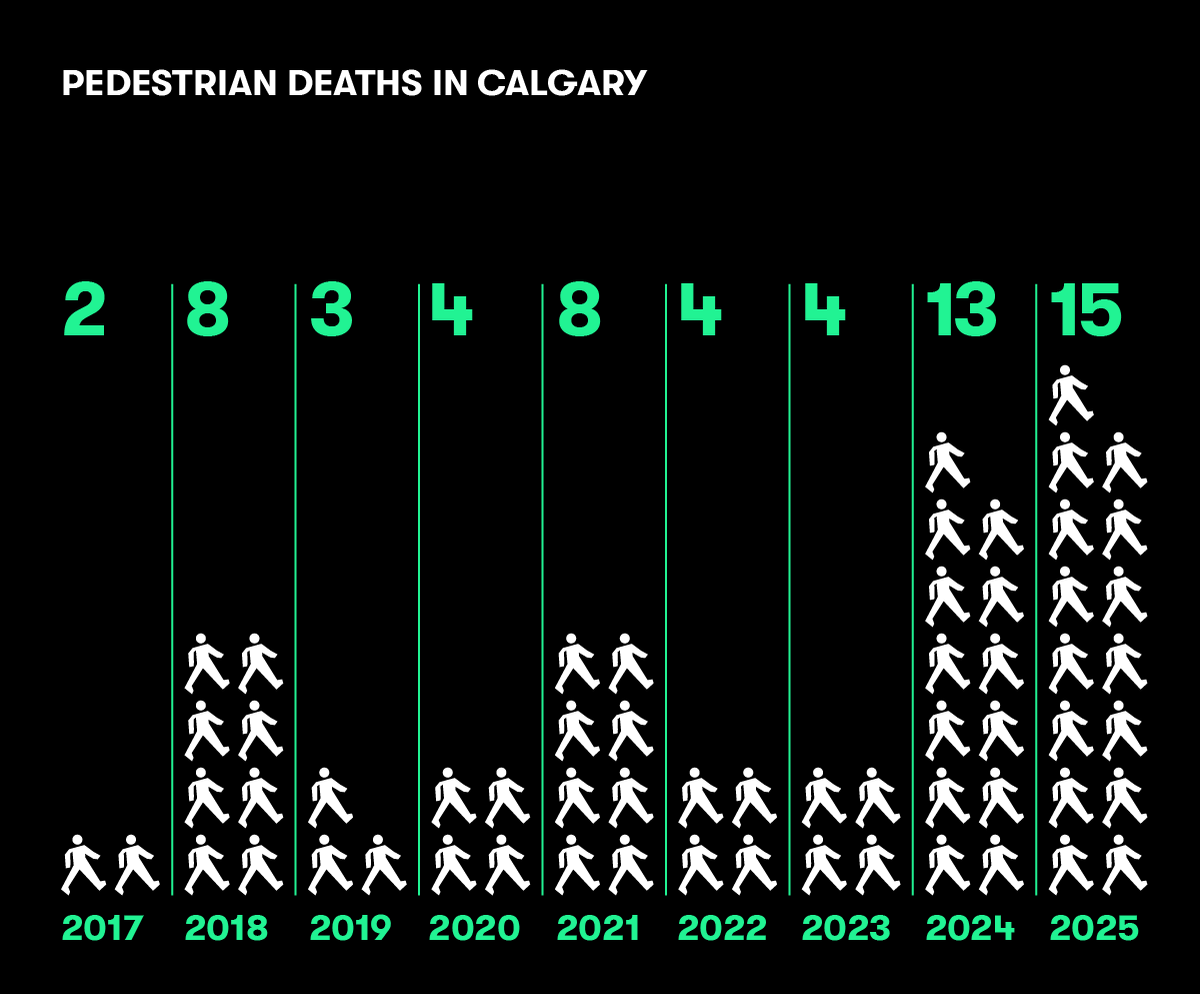
- In 2016, Calgary city council approved a pedestrian strategy that aimed for fewer than four deaths annually by 2025. Instead, Calgary hit a new high of 15 pedestrian fatalities in 2025.
- After initially hesitating to lower speed limits on collector streets (busy roads in neighbourhoods), city hall is now lowering speed limits on 350 kilometres of collector and other streets from 50 to 40 km/h.
- Both Calgary and Edmonton say speeding has increased—including extreme speeding—since the Alberta government drastically curtailed the use of photo radar and speed-on-green cameras in April 2025.
- City hall identified pedestrian leading intervals (head-starts) at signalized intersections as an important safety tool a decade ago, but had only installed 53 as of September. Toronto, where pedestrian deaths have gone down, installed more than 1,500 during that time.
- In the 2010s, developers were building new Calgary communities with streets that needed costly retrofits soon after to make them safer. Despite city hall pledging to fix this, it’s still happening. “We’re spending money, time and resources retrofitting streets recently built,” said traffic services manager Anthony El-araj.
- Council has directed admin to prepare a $20M-a-year budget boost for street safety improvements throughout the city, which council will vote on at budget time in November. “We cannot continue this trend of pedestrian safety being worst-class,” said Councillor John Pantazopoulos.
The full version
A decade ago, in 2016, Calgary city council approved a new pedestrian strategy that aimed to dramatically reduce carnage on city streets by 2025.
Its ultimate aim was Vision Zero, “the political ambition that no one should ever die as a result of traffic.”
The strategy listed 49 actions to make Calgary’s streets safer and more walkable within a decade. A key goal was that by 2025, pedestrian deaths would decline to fewer than four per year.
Instead they have jumped dramatically in the past two years, reaching 13 in 2024 and 15 in 2025—a new high.
Calgary’s “Walk Score” was to increase from 48 to 60. Instead it slid to 39.
And the city’s transportation department recently revealed that developers are still building streets in new communities that get flagged as unsafe for pedestrians soon after residents move in—despite city hall pledging to fix this issue a decade ago.
“Calgary continues to experience unprecedented levels of death and serious injury on our road network,” city traffic services manager Anthony El-araj told city councillors September 1. “And the main contributing factors are speed and distracted driving.”
It’s not only pedestrians who are being killed and maimed. In 2025 Calgary had 38 deaths across all road users (including two cyclists). This was another high, up from 29 the year prior.
This is happening as the Alberta government expands its powers over city streets, removing enforcement tools from local police. In April 2025, the UCP banned photo radar outside of school, playground and construction zones. Now it’s threatening to rip out bike lanes in Alberta’s big cities—and restrict the construction of new ones.
Calgary’s growing population explains some of the increase in traffic deaths in recent years. But the increase has far outpaced recent population growth.
What’s happening—and why?
A decade of delay: ‘Why does it take this long?’
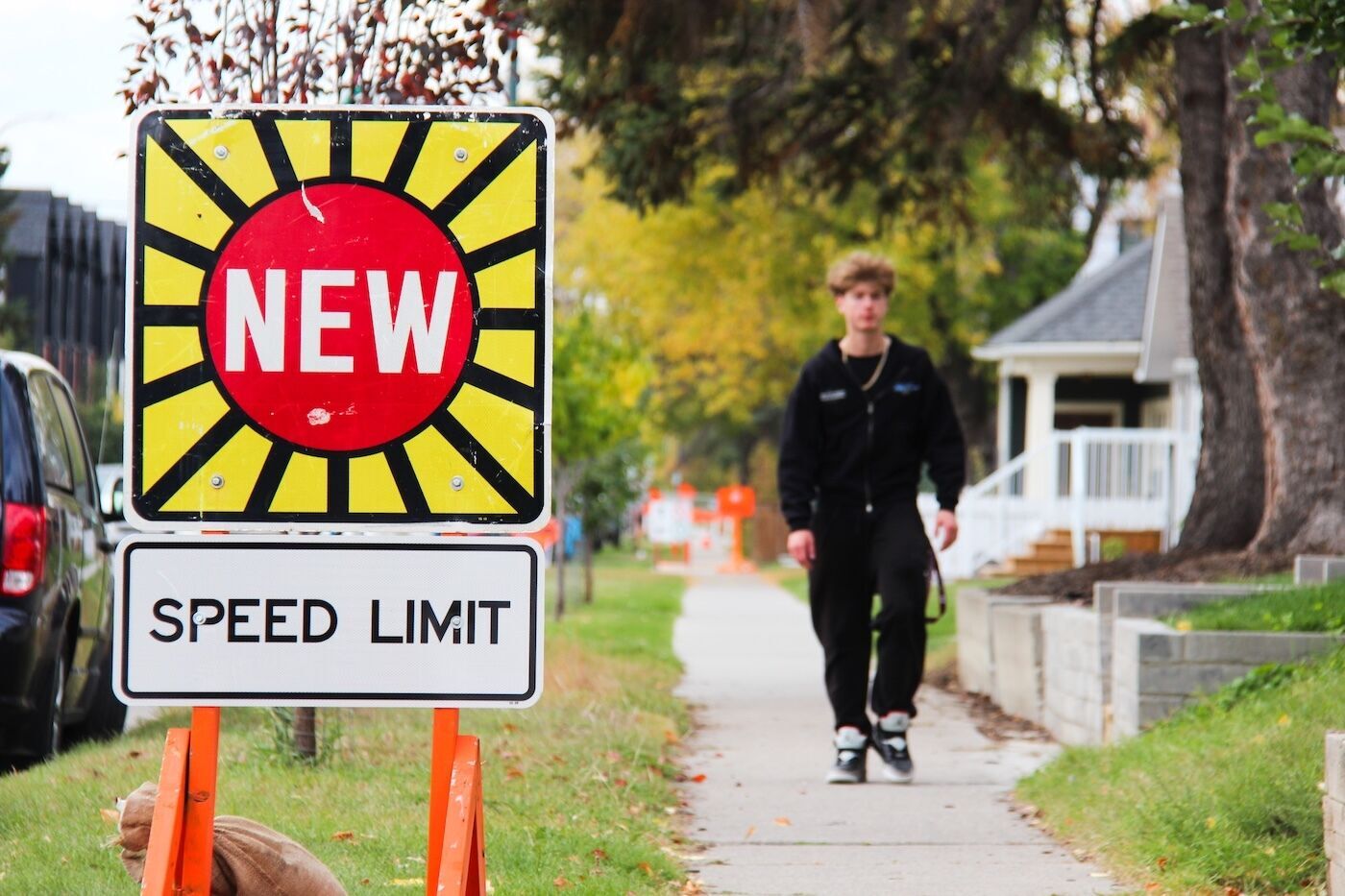
In September, Calgary author Kirti Bhadresa saw city crews swap out signs on 20th Avenue N.W. in Capitol Hill, lowering the speed limit from 50 to 40 km/h.
This is what’s called a “collector street,” a busy road in a residential area.
The change was a long time coming for Bhadresa, who wrote about this street in The Sprawl in 2022 (Walking to school should be easy. Why is it so hard?). She described how, with drivers regularly shortcutting through the neighbourhood, crossing 20th Avenue as a pedestrian was unsafe, even in a marked crosswalk.
“Eventually someone notices us in time to screech to a stop as we hurry across,” she wrote. “This intersection is dangerous and unpredictable—and the city is full of intersections like these.”
Bhadresa has been raising the issue to city hall since her kids were in Kindergarten, filing numerous 311 reports. Her eldest is now 16.
“Why does it take this long?” said Bhadresa. “It’s taken a decade to reduce the speed limit by 10 kilometres. What about the bigger changes?”
In 2021, city council made a major change citywide when it lowered the speed limit on low-volume residential streets from 50 to 40 km/h—a move that was controversial at the time. However, this change excluded collector streets.
The lower-traffic residential streets, which account for about half of Calgary’s road network, have always been relatively safe compared to other road types.
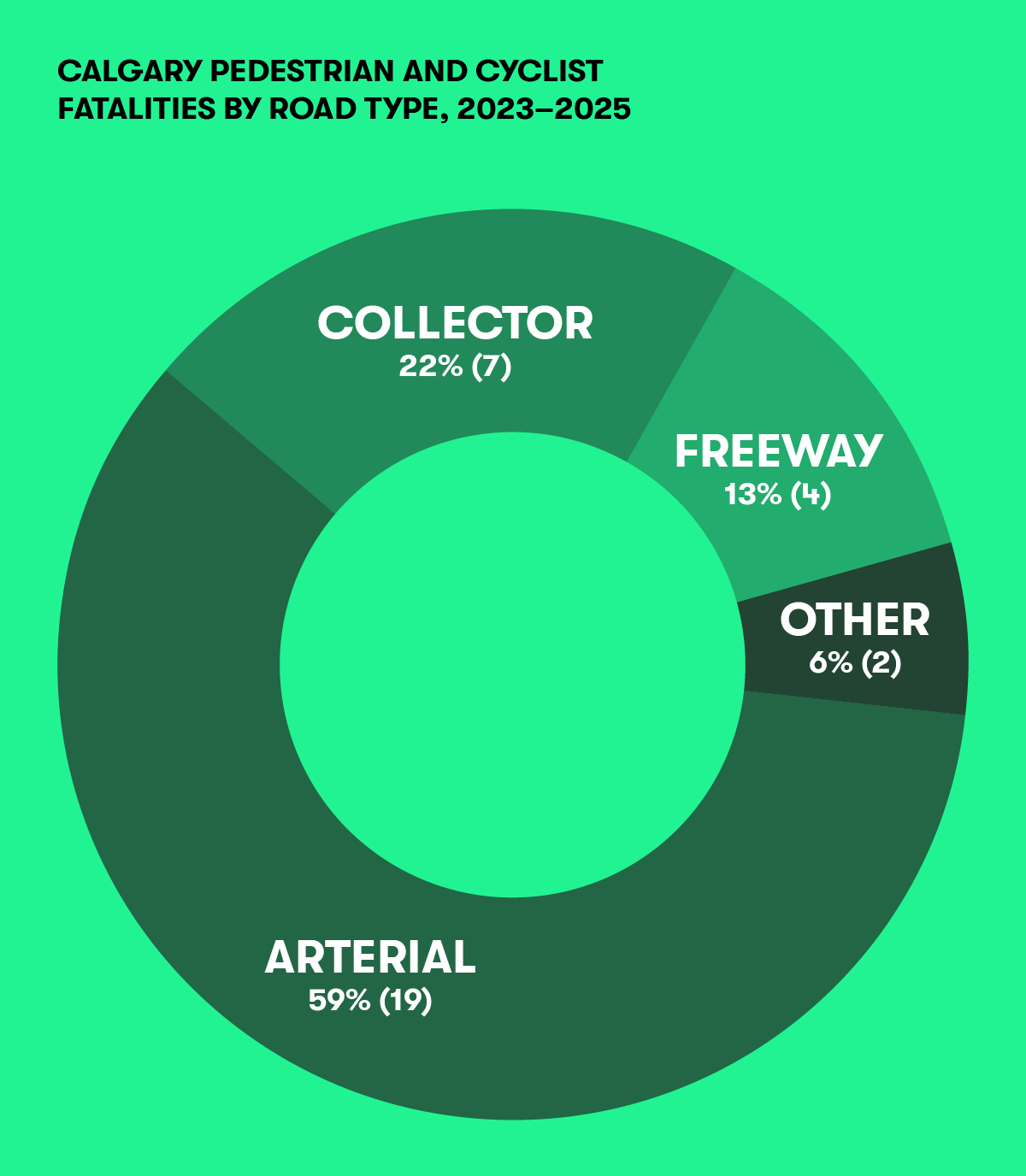
Between 2013 and 2019, only 12% of injuries and deaths of vulnerable road users—pedestrians, cyclists and motorcyclists—happened on local residential streets, according to city data. Nearly double that number, 23%, occurred on collector streets.
While freeways account for most in-car fatalities, most pedestrian and cyclist deaths happened, and continue to happen, on collector and arterial roadways. (Arterials are multi-lane, high-traffic roads such as Bow Trail and Crowchild Trail.)
For years, city hall was hesitant to lower speed limits on collectors. “In the long run, administration recommends that the city move towards a 40 km/h speed limit on collectors and a 30 km/h speed limit on residential roadways,” stated a 2020 city report.
Admin cited existing street design as the reason to hold off.
“Unfortunately, many of the roads in neighbourhoods do not currently provide an environment where these speed limits would be credible to most drivers,” stated the report. “It is not feasible to revise the environment on all city roadways in a short period of time.”
Instead, admin pursued “incremental change.”
City hall now lowering speeds on collector streets
Six years later, city hall is lowering speed limits on some 350 kilometres of collector and other streets across the city—including the portion of 20th Avenue N.W. that Bhadresa has been flagging for years. (See a map of the changes here.)
Toronto took a different approach with its Vision Zero plan, which launched in 2016. Unlike Calgary and Edmonton, Toronto has seen pedestrian casualties decrease. At three million, Toronto’s population is nearly twice the size of Calgary’s.
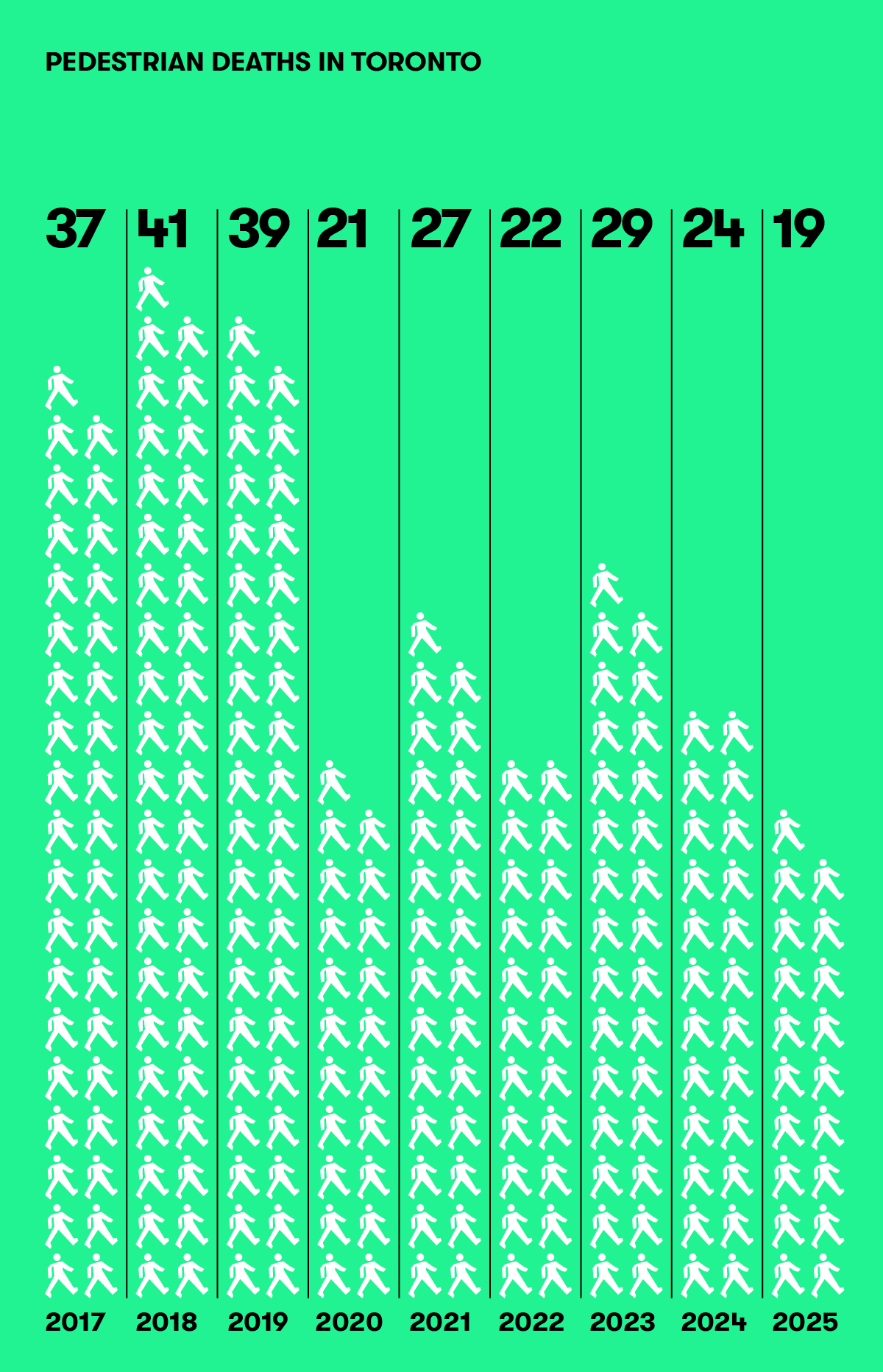
Sheyda Saneinejad, Toronto’s Vision Zero manager, attributes the city’s success to “a layered approach” to road safety, including “safer street design, traffic calming, lower speed limits and pedestrian head-start signals.”
“If eliminating serious injury and fatal collisions is going to be achieved, speed management efforts need to focus on arterial roads,” stated a 2019 City of Toronto report.
Although Toronto acknowledged that “simply reducing the signed speed limit on such roads is not an effective way of reducing average operating speeds,” the “likelihood of people travelling at very fast speeds” drops significantly.
With this in mind, in 2019 Toronto started lowering speed limits on 250 km of major arterial roads. By 2020, it had also lowered the speed limit on another 250 km of minor arterial and collector roads—in addition to residential streets, where the speed limit is lowered to 30 km/h.
With a healthy budget behind its Vision Zero program, Toronto has introduced safety retrofits throughout the city including curb extensions, speed cushions and rapid-flashing beacons.
Calgary has also been strategically deploying these retrofits, successfully slowing traffic in certain problem areas, including streets by schools.
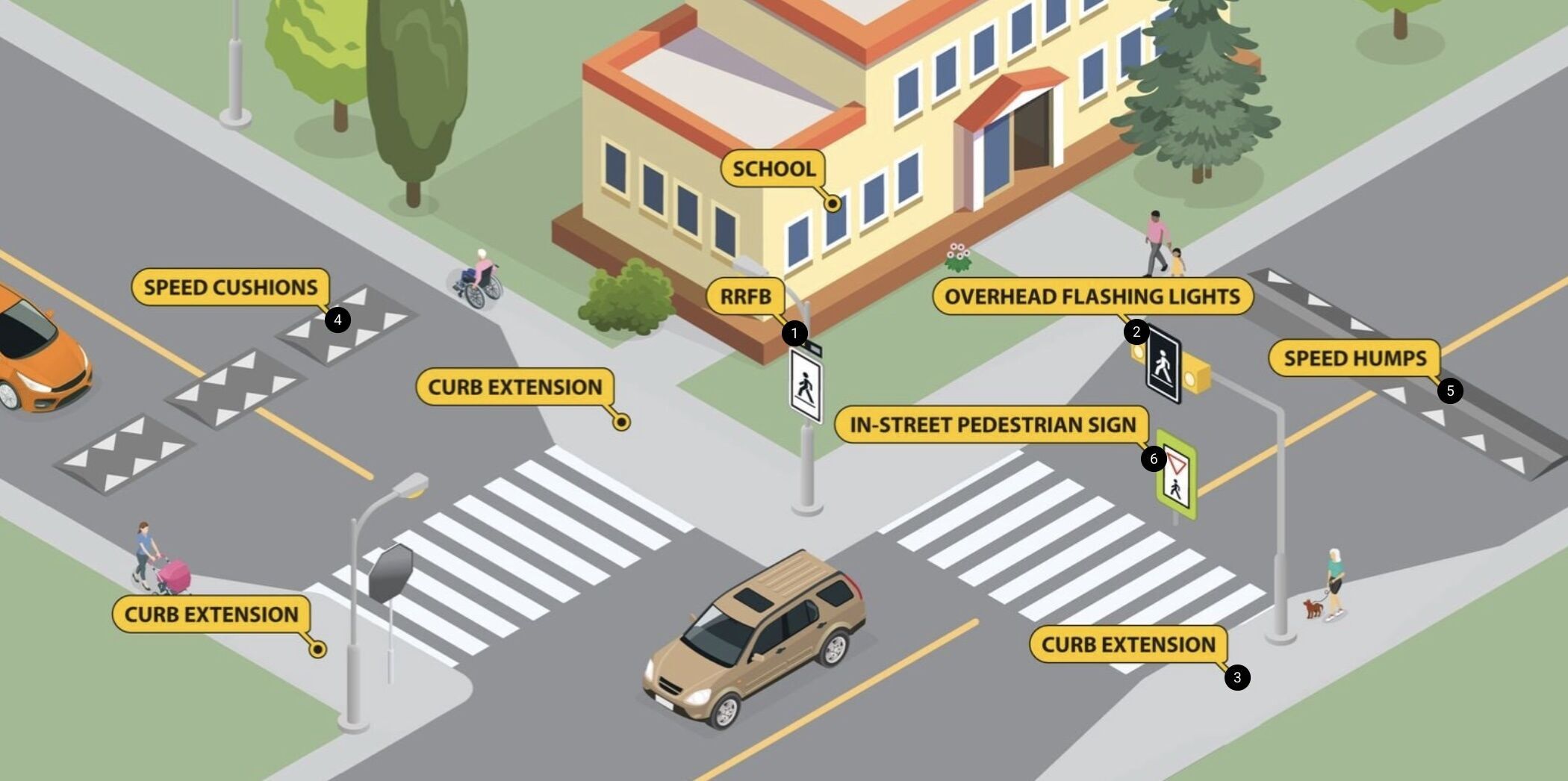
“In the case of speed humps and speed cushions, we see an average speed reduction of 7 km/h,” said El-araj. “That may seem like a small number but this change reduces fatality risk by 30%.”
“On major corridors, targeted improvements have seen a 35% overall collision reduction.”
Greg Hart, the founder of Future Fit Cities and an instructor in the University of Calgary’s planning and architecture school, says these changes are crucial.
“If you’re serious about this, then you need to change the geometry as you enter the school zone area so that you're actually creating a signal in the environment that says to the operator’s brain: ‘Whoa, things are changing here, and it’s going to make me more vulnerable as a driver.’” Hart said.
“Then in that moment you get this reduction in speed, because now I’m paying attention.”
In her 2022 story for The Sprawl, Bhadresa highlighted that city hall’s pedestrian strategy aimed for 20% of Calgary K - 12 students to be walking to school by 2025.
But city hall quietly stopped measuring this and other targets from the pedestrian strategy years ago, despite assurances that it would report such metrics because “this demonstrates accountability to the public.”
The number of kids walking to school in Calgary has continually dropped—from 27% in 2001 to 17.6% in 2011, according to city data.
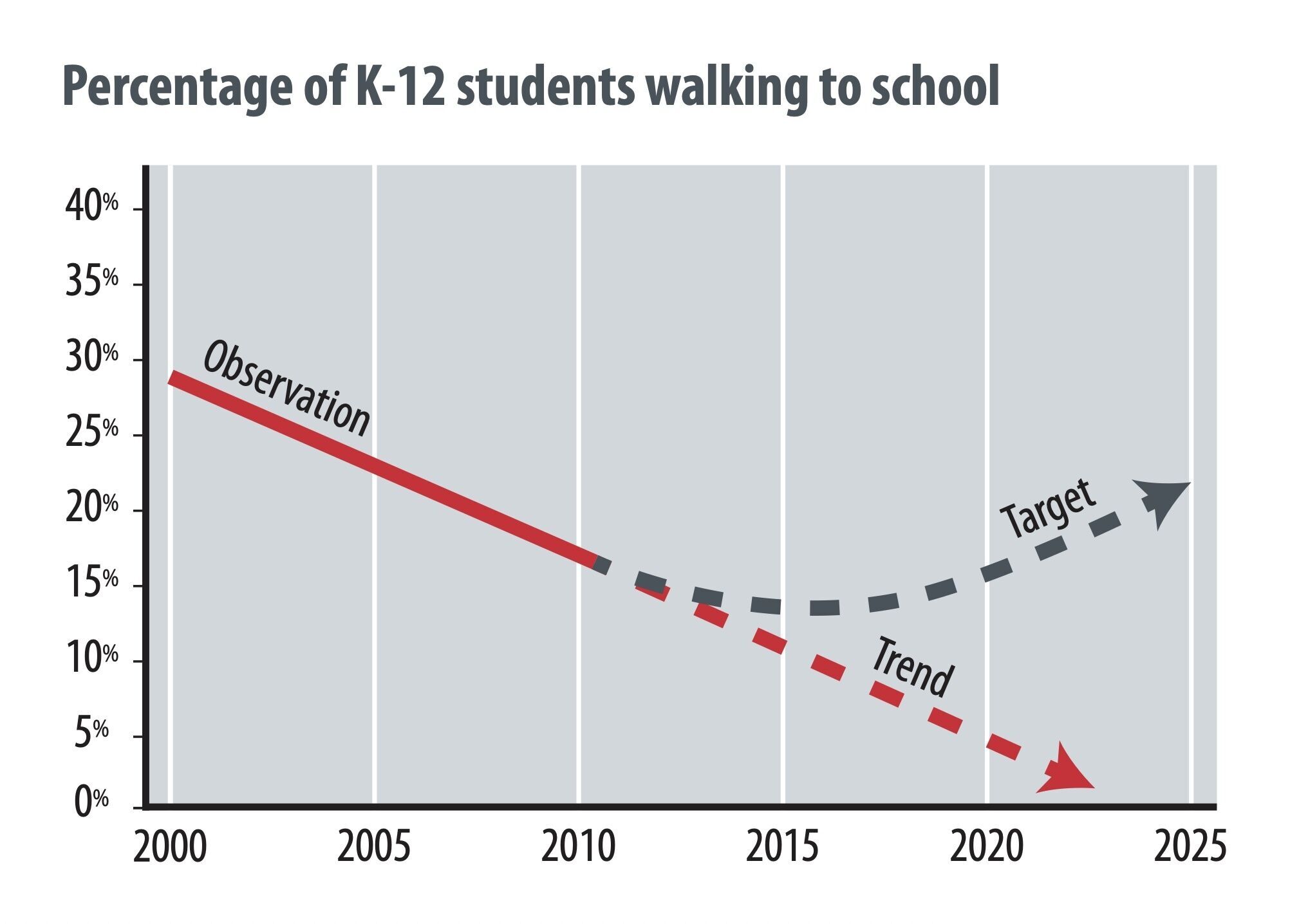
In 2022, the most recent year the city has data for on this target, the percentage of kids walking to school had slid to 15%. (City hall says it temporarily paused but has restarted the My Travel Log survey that provides this information, with new data expected by the end of 2026.)
In the meantime, schools have become notorious for traffic chaos as cars converge at drop-off and pickup times—further deterring walking to school.
“People are parking as close as they can, which makes it even more unsafe for the next group of kids trying to walk in,” said Bhadresa. “It’s a really dangerous cycle.”
The fight for the pedestrian strategy
Getting the pedestrian strategy approved in 2016 was a struggle, recalls former councillor Druh Farrell, who championed it when she was on council until 2021.
“The senior administration were dragged kicking and screaming to develop that strategy,” said Farrell. “I think they wanted to go back to the way things were—which was deadly, as we see.”
“For the pedestrian strategy to even get started, we needed to have a lineup of grieving families at the podium in the council chambers, weeping about their grief. And it should never have to come to that. These deaths are preventable, and we know they’re preventable.”
But if getting it approved was a challenge, getting it implemented was even harder.
“Administration made each step difficult when it should have been easy,” said Farrell.
Both Calgary and Toronto identified pedestrian leading intervals as an important way to reduce turning collisions. “Pedestrian head start signals will be proactively implemented at most signalized intersections across the city as a default safety feature,” stated a 2019 City of Toronto report.
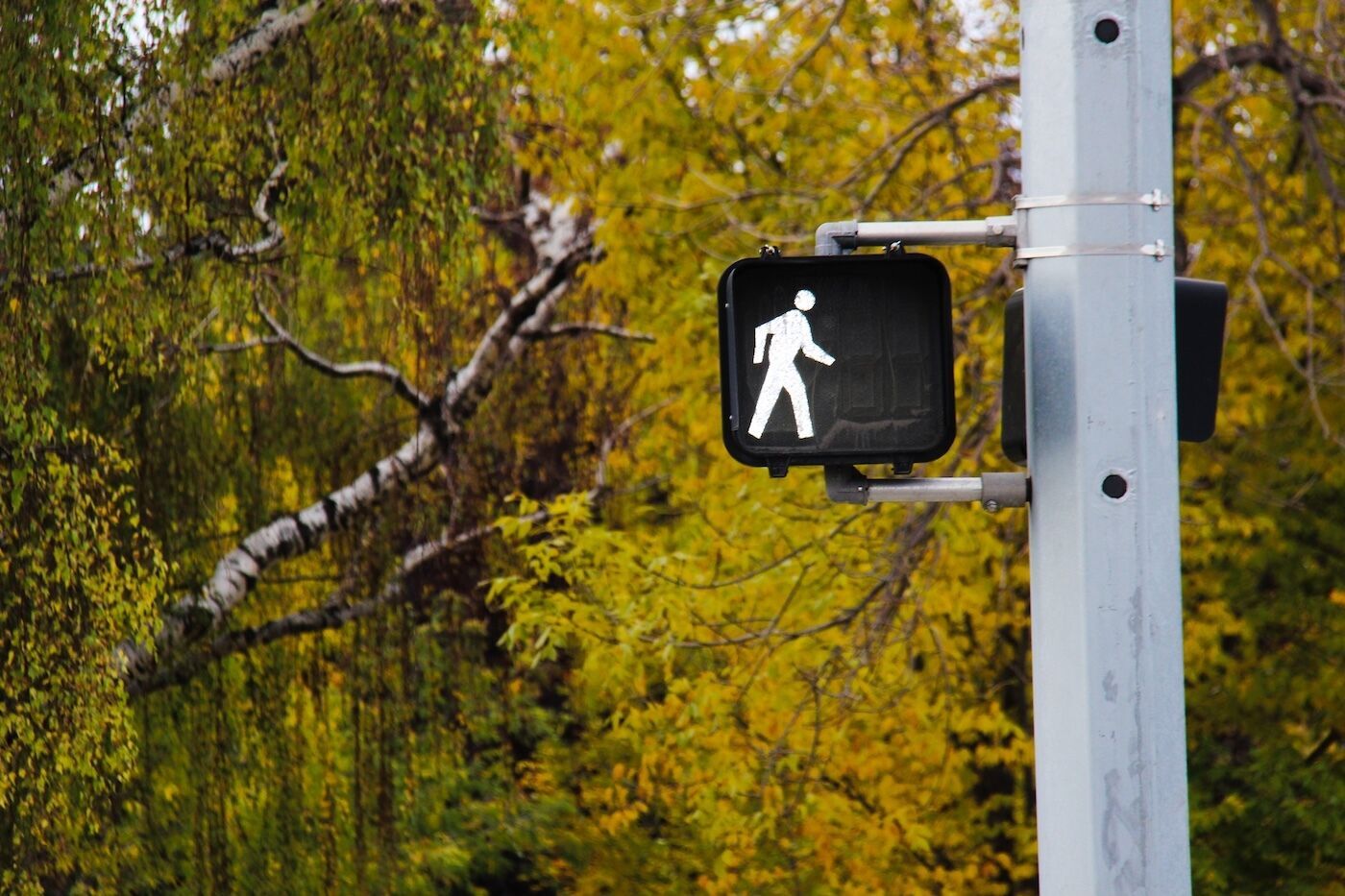
These signals allow pedestrians to start crossing the street before the light turns green for drivers a few seconds later.
Calgary’s pedestrian strategy called for leading pedestrian intervals and other turning controls, such as no right turn on red, to be piloted “in high pedestrian activity locations.” (Admin has said it costs about $2,000 per intersection for leading pedestrian intervals.)
By 2025, Toronto had installed leading pedestrian intervals at 1,662 intersections. That’s well over half the intersections in the city; they are common enough that drivers now expect them. As of September 2026, Calgary had 53 (out of more than 1,300 signalized intersections).
The slow pace mystifies Farrell.
“The map is there,” she said. “It’s not complicated. Leading pedestrian intervals is easy and it’s cheap. Why wasn’t it implemented?”
Councillor DJ Kelly, together with Councillor Andrew Yule and Mayor Jeromy Farkas, recently brought a motion to council to install leading pedestrian intervals at “every appropriate signalized pedestrian crossing” in the city. “It allows pedestrians to establish themselves in the crosswalk and become much more visible to drivers,” said Kelly.
“Safety should not depend on how fast someone can walk or how confident they are at navigating a busy intersection.”
On September 22, council approved this 14 - 1, with Councillor Dan McLean opposed.
“A lot of drivers are frustrated, and I think that’s just going to add to more frustration,” said McLean. “Less mobility for the cars.”
“This accelerates work we would have done over probably five to 10 years,” roads director Troy McLeod told council. “It accelerates it to two.”
The Sprawl requested to speak with McLeod for this story, as he has been Calgary’s roads director since 2014, but the city’s communications department said he was unavailable for an interview.
Safety should not depend on how fast someone can walk or how confident they are at navigating a busy intersection.
City still doing ‘costly’ retrofits of new streets
Another issue a decade ago was that streets in new communities were getting built with the same design problems that made older streets perilous for pedestrians.
“The goal with the strategy was that you build it right the first time,” said Farrell. “What we were finding is in brand new communities, we were having the communities contact their councillor demanding safer streets. Well, don’t make those mistakes—continually making the same mistake and having to retrofit.”
One of the 49 actions in the strategy was to collaborate with the development industry “to embed walking principles in community design.”
But a decade later, the same problem persists—and Calgarians are still paying for the fixes.
“There’s locations within Calgary and new communities that have been built within the last few years [and] we’re having to go back and do those retrofits,” El-araj told council’s community development committee on September 1. Such upgrades, he added, are “costly.”
“We’re spending money, time, and resources retrofitting streets recently built.”
The goal with the strategy was that you build it right the first time.
In an interview, El-araj said “I don’t have specific numbers in terms of how frequent this is happening, but it’s something that we’re seeing as a pattern.” The retrofits can include curb extensions, ladder crosswalks or speed cushions, depending on the location, El-araj said.
Now admin is pledging to do what it said it would do a decade ago—this time through the Street Manual, a policy currently in the works that is intended to guide developers as they build streets in new communities. It’s slated to go to council in 2027.
“By adopting the Calgary Street Manual, Calgary can work to be building safer streets from day one,” El-araj said.
An ‘arms race’ of ever-larger trucks and SUVs
While some things haven’t changed, others have, including the size of vehicles on city streets—an issue out of city hall’s control.
In August, a coalition of active-transportation organizations, including Bike Calgary and Youth en Route, called on Alberta’s chief medical officer to investigate the dangers posed by pickup trucks and SUVs. These vehicles have gotten bigger over time, with growing “blind zones” where drivers can’t see what’s right in front of them.
“The research shows that for every 10-centimetre increase in the height of the front end, you’ve got a 22% increase in fatality risk for pedestrians and cyclists,” said Albert Koehl of the Coalition to Reduce Auto Size Hazards (C.R.A.S.H.).
He notes that pickups such as the Ford F-150 are particularly popular in Alberta, where pedestrian fatalities have risen in both Edmonton and Calgary. Koehl likens the situation to an “arms race,” where people get bigger vehicles to keep themselves and their families safe while putting vulnerable road users at greater risk.
The ubiquity of screens has also changed behaviour both inside and outside vehicles. What was once forbidden—screen use by drivers—is common and even encouraged by car manufacturers.
“Not only smartphone use, but also in-vehicle touchscreen systems can create unsafe levels of visual and cognitive distraction,” states a 2026 city report, “particularly when drivers are programming navigation, sending messages, or completing other complex tasks.”
With these distractions in the mix, vehicle size matters, says Koehl.
“If you're driving a Honda Civic and you’re on your phone and you hit someone, compared to if you’re in a Ford F-150 or Dodge Ram, you’re more likely to kill someone if you’re in the F-150 or the Dodge Ram,” said Koehl.
At a September council committee meeting, admin brought up a Transport Canada stat from 2021: Distracted driving contributed to 22.5% of fatal collisions nationwide.
“That is likely a highly underreported number,” said Inspector Rob Patterson, who leads the Calgary police’s traffic section.
“It is very difficult when we’re deconstructing a crash to prove that the person was on their cell phone at that time... People aren’t particularly willing to admit that they were on it in a collision.”
Meanwhile, it’s not unusual for pedestrians to cross the street with their eyes down, glued to a phone.
“Absolutely there have been situations where somebody has walked straight across out in front of a vehicle or in front of a CTrain using their device,” said Patterson. “But certainly right now the bigger factors seem to be around drivers. They pose the greater threat to other people on the road.”
“A pedestrian walking down the road on their phone is probably going to be risk to themselves. A driver driving down the road being distracted is a risk to everyone, including every other driver as well as every other vulnerable road user.”
It is very difficult when we’re deconstructing a crash to prove that the person was on their cell phone at that time.
The UCP removed enforcement tools from local police
Another issue outside of city hall’s control is new provincial restrictions on “automated traffic enforcement” such as photo radar and speed-on-green cameras.
In April 2025, the UCP government banned photo radar outside of playground, school and construction zones. Calgary and Edmonton have both reported that speeding—including extreme speeding—has increased in both cities as a result.
In a letter to Transportation Minister Devin Dreeshen in February, Mayor Farkas called the rise in traffic fatalities a “critical public safety crisis,” calling on the province to revisit the photo radar ban. Police say it left a $28 million hole in their budget from lost fine revenue; earlier this year Farkas called it a “defunding” of the police.
“Any restored revenue will be earmarked for traffic-safety improvements, including safer intersections, crosswalk upgrades, school-zone protections, and traffic-calming measures,” wrote Farkas to Dreeshen.
The province’s policy remains unchanged.
“According to Calgary police data, since the province restricted automated enforcement, Calgary has seen an average of 20 kilometres over the speed limit at deactivated enforcement sites,” said El-araj.
“We need sustainable political advocacy to the province to restore automated enforcement.”
In the meantime, El-araj said, “speed management is our highest leverage tool.”
The city is also facing pressure from the UCP government as it threatens to rip out bike lanes in Alberta cities—and restrict the building of new ones. Councillor McLean has a motion coming to council later in October to halt new bike lane projects “pending provincial legislative direction.”
“The province ultimately is the arbiter that will tell us… I’m just getting ahead of the game,” said McLean.
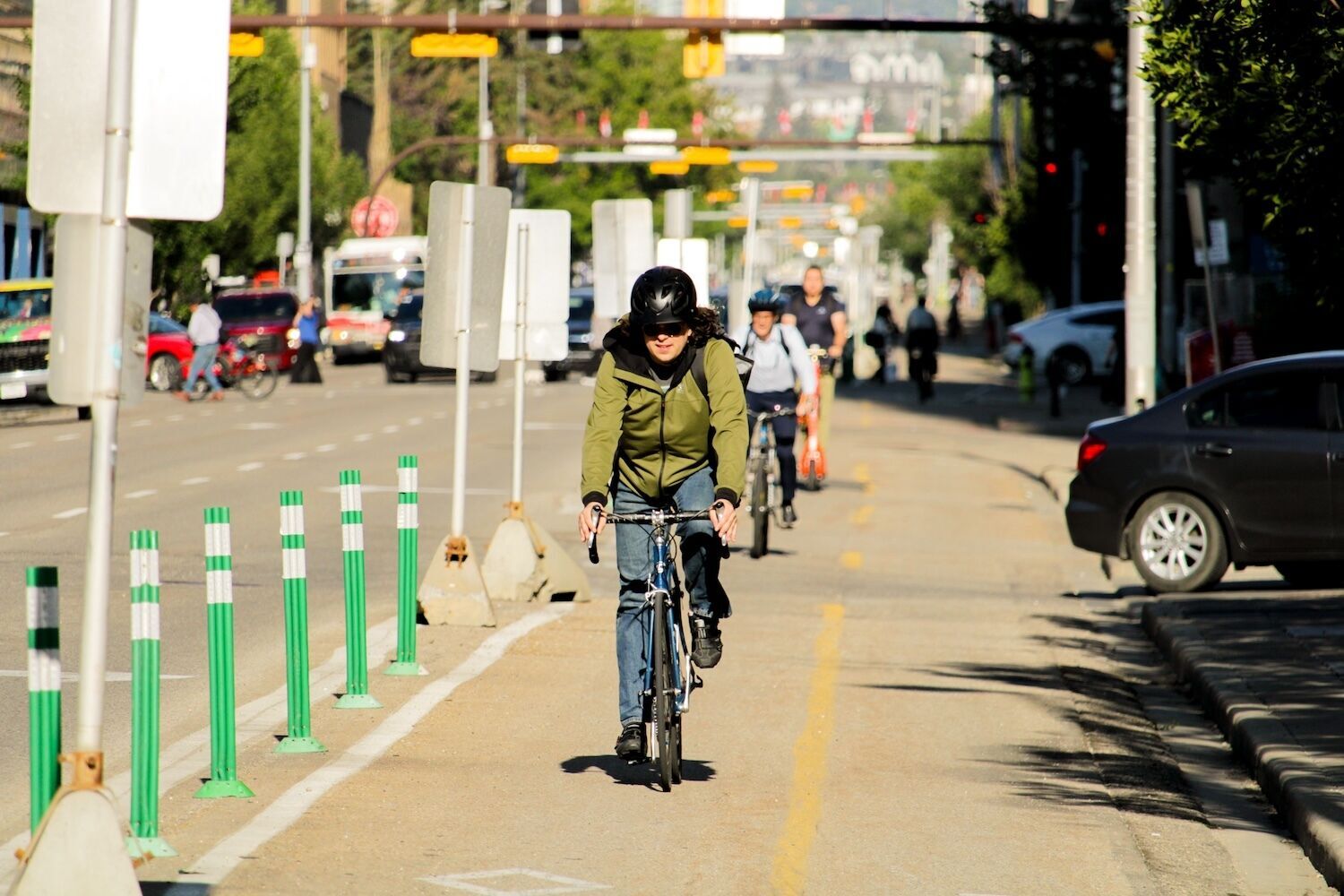
Mayor Jeromy Farkas called it “dog-whistle politics” and reiterated one of his campaign promises that infrastructure funding should be tied to mode usage.
“We need to focus on enabling choices for Calgarians,” said Farkas. “And I would say that it’s very, very Big Government for any politician at any level to come in and say we’re going to remove choices from you.”
Farkas says active transportation is not only a safety issue but an affordability issue.
“If we lock Calgarian families into say having two or three automobiles, we’re actually making them more car-dependent—and we’re making things more expensive for families if otherwise they could pull off a trip by walking or a very short commute for their kid by bike to get to school,” said Farkas.
“I think that we need to continue to fund those choices and make sure that they’re safe and available and affordable for Calgarians.”
Council will vote on street safety—and more—in November
Council is setting the city’s next four-year budget in November, with 2026 on pace to be as bad as last year for traffic fatalities. To date there have been 27 deaths, including seven pedestrians.
“The numbers speak for themselves,” said Councillor Myke Atkinson. “We need to be doing better than we are… Calgarians should be expecting more from the city in terms of meeting the safety expectations on our streets.”
City hall has been spending about $7 million per year on traffic safety retrofits since 2023. In June, council added $6 million of one-time funding (from surplus dollars) to deploy more interventions such as marked crosswalks and rapid-flashing beacons across the city.
Councillor Nathaniel Schmidt, who introduced the motion, noted that the Calgary Safer Mobility Plan calls for a 25% reduction in major injury and fatality collisions between 2024 and 2028.
“And so far, in the first two years, all we’re seeing is a rise… We need to do this now because the numbers are not slowing down,” said Schmidt.
Council approved Schmidt’s motion unanimously.
In September, admin presented council’s community development committee with two scenarios for beefing up pedestrian safety in the upcoming four-year budget: a boost of $10 million a year, which would retrofit about 150 dangerous locations annually, or $20 million which would do 300.
Even under this scenario, admin says it will take five years to tackle high-risk locations that have already been identified.
Committee asked admin to prep the $20 million option for council to decide on in November.
“Calgarians have clearly said when you’re on a record for fatalities and accidents with pedestrian safety, that’s unacceptable,” said Councillor John Pantazopoulos. “We cannot continue this trend of pedestrian safety being worst-class.”
Jeremy Klaszus is founder and editor of The Sprawl.
Support independent Calgary journalism!
Sign Me Up!The Sprawl connects Calgarians with their city through in-depth, curiosity-driven journalism. But we can't do it alone. If you value our work, support The Sprawl so we can keep digging into municipal issues in Calgary!