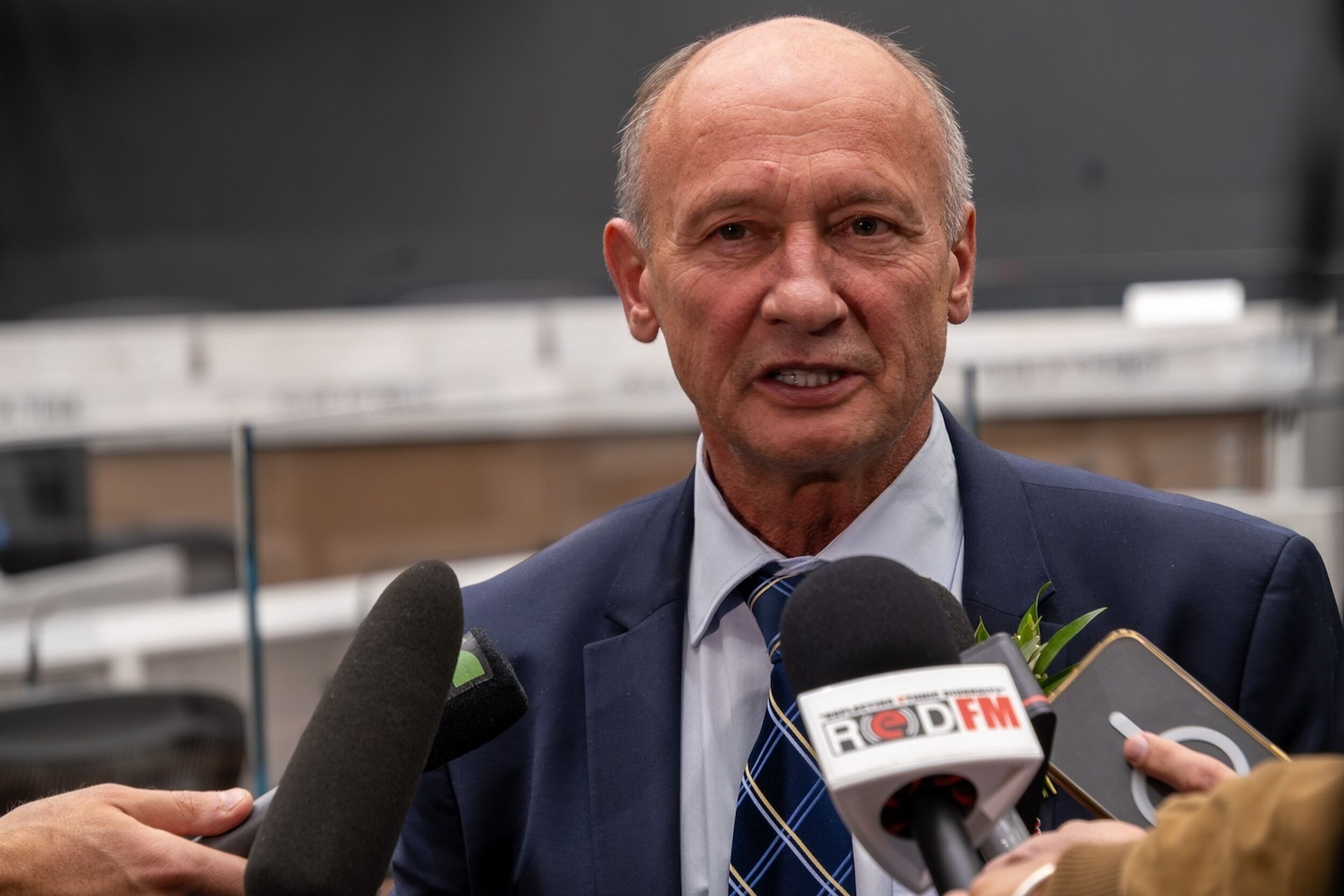
Councillor Andre Chabot. Photo: Farkhod Fayzullaev
One Calgary councillor’s protest against ‘special treatment’ for wealthy neighbourhoods
Why Chabot opposes a little-known tax bylaw.

Support independent Calgary journalism!
Sign Me Up!The Sprawl connects Calgarians with their city through in-depth, curiosity-driven journalism. But we can't do it alone. If you value our work, support The Sprawl so we can keep digging into municipal issues in Calgary!
Is Councillor Andre Chabot a socialist?
“Not a socialist,” Chabot replied when I asked him, somewhat tongue-in cheek, this week.
I put the question to the veteran conservative councillor because of an item that has become an annual tradition at city hall. It concerns a special tax bylaw that lets certain neighbourhoods pay an extra municipal tax for “enhanced” landscape improvements over and above the city’s base service.
And what happens every year is this: Everyone on council supports renewing the bylaw. Everyone except Chabot. He’s the lone dissenter. It happened again February 24.
His beef is that some Calgary neighbourhoods shouldn’t get “special treatment”—even if they pay for it—while others don’t.
“It comes down to ability to pay,” Chabot said. “Enhanced boulevard maintenance should be something that should be offered citywide, and it should be part of the tax increase. It should be part of the mill rate. It should not be given only to those communities that have the ability to pay.”
The levy is initiated by community organizations and requires support of two-thirds of homeowners. Once a neighbourhood opts in, city hall collects the levy and passes it on to the community organization, which hires private contractors to do the work.
When they see other community associations getting special treatment they say: Why do they get special treatment?
City hall also provides a liaison to support the community and help with navigating city services.
The program was piloted in the upscale area of Christie Estates, on the west edge of the city, in 1996 and has since expanded to 10 more neighbourhoods since. Most are in the northwest—including Valley Ridge, Edgemont, Scenic Acres and Hawkwood.
A 12th neighbourhood, McKenzie Lake, uses this special tax mechanism for snow clearing on pathways.
The levies vary widely. Most are under $80 a year. In McKenzie Lake it’s less than $6. In Royal Oak Estates, the highest by far, it’s $225. In all, the city expects to collect $1.78 million in these levies this year.
Ward 1 Councillor Kim Tyers, who has three participating neighbourhoods in her northwest ward, highlighted that these efforts are volunteer-led. Communities that want this program organize for it.
“None of those people are paid to go out there and lobby their community for that change,” she said.
Tyers urged council to support the renewal. “It shows that we're able to care about the communities that want a little bit more as far as the aesthetic and things like that,” she said.
The neighbourhoods that opt in have household incomes well above the citywide median—and few renters. Only one of the participating neighbourhoods, Douglas Glen, is east of Deerfoot Trail.
None are in east Calgary’s Ward 10, which Chabot represents, and which has lower incomes.
It shows that we’re able to care about the communities that want a little bit more as far as the aesthetic and things like that.
“I think that Calgarians expect similar-type services for the taxes that they pay,” said Chabot. “And when they see other community associations getting special treatment they say: Why do they get special treatment?”
“And then the response is, well, they pay extra taxes. They go, well, it doesn't matter just because they are richer than we are. Why should they get special treatment just because they have the ability to pay for more?”
“It should be equally distributed… If you have a higher valued home, then you pay more. If you have a lower valued home, you pay less. But the service should be equal citywide.”
Another barrier, Chabot says, is that his ward has many renters. Because only homeowners can organize for these improvements, they require landlord buy-in—which is harder to get. “The tenants themselves ultimately have no say in it,” he said.
The Municipal Government Act stipulates that this kind of bylaw needs to be renewed annually. Which is why Chabot makes his contrarian stand every year.
His annual opposition can irk others on council.
“This is no more than neighbours getting together and saying: Let's pool our money and let's have somebody come and do the work that we don't want to have to do ourselves,” former councillor Peter Demong said when it came up last year. “This is like a group of neighbours getting together and hiring the same plumber or landscaper—no different in any way, shape or form.”
“There is no loss by anybody else in the community or the city.”
While Chabot may not get votes on this one, he does get some verbal support.
“I actually agree with everything that Councillor Chabot said,” Ward 4 Councillor DJ Kelly said at council.
“I think there's another way to be able to do this that’s better. But I do want to recognize the fact that voting against this right now actually takes the dollars away from people who are already planning on it.”
“I’ll be supporting this today but I would like to have that conversation about how we could improve this in a more equitable way.”
Mayor Jeromy Farkas said the program is “due for review” and he is wary of the “pay-for-play” model, but was persuaded by Councillor Tyers’s debate about the levies being community-led.
“I think the objective overall should be for us to try to lift the floor, rather than knock down some of these communities a peg,” said Farkas.
Speaking of municipal taxes… municipalities (one in particular) are apoplectic over the provincial budget, which raises the education property tax requisition from $3.1 to $3.6 billion.
Because of high property values here, Calgarians will be hit extra hard on their property tax bills, with the provincial requisition jumping 20% here versus only 11% in Edmonton. “It’s not fair,” said Farkas.
The Alberta Municipalities association says the province is “hiding provincial tax increases” in property taxes. University of Calgary economist Lindsay Tedds says the same.
“When the UCP government reaches into the property tax bill to raise provincial revenue, it is not just choosing one instrument among many,” Tedds wrote on her blog this week. “It is choosing the one instrument it has restricted municipalities to, and crowding out the fiscal room those municipalities need for their own priorities.”
The government cuts your income tax with one hand and takes more from your property tax bill with the other.
The provincial portion of property tax has long been a sore point for municipalities, which get blamed for the entire bill, even though they have no control over the province’s portion.
Tedds notes that, after the province repeatedly urged municipalities to keep taxes low, Calgary city council reduced its municipal property tax increase to 1.6% last fall.
“The province then turned around and imposed a 20% increase in Calgary’s education property tax requisition, adding $340 to the same bill. The municipal restraint was real. The provincial increase swamped it entirely.”
Who says property taxes are boring?!
Jeremy Klaszus is founder and editor of The Sprawl.
Support independent Calgary journalism!
Sign Me Up!The Sprawl connects Calgarians with their city through in-depth, curiosity-driven journalism. But we can't do it alone. If you value our work, support The Sprawl so we can keep digging into municipal issues in Calgary!