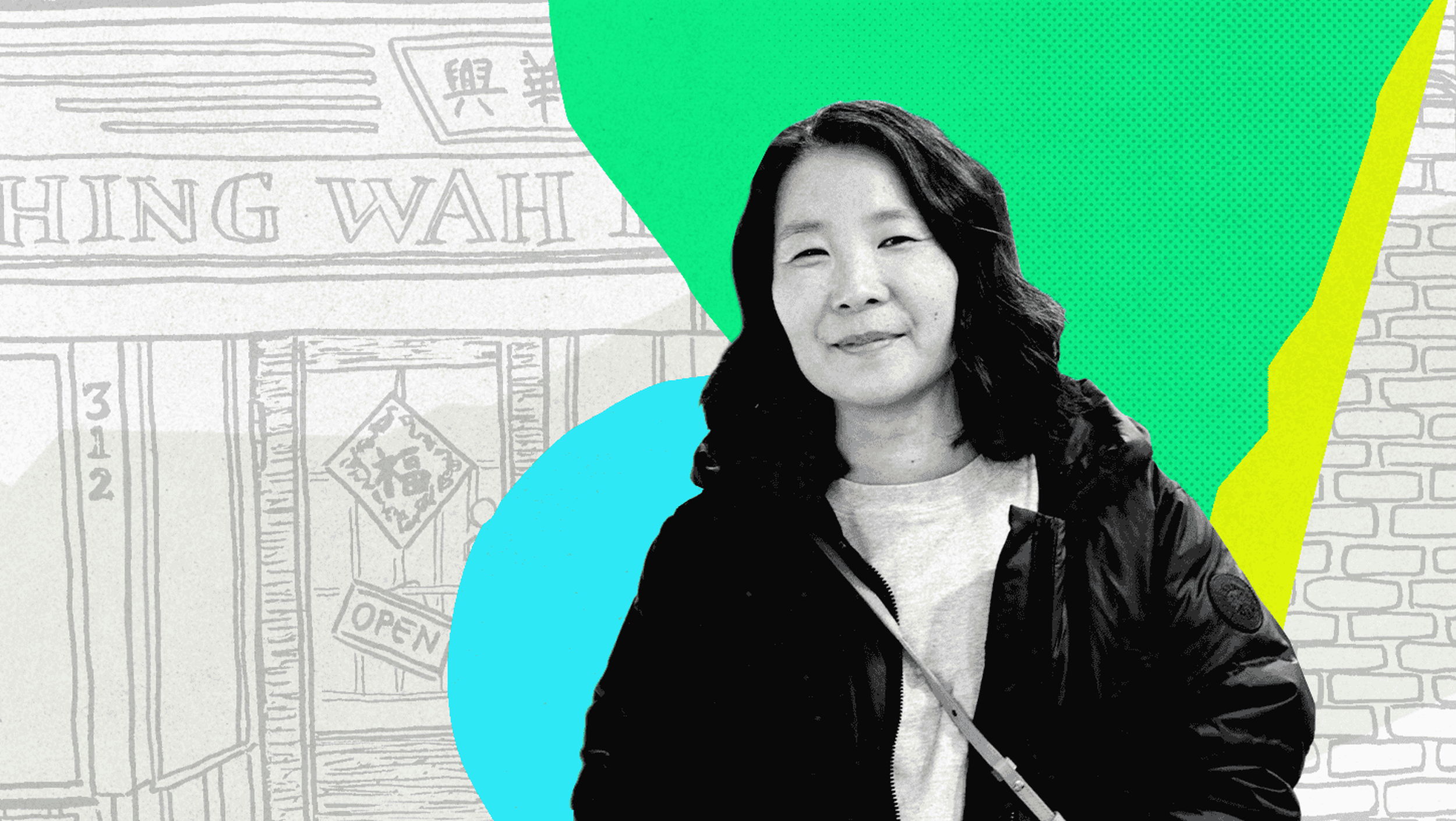
Photo illustration by The Sprawl. Art by Teresa Wong, photo by Jeremy Klaszus
In Calgary’s Chinatown, Teresa Wong revisits a family history
Come print with us on June 14!

Join The Sprawl for a community printing pop-up with local cartoonist and author Teresa Wong!
Wong’s 2024 graphic memoir, All Our Ordinary Stories, is about growing up in Calgary as the child of immigrants. During the Cultural Revolution in China, her parents escaped to Hong Kong before immigrating to Calgary. And long before that, her great-grandfather had come to Calgary and lived in Chinatown before the Chinese Exclusion Act of 1923 shut the door.
She digs into all of that, and more, in her book.
Wong’s work has been published in the New Yorker, The Believer and elsewhere. Now she has created a new piece of artwork specifically to be letterpress printed on The Sprawl’s Pop-Up Press. Save the date! There is no cost and this is open to all.
Meet at Sien Lok Park
Sunday, June 14, 2026
2 p.m.
I spoke with Wong inside Dragon City Mall about her family’s roots in Chinatown, her book, and what she’s created for the Pop-Up Press—and why.
We’re standing in the middle of Chinatown. When you think of your family and their connection to this place, how far does it go back?
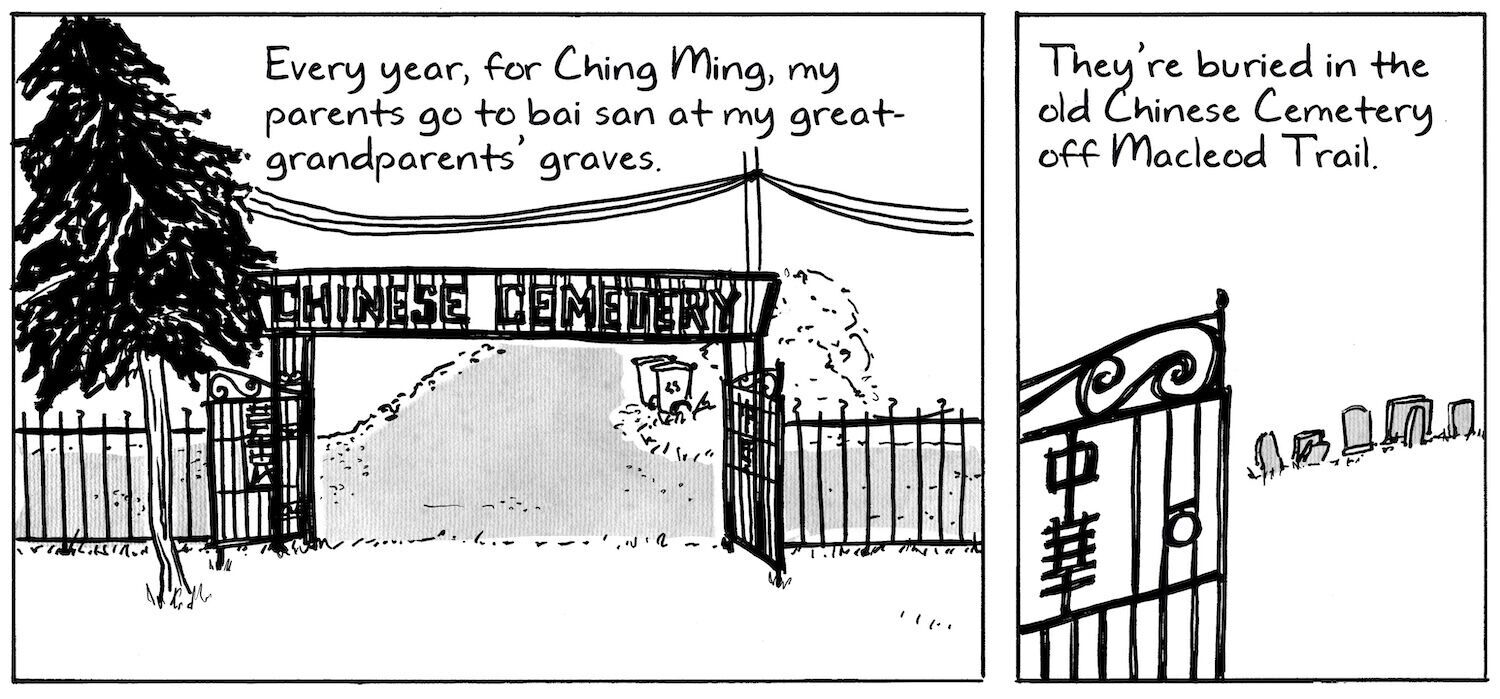
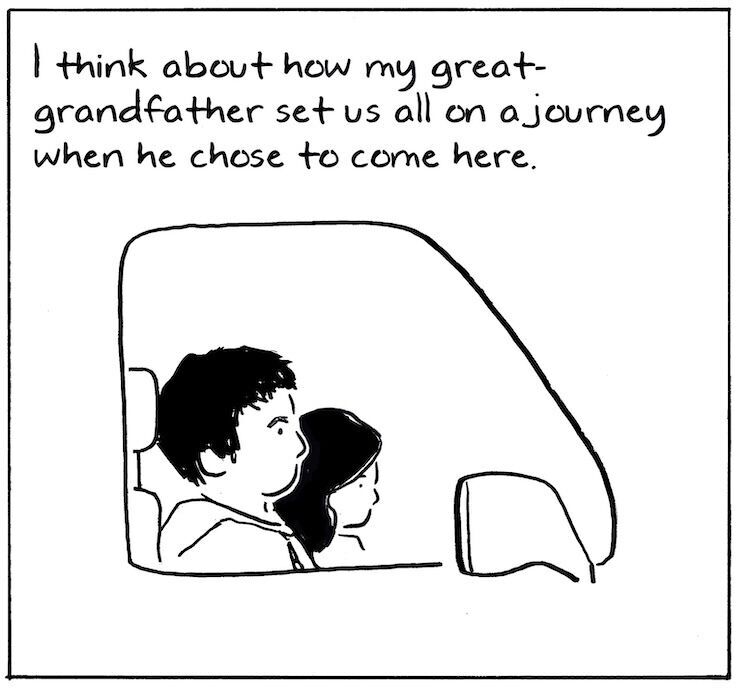
Pretty far back, because my parents came here in the ’70s, but the reason they came here was that my great-grandfather had come here in the early 1900s. And so when my dad was in Hong Kong, he was sponsored to come over here by his grandfather.
My great-grandfather had been in Calgary’s Chinatown very early on. And particularly this location is meaningful because it’s just a few blocks away from the Harry Hays building, which actually was annexed from old-time Chinese immigrants to be built there. And my great-grandfather’s house was on that land.
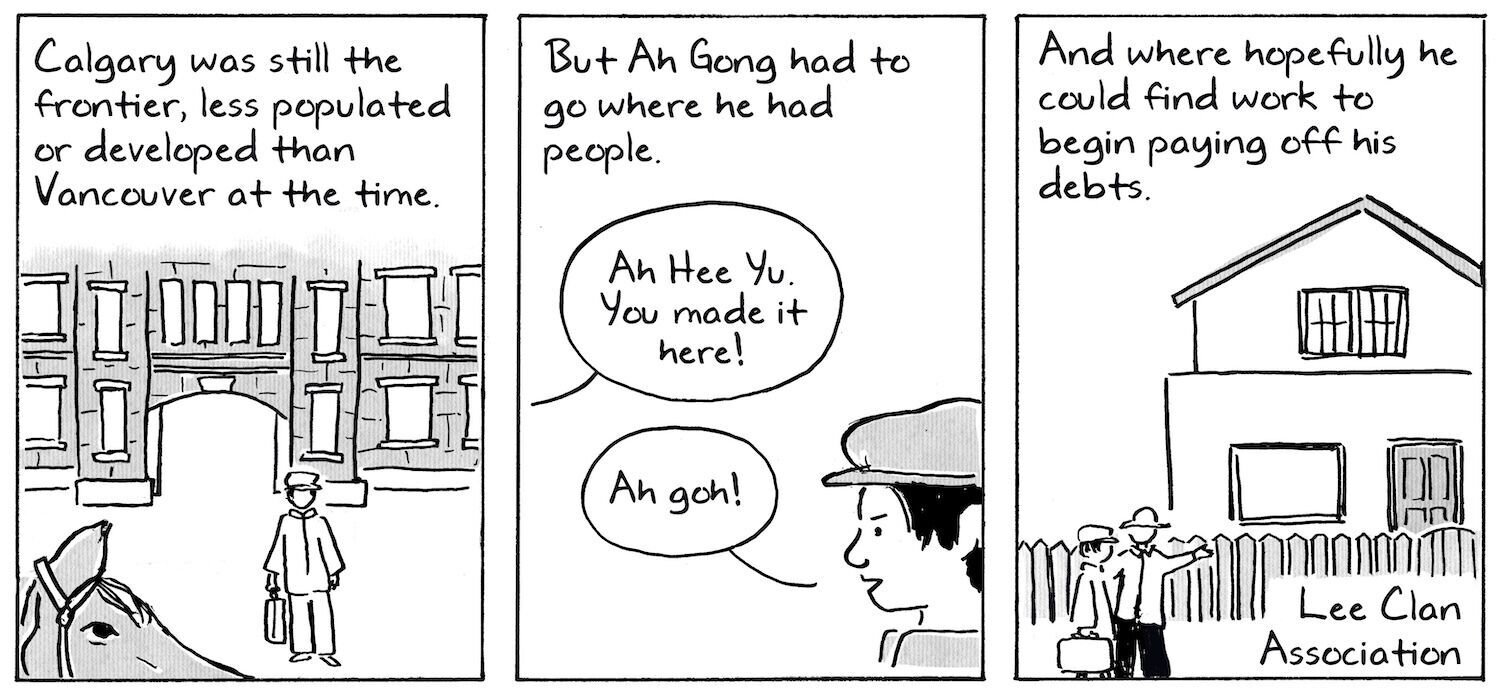
He was right by the river, and he lived here for most of his life. He came here as a young person—18, 19, years old—went back to China to start a family, and then was unable to bring them here because of the Chinese Exclusion Act in 1923.
And so his daughter, my grandmother, grew up all her life in China getting letters from this place and hearing about Calgary—and so did my dad. He knew he had a grandfather in Calgary, and eventually they were both able to come here. And now basically my entire family is here.
The Chinese Exclusion Act obviously affected your family, but you write about how it affected many more families at that time.
It definitely made a mark on an entire generation of Chinese people, whether that’s by keeping some immigrants here unable to go back—they didn’t make enough money to go back and have a family, and so it was the end of the line here. And then for other people it was that they grew up without their fathers or grandfathers. The immigrants here would send money home and have very little contact with their families.
I asked you if you were interested in drawing a local place of significance to you. Can you tell me about what you chose and why?
I chose to draw Hing Wah Imports, which is right on the main Centre Street here, cutting through Calgary’s Chinatown. And I drew that for a couple of reasons. One is that I know it would have been here when my great-grandfather was still alive, so there’s that connection to history. It would have been something he walked by every day.
And then also my own memories of coming to Chinatown back in the early 1980s as a kid with my mom running errands.
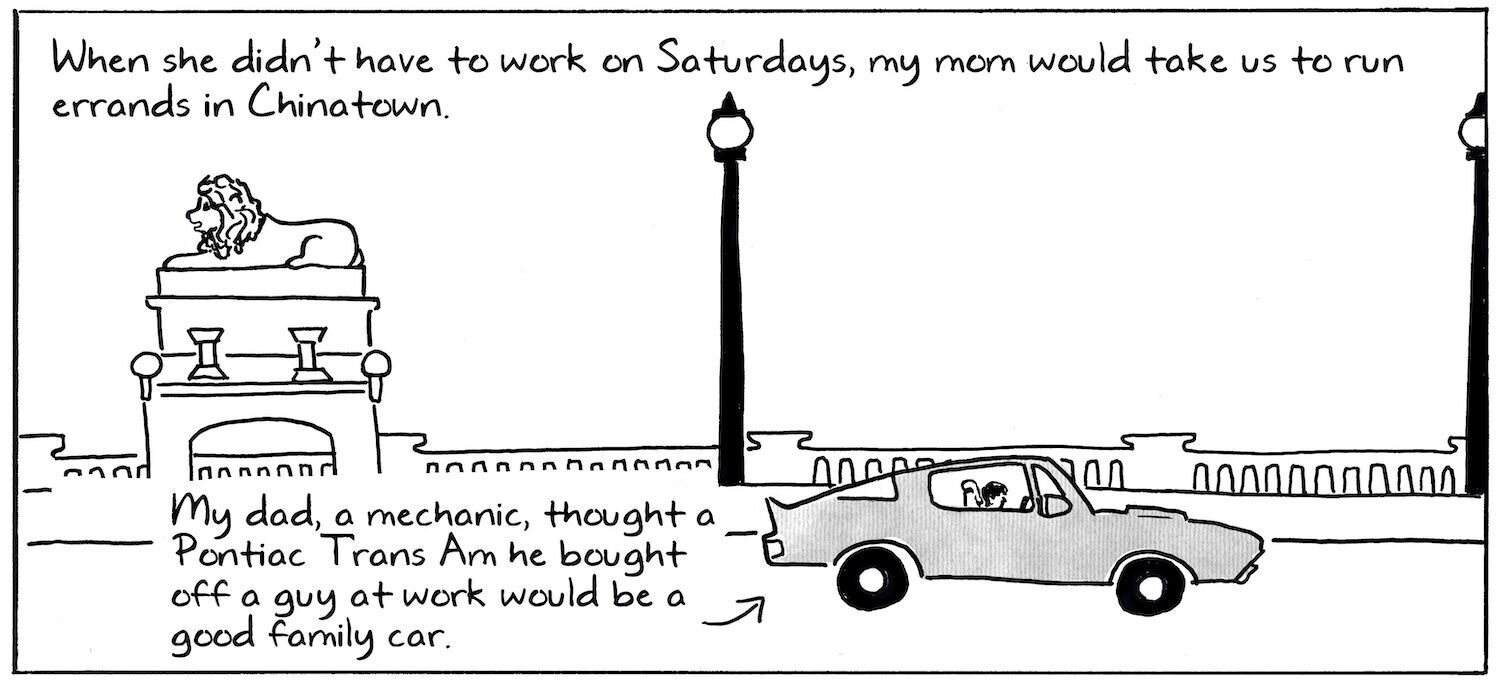
Back then, basically the only place you could get Chinese groceries was down here in Chinatown. And so she would come and buy barbecue duck and herbs for making soup and things like that.
And we would often stop at Hing Wah for a little treat. There are these little Chinese—I guess you’d call them candies—called Haw Flakes, and sometimes we’d be treated to that, me and my brother. They’re little discs that are dried and sweet and made from the hawthorn berry. And so it just holds a lot of good memories for me.
I guess it’s also thinking into the future. I wanted to commemorate a place that is sort of slipping from us in a way, because Chinatowns all over North America are experiencing decline and gentrification. In one way it’s good, because you could get Chinese groceries anywhere in the city. But in another way we’re losing a part of our heritage when Chinatowns are no longer thriving.
And so I wanted to make a piece of art that stood for all of that, the past and the future.
You talk about the significance of Chinatown and your great-grandfather being in a house where the Harry Hays is now—I mean, in 2026 to comprehend a neighbourhood of houses here is hard to even think about.
Yeah, there used to be a bunch of houses on that plot of land there by the river on Second Ave.—Riverfront Ave., I guess they call it now. I always understand things have to change. People change. The needs of a city and a population change, and maybe we don’t need a centralized Chinatown as much as, obviously, they used to need when my great-grandparents and when my parents first came to Calgary.
But it’s such a special place too and I appreciate that there are people in this city who are working to revitalize Chinatown and make it a cultural centre that still keeps with the times and serves the needs of the community, maybe in a different way. Maybe not just through groceries, but with cultural events or community-focused events.
I wanted to make a piece of art that stood for all of that — the past and the future.
In the book you say you’re obsessed with the past. Where does that come from for you?
I’m assuming it’s kind of personality, although my brother is a little bit the same way. There’s a lot of nostalgia about things, and I think nostalgic people are kind of born that way a little bit.
I think another reason, though, is that I’m always trying to kind of get at the root of things—how did things happen? And in my book I talk a lot about that, because my parents and I don’t have the best relationship. And so I wanted to dig and look back and try to figure out where could that come from? Is it just we have different personalities?
But I do think that there is something to the fact that they grew up with severed families. And so there’s something within them that lacks the ability to kind of reach out to their children in the same way as I’d like, at least in a way that I’d appreciate.
I think looking to the past kind of helps you understand yourself a little better, your relationships, and to understand that it’s not all you and your family—that a lot of the time, there are also cultural and historical factors at play that you might not have thought of first.
You had heard scraps of stories from your parents and grandparents and whatnot, but in the book you can tell you did a lot of research. And you document yourself doing lots of research. Trying to find a photograph of your great-grandfather, for example. I have to ask—did you ever end up finding a photo of your great-grandfather?
That’s a really beautiful thing that came out of doing that story in my book. There’s a section in my book where I’m trying to find his records with the Canadian government, because they documented every time that he entered and exited Canada. And he had to have photographic documentation.
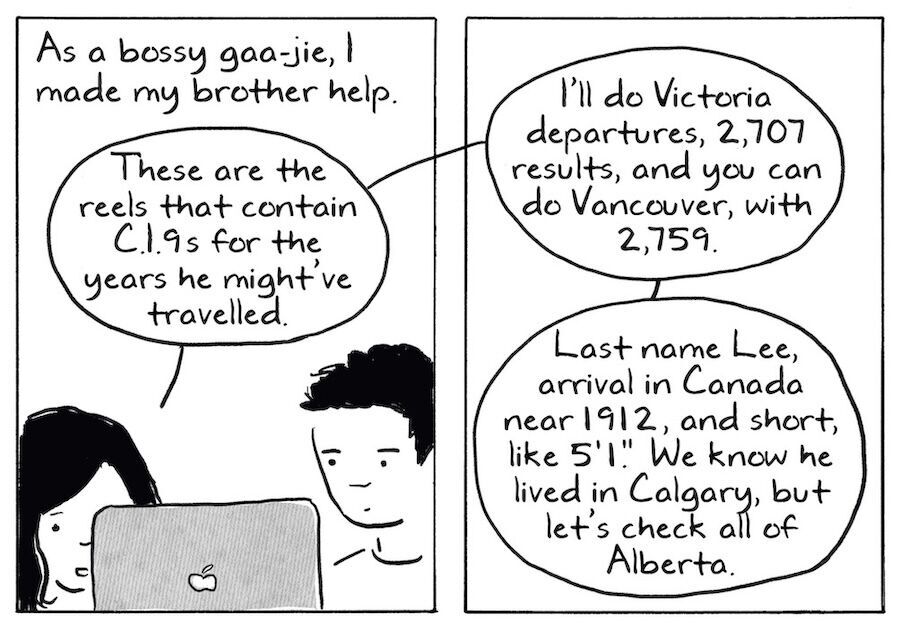
And I took that part before the book was even published, and published that segment on the CBC website as a First Person story—and through that was introduced to a group on Facebook that specialized in genealogical research for Asian Canadians.
This was after my book had been submitted to the publisher. There wasn’t any way to change that. But I did reach out to that group, and I posted a photograph of my great-grandfather’s gravestone, which is in the old Chinese Cemetery off of Macleod Trail. And within, I think, three hours—it was insane!—members of that group had tracked down all his documentation, and they sent it to me. And so I did finally get to see.
He had documents from when he went to China in 1933 I think, and then in 1928 and then his earliest trip in 1924-25. And it was really meaningful to see him—how young he looked. He would have been only in his late 20s. And also how much family resemblance there still is, because the first thing I thought was we have the same eyes. Also I thought he looked a lot like my niece—my brother’s daughter—and just to see that connection kind of in a visceral way was quite moving.
That’s wild, because you talk about you and your brother combing through these thousands and thousands of records to try and find this—and then this Facebook group finds it within hours.
They had been working doggedly. When I was looking they had not yet digitized every file yet, and this group had submitted requests to the Library and Archives Canada over and over again to get more and more sets of microfilm digitized. And so by the time that CBC story came out of mine, I think they had the full set there. They were trying to do it in time for the 100th anniversary of the Chinese Exclusion Act, actually.
And then when they released the full set, members of that group each volunteered hundreds of hours of time to categorizing everything on each microfilm image into a giant Google spreadsheet.
I couldn’t have been able to do that. And the fact that these strangers totally did it, and they did it for basically everyone, for free, because they want people to be able to find their ancestors—it was so amazing. They know how to do a search. So if anyone else is looking for their Chinese ancestors, hit me up! I’ll get you into the group.
I’m curious about the response to your book since it’s been published. Have you heard from other kids of Chinese immigrants who had similar experiences?
I often hear from people, whether it’s Chinese immigrants or any kids of immigrants, who say that they’ve gone through the same thing—that somehow I’ve captured their lives without knowing them or their specific situations. And so I realize that a lot of us out there go through similar things. We have a lot of questions about our past and our ancestors’ pasts, and a lot of questions about how to move forward when you kind of come from a line of broken families and maybe your relationships aren’t as healthy as they could be. And so it's always a privilege to hear from readers, and I’ve been lucky to receive lots of messages about that.
Did doing the book change how you look at Calgary at all?
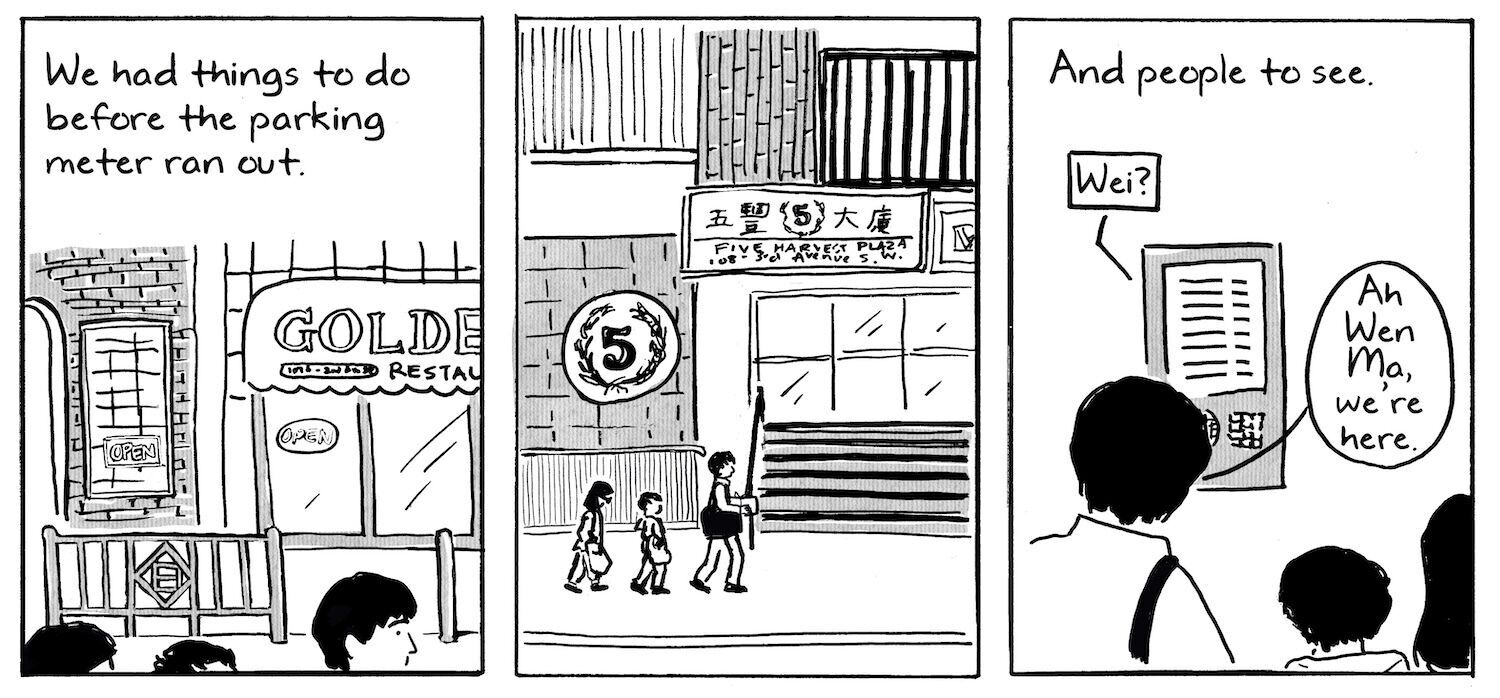
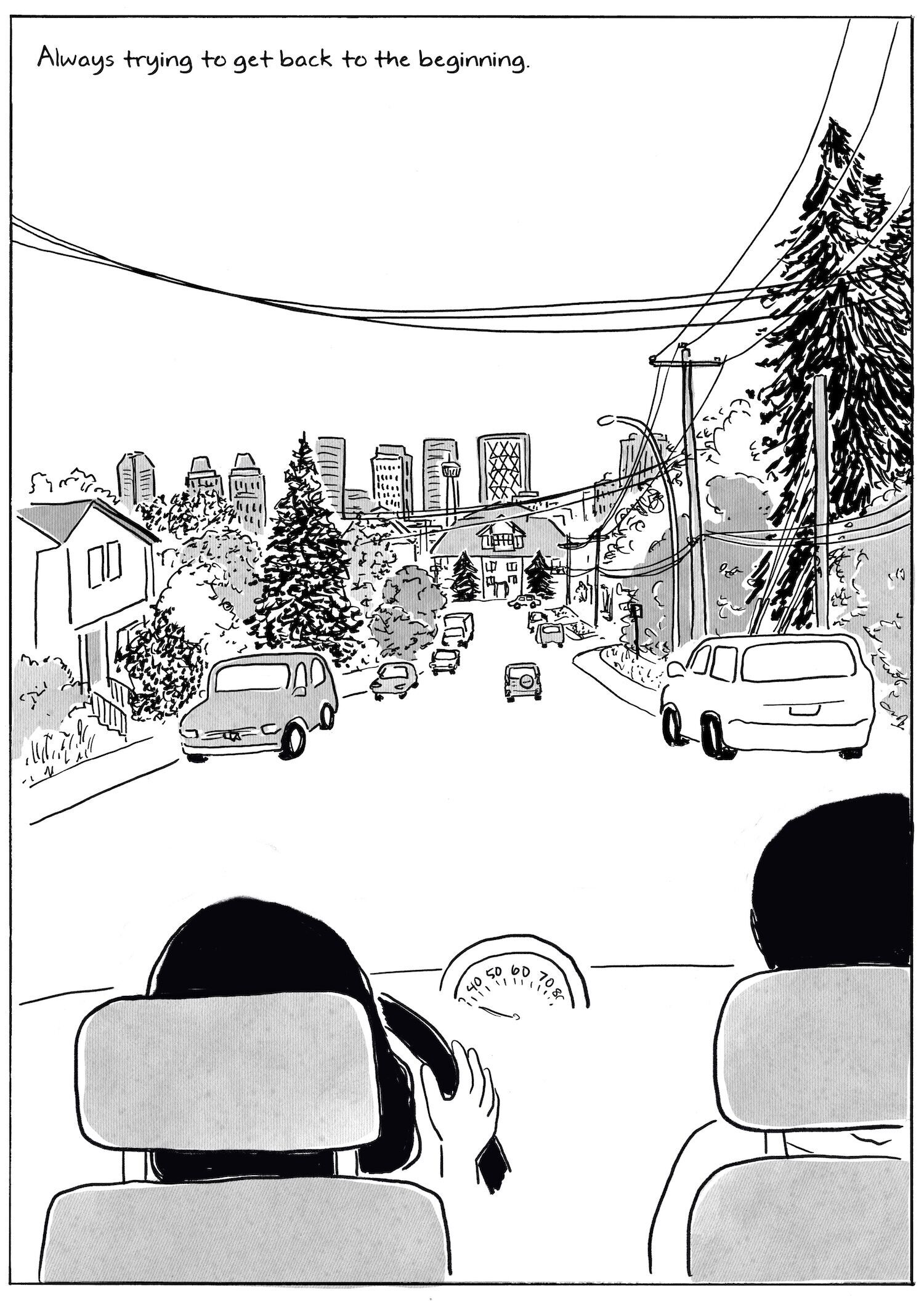
Absolutely. It really did. I didn’t realize when I started the book how much about Calgary it would be. But with a graphic memoir, you have to draw something—there has to be visuals. And when I started actually drawing out the pages, I realized that I needed to ground these stories in real places.
And so I drove around Calgary a lot and found the places I wanted to draw—or if there are places that were long gone, like the old Deerfoot Mall, I went online and tried to do as much visual research as possible.
Drawing the city, or places in the city, just made me love it more somehow and appreciate it.
Drawing the city, or places in the city, just made me love it more somehow and appreciate it.
There’s a quote by the cartoonist Wendy McNaughton who says “drawing is looking and looking is loving.” And I really felt that the more that I looked at the city in a really attentive way and spent time drawing the very particular parts of it, I learned to appreciate the city so much more. It’s not always the most beautiful city, but all those places I drew hold a special place in my heart.
So, for example, I spent time drawing the Harry Hays building. If you ever try to draw it, you’ll realize none of it makes any sense—the angles and how it stacks together. But now, whenever I drive by it, I’m like, “I love this building so much,” because it makes no sense.
And there are a lot of goodies in the book—like you draw the bus schedule for the Route 13 to Mount Royal. And there’s a bunch of little stuff like that, where it’s like, “Oh yeah, I remember that.”
If you know the city, there are definitely Easter eggs for people to recognize. And I wanted to keep things as accurate as I could. Sometimes I couldn’t find the right photo reference, but roughly it’s the city that I know.
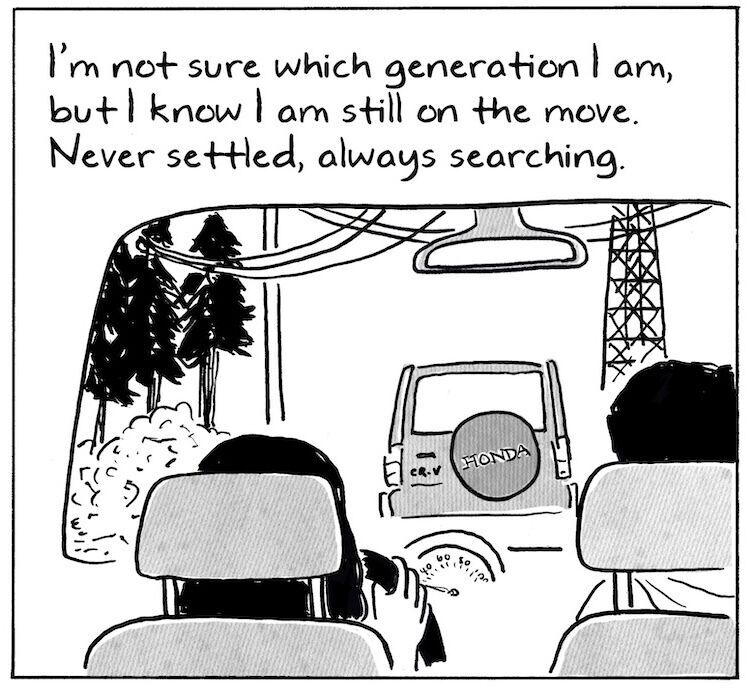
I also did that for myself, because I always appreciate it when I see Calgary in a TV show, or even if I read the word “Calgary” in someone else’s book. Because things are rarely set here. This is not New York City or whatever, but it is a special place to those of us who live here, who were raised here. And so you can find, I guess, the specialness in kind of an ordinary city.
Jeremy Klaszus is founder and editor of The Sprawl. Join us on Sunday, June 14, 2026, for a community printing pop-up with Teresa Wong! Meet at Sien Lok Park at 2 p.m.
Support independent Calgary journalism!
Sign Me Up!The Sprawl connects Calgarians with their city through in-depth, curiosity-driven journalism. But we can't do it alone. If you value our work, support The Sprawl so we can keep digging into municipal issues in Calgary!