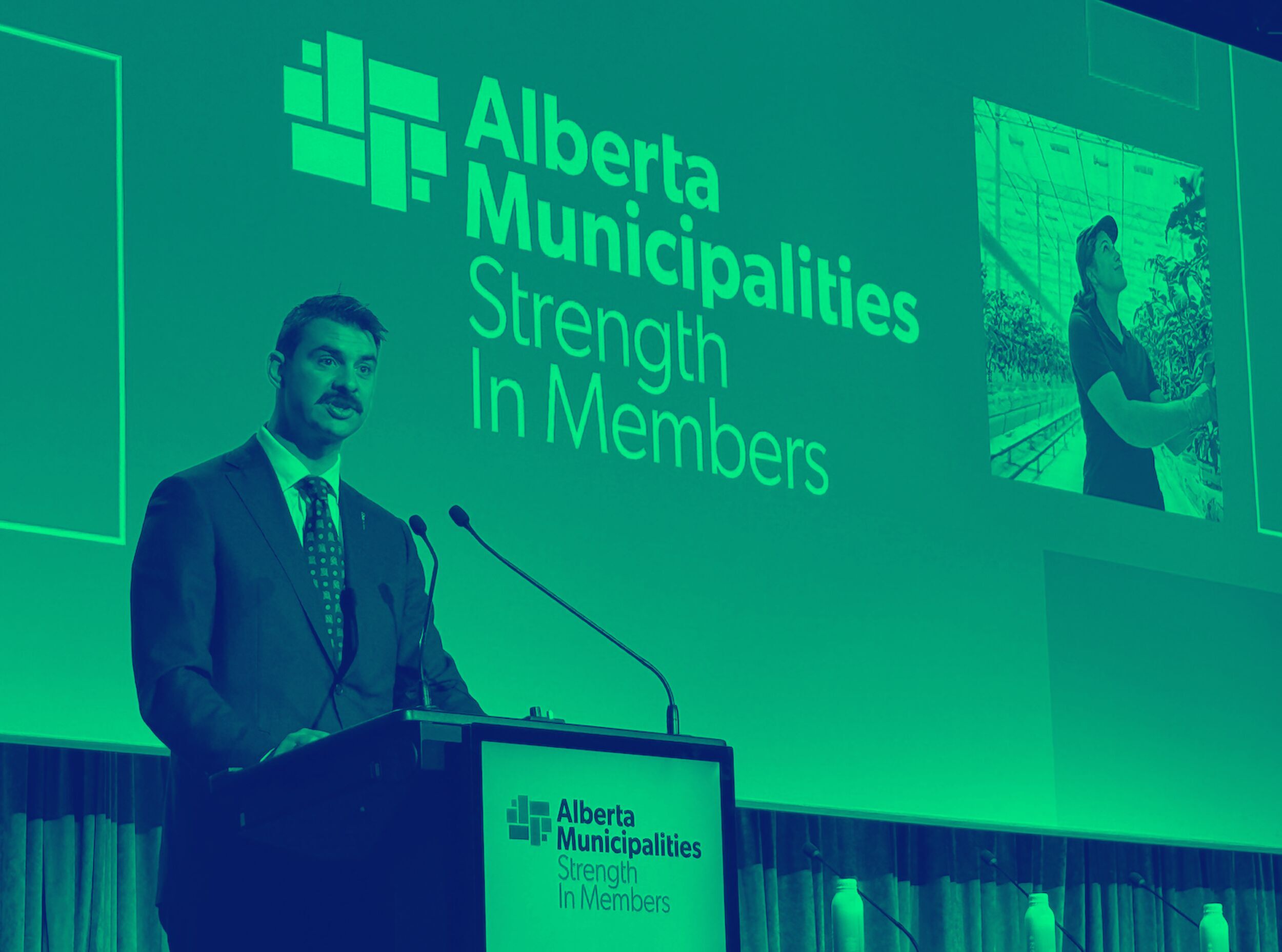
Municipal Affairs Minister Dan Williams on November 14, 2025. Photo: Jeremy Klaszus
Alberta cities seek autonomy as UCP floats more reforms
Smith offers to take tax power from municipalities.

Support independent Calgary journalism!
Sign Me Up!The Sprawl connects Calgarians with their city through in-depth, curiosity-driven journalism. But we can't do it alone. If you value our work, support The Sprawl so we can keep digging into municipal issues in Calgary!
How much power should Alberta municipalities have—and will upcoming UCP reforms strengthen local autonomy or further restrict it?
These questions hung in the air as municipal mayors and councillors, many of whom are new to the job, gathered in downtown Calgary last week for the Alberta Municipalities convention.
Speaking to delegates on November 14, Alberta NDP leader Naheed Nenshi said the current relationship between the province and municipalities is different than the ups and downs he saw when he was Calgary's mayor.
"Typically what we saw was a provincial government that, at best, treated municipal partners with indifference," said Nenshi, who now leads the party that held provincial power from 2015 to 2019.
"That has changed. Because now what I'm seeing is a provincial government that's treating our municipal partners with contempt—downloading costs on municipalities, restricting municipalities' ability to do their jobs through bills like Bill 18 and Bill 20."
Alberta Municipalities, the association that represents towns and cities, was critical of both laws. Bill 18 prevents municipalities from making funding deals with the federal government without provincial approval. Bill 20 overhauled elections, banning tabulators, requiring hand counts, and introducing political parties in Calgary and Edmonton.
A new provincially-required form to vote for school trustee, meanwhile, jammed lines at many voting stations.
"It's very clear that the UCP's changes were actually meant to make it harder for people to vote, and I think that's anti-democratic," Nenshi told reporters, pledging to repeal both Bill 18 and 20 if the NDP is elected.
What I’m seeing is a provincial government that’s treating our municipal partners with contempt.
Municipal Affairs Minister Dan Williams pitched a fresh start of sorts to delegates. "We have a chance with a new election and a new minister to reset relationships," said Williams, who took over the municipal affairs ministry from Ric McIver in May.
Premier Danielle Smith, meanwhile, mused about overhauling the Municipal Government Act, the provincial legislation that sets out municipal powers. “I wonder if there is a need to rethink the whole act rather than just changing it piecemeal," Smith said, as reported in the Western Standard.
Asked by The Sprawl about the scope of such a rethink, Williams said a province-wide code of conduct for municipal politicians, to be introduced in the spring, will be one element. Earlier this year, the UCP introduced Bill 50 which amends the Municipal Government Act to repeal all municipal codes of conduct, which were previously set by each municipality.
Bill 50 also required municipal chief administrative officers (CAO) to notify all council members within 72 hours anytime municipalities exercise "natural person" powers. Municipalities opposed the change, saying it would mean reporting day-to-day administrative activities like signing contracts, hiring staff and even using a credit card. (This amendment isn't yet in force.)
Authority for "what and when the CAO should report should be left to the authority of each council," Alberta Municipalities argued.
Upcoming legislation will address municipalities' concerns on this, Williams told delegates. "I've heard it loud and clear and I'm happy to say we're going to get that right with your advice."
Williams said the province will also amend the Municipal Government Act "in a number of other ways" and promised "thorough engagement with municipalities" on upcoming changes.
"It's a big undertaking and with the premier making that comment... I'm going to start turning my attention to that," said Williams.
I wonder if there is a need to rethink the whole act rather than just changing it piecemeal.
One ongoing point of contention is taxes. Municipalities collect taxes for themselves but they also collect an education tax on behalf of the province, which they pass directly on to the Alberta government.
It's an arrangement that endlessly frustrates municipalities as it costs them extra (millions, in Calgary's case) to collect the provincial requisition and many citizens assume their entire property tax bill is the city's doing. In 2025, about 63% of residential property taxes went to funding city services, with 37% going straight to the province.
Calgary city council finalizes its budget each November—as it will next week in the final year of a four-year budget cycle—without knowing the provincial requisition. That comes down with the provincial budget in February. In Alberta's 2025 budget, the provincial requisition for Calgary jumped by 17.5%. Then-councillor Peter Demong called it "the most egregious situation I’ve ever come across."
"We get raked over the coals for months on end on a three-and-a-half to 5% property tax increase," Demong said at the time. "The province, within a day, with no consultation, increases by over 17%—and we don't hear a single comment from any media opinion piece."
"There is large concern when we see the province doing double-digit increases," said newly-elected Alberta Municipalities president Dylan Bressey, who is a councillor in Grande Prairie.
Alberta Municipalities has long called on the province to collect its own education tax, saying this would be more transparent. "We want residents to know what level of government is driving their costs," Bressey said.
Premier Smith has floated the opposite: that the province collect property taxes and then dispense them to municipalities, an idea she introduced at last year's convention and repeated at this one.
"If there are any municipalities who want to hand that power over to us so that they can get efficiencies and that we would reverse it—where we collect the taxes and we rebate to them—we'd be very happy to have that conversation," Smith said, although she acknowledged municipalities would likely not be keen.
She is right. "We have absolutely no desire for the province to start doing our work for us," said Bressey. "We still do want to be levying our municipal property tax... and let the province collect its own."
There are also unresolved questions around who can tax how much—and for what. Smith's recent ministerial mandate letter to Williams asks him to "explore and make recommendations for ways to limit excessive municipal property tax increases."
Canmore, meanwhile, created a vacancy tax on second homeowners in 2024, but Smith's mandate letter asks Williams to "protect Albertans from specialized municipal taxes directed at homes that are not a primary residence."
We have absolutely no desire for the province to start doing our work for us.
The province appears warmer on allowing some municipalities to create an "accommodation tax" on hotel and short-term rental guests to help cover strains on local infrastructure. At the convention, delegates passed a resolution, put forward by Airdrie, that calls for amending the Municipal Government Act to allow for such a tax.
Bressey said he appreciated hearing Minister Williams talk about resetting relationships and added that local autonomy is crucial.
"We really do believe that local decision makers are able to find the best solutions for local communities, and so our assertion is that that needs to be respected," said Bressey.
As for a rethink of the entire Municipal Government Act (MGA), Calgary Mayor Jeromy Farkas wonders what the purpose will be.
"It seems like the MGA is revisited every six months," Farkas said. "So to what end, right? There's a lot to be said that the governance model doesn't work in terms of treating a summer village of 50 people the same way as a municipality of nearly two million people."
"I have an open mind to it—but again, the question is to what end... It's very ambiguous at this point."
Jeremy Klaszus is founder and editor of The Sprawl. If you value our independent local journalism, support it!
Support independent Calgary journalism!
Sign Me Up!The Sprawl connects Calgarians with their city through in-depth, curiosity-driven journalism. But we can't do it alone. If you value our work, support The Sprawl so we can keep digging into municipal issues in Calgary!