The gifts of story: A conversation with David Goa
‘Stories provide the way toward conviviality.’

This is an interlude.
There’s a lot going on, from the city budget to bike lanes. I've got the next Sprawlcast episode and a few other pieces in the works. But this weekend I am bringing you something different—and more personal.
It’s a conversation with a friend, one who has influenced my work for the better.
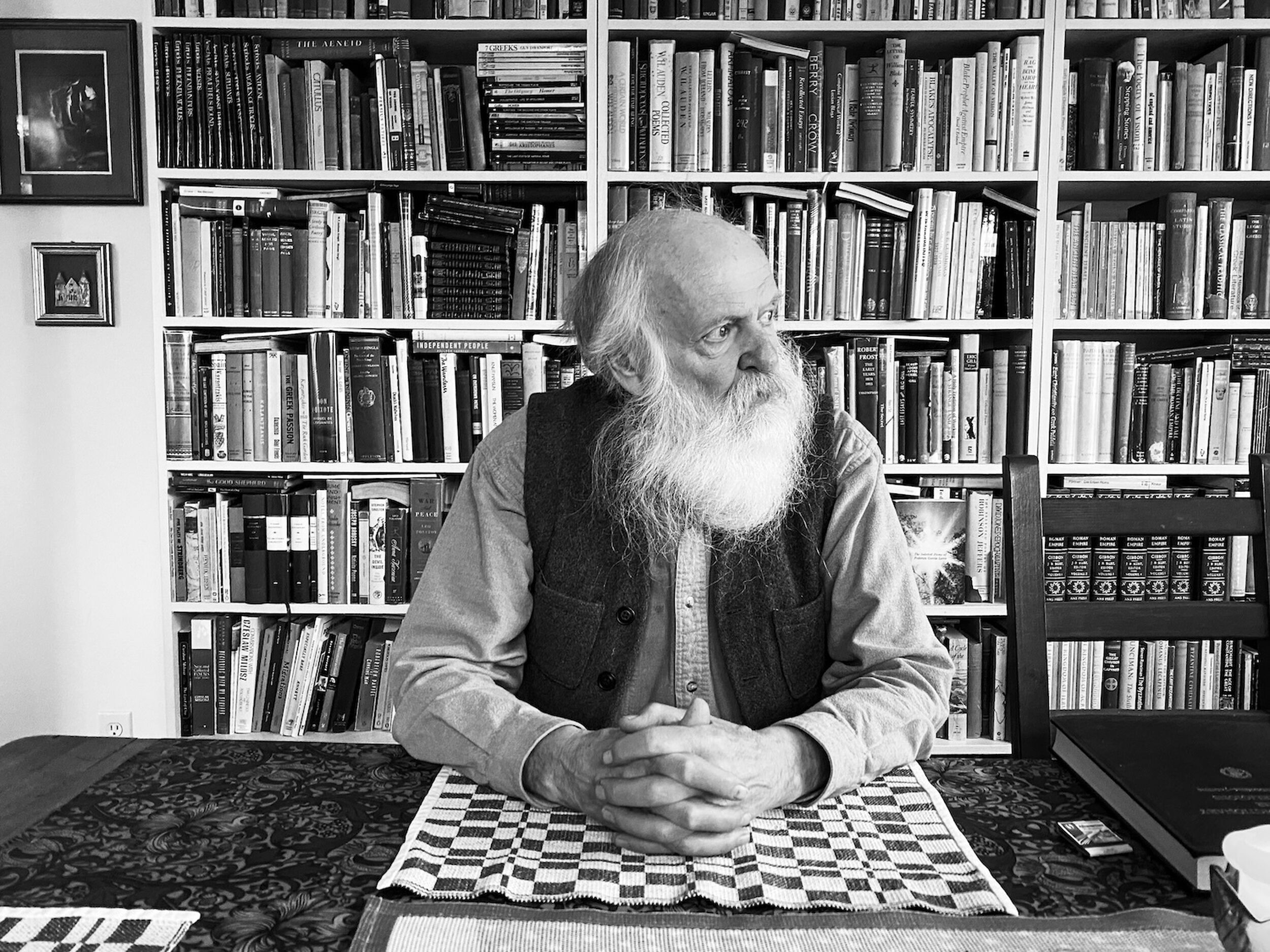
For three decades, David Goa worked at the Royal Alberta Museum in Edmonton, where he was curator of folklife. At the museum, his research focused on different cultural and religious communities in Alberta, exploring what he calls “the fields of meaning.”
After that, he became founding director of the Chester Ronning Centre for the Study of Religion and Public Life at the University of Alberta.
David’s work has focused largely on cultural memory and deepening public understanding across ideological silos. It’s work that he continues to this day, regularly hosting “philosopher cafes” in Camrose, where he lived until he was seven, and Edmonton, where he’s mostly lived since.
I first encountered David through an interview he did years ago. In this interview he was asked which tools he uses in his work.
“Story—your story, my story, our story,” he replied. “Stories provide the way toward conviviality. In the presence of story, the world is made new because we are changed.”
My journals have many such insights from David scrawled in them.
In the presence of story, the world is made new because we are changed.
David’s teaching and writing have nourished The Sprawl’s slow journalism approach. “One does not have to be buried in the fray,” I heard him say a few years back. “And if in fact you are not buried in the fray, you have some chance of being a bit more open to the range of things that are taking place in your life and in our common life in the world.”
For me, one of the gifts of David’s work has been to get me thinking at a deeper level about my own work.
Does it enlarge understanding of “the other,” or shrink it? Does it call out the worst in people, or call forth the best? Does it tell people what to think, or does it increase our capacity for thinking together on issues of local concern?
Thinking together... is such a thing even possible in our ever-fragmenting world?
From David, I have learned that it is. He does this regularly with his philosopher cafes, gathering small groups of people to think together—that’s what he calls it—about issues and current events.
This is different from debating or defending pre-established positions. It affirms a posture of openness and regard for the other. It suggests that ruminating alone only gets one so far (and in fact can be dangerous!). But by thinking together, in dialogue, we might arrive at a new insight—maybe even one we can hold in common.
This gives me hope. We need more of this in our world!
David’s work has focused largely on strengthening cultural memory and deepening public understanding across ideological silos.
In 2021, I spoke with David for Sprawlcast about the challenges of the city and the significance of seeing and hearing the stranger (Welcoming the stranger as an act of delight). This remains one of my all-time favourite episodes.
“I am interested in those things which make our city a convivial place,” David told the Edmonton Journal in 1996, “and it’s not possible these days to have a convivial city unless we get rid of some of our fear, particularly about young people, particularly about street people, and seek ways to have their lives come together and be able to serve our world.”
As a child in the 1950s, David saw this demonstrated by his father in Edmonton.
On weekends they’d take the bus downtown, where his father would often invite someone begging on the street for lunch on 97th Street. Over a modest meal, they would hear some of that person’s story. “I developed, I think because of those Saturday sojourns, a delight in the city and a sense that meeting the stranger was always an opportunity,” David told me.
“When we meet strangers, it is often an annunciation. We will often hear a new word which will illuminate our life, illuminate relationships, illuminate the world.”
This is what it is like to have a conversation with David.
With his mother, he experienced another aspect of conversation through her friendships with neighbour women in Camrose. “Here I saw nurture,” he writes. “Here, around the kitchen table, I saw my mother express her strongest opinions and judgments without taking sides that deepened alienation. The nurture was in the midst of common struggle to understand our lives together in the world.”
Much of David’s work, as a result, has been about seeking to understand how people understand. This, incidentally, is what journalism should do as well.
Around the kitchen table, I saw my mother express her strongest opinions and judgments without taking sides that deepened alienation.
This is a long preamble to my point: the tables have turned! Earlier this fall, David came to Calgary to speak with me for his podcast, In Conversation with David Goa, about my own formation and how it has shaped my work with The Sprawl.
We trace quite a trail—from Germany and Russia, where my ancestors lived, to Wisconsin, where my grandfather and uncles became Lutheran pastors, to Mobridge, South Dakota, where my parents met at a Lutheran high school. Likewise, I left home at 15 to attend Prairie High School in Three Hills, which was a formative experience, as we discuss.
It was a gift to be able to reflect with David on these early experiences and how they shape my work today. I am grateful for the conversation. Today I share it with you as well. You can listen here.
May we all seek to deepen our lives and call forth the best in each other, no matter where we are!
Jeremy Klaszus is founder and editor of The Sprawl.
Support independent Calgary journalism!
Sign Me Up!The Sprawl connects Calgarians with their city through in-depth, curiosity-driven journalism. But we can't do it alone. If you value our work, support The Sprawl so we can keep digging into municipal issues in Calgary!