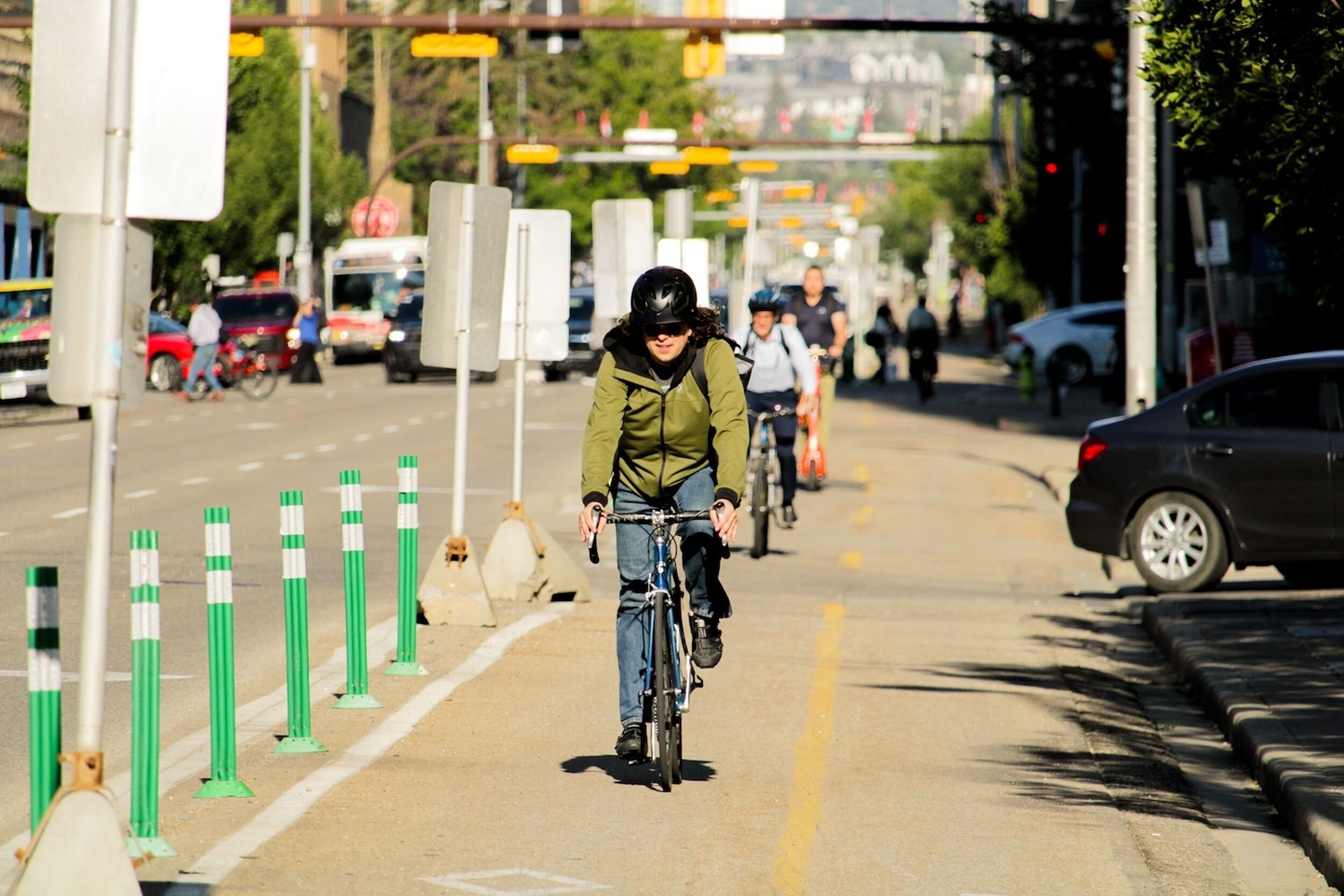
Cyclists on 12th Avenue S.W. Photo: Jeremy Klaszus
The boom and bust of Calgary’s bike lanes
No one is leading the cycling file at city hall.

Support independent Calgary journalism!
Sign Me Up!The Sprawl connects Calgarians with their city through in-depth, curiosity-driven journalism. But we can't do it alone. If you value our work, support The Sprawl so we can keep digging into municipal issues in Calgary!
Is Calgary city hall out of control in building new bike lanes or negligent in building too few?
Opinions abound. But with Alberta Transportation Minister Devin Dreeshen talking about pausing new bike lanes in Calgary and Edmonton (he’s meeting with Mayor Jyoti Gondek about this July 30), it’s worth looking at what city hall has and hasn’t done on the cycling file.
In 2011, Calgary city hall rolled out a cycling strategy “to become one of the premier cycling cities in North America.” That strategy set a goal of building 30 kilometres of protected cycle tracks, “physically separated from traffic and pedestrians,” by 2020.
Five years after that target date, city hall has yet to meet that goal. Today, Calgary has 26.2 kilometres of cycle tracks.
The same strategy called for 180 kilometres of painted bike lanes by 2020. Today Calgary has a quarter of that, with 45.6 kilometres of painted lanes, according to city hall. To put those numbers in context, Calgary has nearly 7,700 kilometres of roads.
“They've definitely fallen well below the targets of the original strategy,” said Bike Calgary’s Kimberly Nelson. “But at the same time, I think there's a lot of things now that are being done automatically which used to have to be a fight.”
City hall’s biggest move was the downtown cycle track network, which opened with 7.3 kilometres in the summer of 2015. “We had a few very good years because we had a supportive council behind us,” said Tom Thivener, who was the city’s cycling coordinator at the time. “We had supportive senior management.”
Then momentum stalled.
In 2017, city hall built just 0.1 kilometre of cycle track. Thivener left in 2019. “By then, the mood had kind of changed at city hall—a lot less support for cycling initiatives,” said Thivener, who now works as transportation planning manager for the city of Coquitlam.
We had a few very good years because we had a supportive council behind us. We had supportive senior management.
After Thivener left, city hall posted for a new cycling coordinator but then city brass took the posting down in response to political blowback from Councillor Sean Chu and then-councillor Joe Magliocca (who was recently found guilty of fraud).
From there, no one was tasked with spearheading the bike file at city hall. Instead, responsibility for cycling was spread across various roles and, eventually, departments.
Today, with no one leading it, Calgary’s bike infrastructure is a patchwork, full of gaps and disconnections.
On July 11, a cyclist was killed in Killarney by a dump truck on 26th Avenue S.W. while riding in the street's painted lane. Cyclist safety on 26th has been flagged as a concern for years. The street is slated to get protected bike lanes when the road is rebuilt, with construction set to begin in 2026.
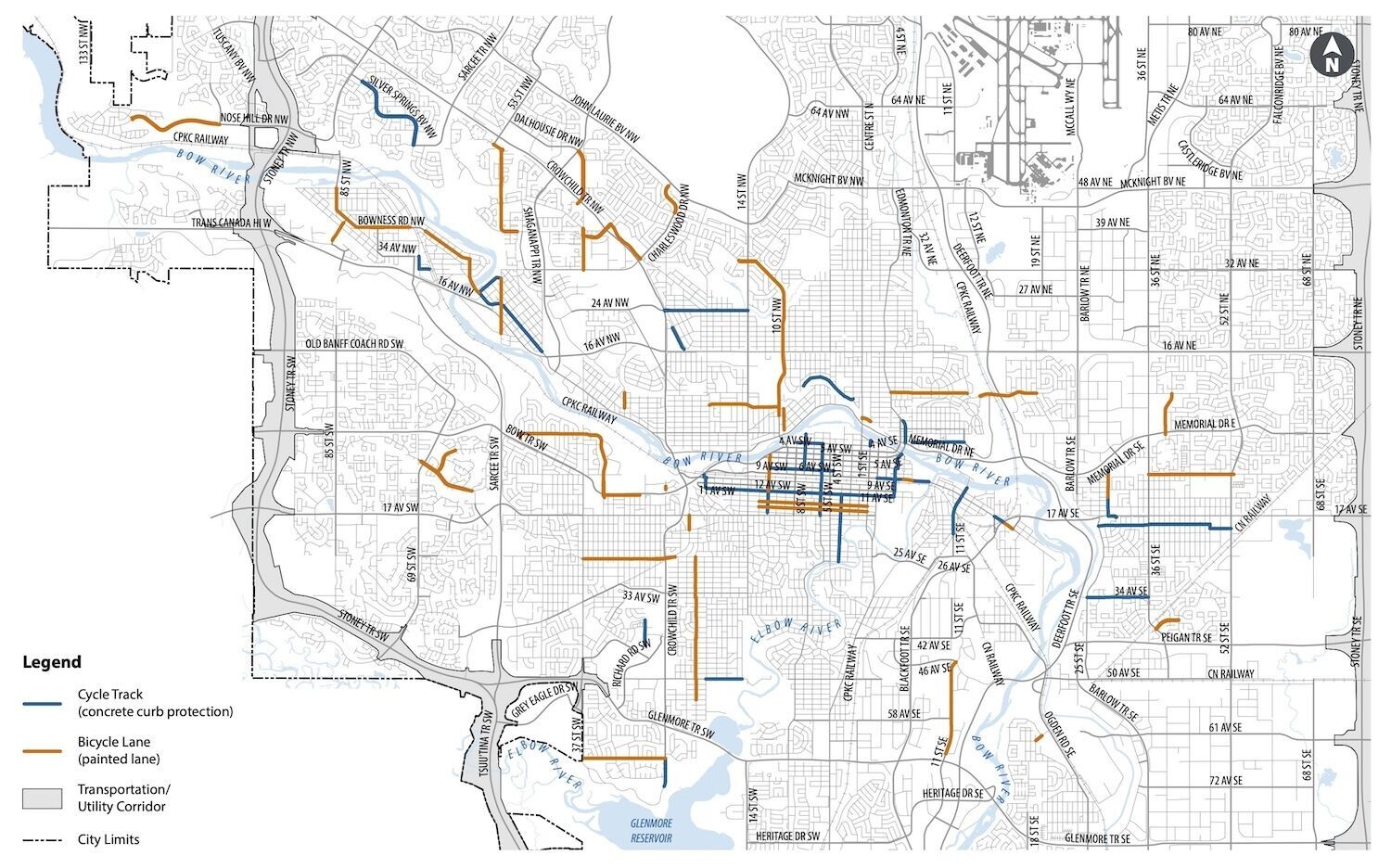
Paradoxically, while political support for cycling infrastructure is at its lowest ebb in years, city hall is integrating cycling into road redesign projects in a way it didn’t ten or 15 years ago.
“There was definitely a lull,” said Nelson. But after the pandemic hit, the city started building more again—and not just downtown. “It created a bit of a spark,” Nelson said. “They're trying to do it as they're doing the upkeep on specific roads.”
One example is in Forest Lawn and Southview. For years city hall only built protected bike lanes west of Deerfoot Trail. That changed in 2022, when the city rebuilt 19th Avenue S.E. with a cycle track.
“I'm glad we're expanding and heading farther east,” said Ariana Kippers, Ward 9 candidate for The Calgary Party in the upcoming municipal election. “There's been a big shift in how we get around and I'm happy to see we're providing those opportunities to folks over on this side of the Deerfoot.”
And the downtown cycle track network?
It started with a 6.5 kilometre pilot, and has grown to 9.9 kilometres (10.7, if you include Mission). But ten years on, maintenance is a problem. Broken delineators are common, as is sketchy asphalt and battered concrete barriers—not to mention frequent blockages by work crews (including the city’s) and delivery trucks parking in the lanes.
“I feel as though it's never gotten out of its pilot project phase in a lot of ways,” said biking advocate Alyssa Quinney. “There's parts of it that are still very much not permanent-feeling. A lot of it is deteriorating. And then there's parts of it where there’s connections that aren't being made to the greater cycle network ”
I feel as though it’s never gotten out of its pilot project phase in a lot of ways… A lot of it is deteriorating.
Tools to track and show cycling data have also fallen into dilapidation, making it difficult for Calgarians to find basic information.
The city counts trips on the downtown cycle tracks, but some of the counters have been broken at times which has put holes in that data.
City hall also does an annual cordon count of people going in and out of the downtown core each May, but the most recent data on the city cordon count webpage is from 2022. The 2023 data is buried in the city’s Open Data database.
The city provided the 2024 data to The Sprawl and it shows 2% of trips were by bike—the same percentage it was a decade ago (it did rise to 3% in 2017, 2018 and 2021). The cycling strategy target was 4% by 2020.
“The recipe is simple: keep building good infrastructure,” said Thivener. “Make sure that the facilities just don't end—which, arguably, was the big Achilles heel of the first network. It was kind of a floating network. It didn't connect really that well to the river path system.”
“Solve those gaps, and then start to upgrade the existing ones that you do have. Because obviously with quick builds, it only lasts a few years and then it starts to fall apart and become a maintenance hassle.”
As the cycling strategy fades from view, city hall's more recent focus has been the 5A network of pathways and bikeways (5A means “always available for all ages and abilities”). The city’s climate strategy calls for the 5A network to be completely implemented by 2050 but what exactly that entails remains vague.
City hall is cagey about even discussing bike lanes. City admin refused to do an interview for this story after repeated requests from The Sprawl over multiple days.
With the municipal election coming up October 20, candidates have a range of perspectives. Ward 13 councillor Dan McLean, running for re-election with the Communities First party, recently suggested that city hall should remove the cycle track on 8th Avenue S.W.
City hall is cagey about even discussing bike lanes. City admin refused to do an interview for this story after repeated requests.
Others want a pause. “I think we've done an amazing job of creating these bike lanes for Calgarians to recreate, to get to work,” said Joanne Birce, an independent candidate running in Ward 6. “I do think, though, we need to shift gears. We've got more than enough bike lanes, in my opinion.”
“I think people are frustrated with the thought of more bike lanes going in. They would like to see their tax dollars going to more important things.”
In Ward 7, where former councillor Druh Farrell was a relentless champion of bike infrastructure, lack of protected lanes has become a campaign topic.
Independent candidate David Barrett has told Minister Dreeshen to stay in his lane: “Calgary city council should decide the transportation infrastructure we build out, not a provincial government that loves to overstep their responsibilities.” Myke Atkinson, another independent candidate, wants a complete protected cycling network in Ward 7 by 2035.
Meanwhile independent mayoral candidate Jeromy Farkas, who was critical of expanding the downtown cycle track network when he was a councillor, has proposed tying capital transportation dollars to mode usage.
“Up until now we've had the sort of cars versus bikes debate and I think the way to break that logjam is to just acknowledge that every single form of transportation is legitimate,” Farkas said. “When we tie funding to usage, we take the guesswork and the gamesmanship out of it.”
CORRECTION 07/30/2025: This story originally stated that the downtown cycle track network has “grown from 7.3 kilometres in 2015 to 20 kilometres today.” This is incorrect. The original pilot network was 6.5 kilometres. City hall told The Sprawl the downtown cycle track network is now 20 kilometres but later clarified that this stat is lane kilometres, with each direction counting as its own lane—and that there are 9.9 kilometres of protected cycle tracks downtown. The Sprawl regrets the errors.
Jeremy Klaszus is founder and editor of The Sprawl.
Support independent Calgary journalism!
Sign Me Up!The Sprawl connects Calgarians with their city through in-depth, curiosity-driven journalism. But we can't do it alone. If you value our work, support The Sprawl so we can keep digging into municipal issues in Calgary!