Photo: Farkhod Fayzullaev
Hey, where’s my bus?! Calgary Transit regularly cancels scheduled trips
Riders on 33 routes affected by budget crunch.

Support independent Calgary journalism!
Sign Me Up!The Sprawl connects Calgarians with their city through in-depth, curiosity-driven journalism. But we can't do it alone. If you value our work, support The Sprawl so we can keep digging into municipal issues in Calgary!
In September, my daughter made a surprising declaration. The Calgary Transit bus she takes to school in the morning was gone. Not late, but gone.
My first response: What do you mean it’s gone? It can’t be gone. Our bus (#17 - Renfrew/Ramsay) only comes every 35 minutes. How can the morning peak-hour bus that takes students to the local high school be gone?
She was right. It was gone. With no warning or explanation, her bus no longer showed up, leaving a gap of more than an hour between morning buses.
Thus began a months-long saga entitled Is My Bus Coming Today Or Not?
It is a situation many Calgarians have become familiar with in recent months. Calgary Transit has cancelled scheduled peak-hour buses on some 33 routes, to varying degrees depending on the day, since September.
The cancellations are due to a budget and driver crunch, says Sharon Fleming, director of Calgary Transit. “We're in a situation where we have a base number of spare operators that are always on call in our facilities, waiting for missed trips by operators that may be sick or delayed,” said Fleming.
“Typically we'll fill those spots up with our spare operator pool. But when we run out of spare operators and we don't have sufficient budget for overtime that's required to fill those trips, then we do cancel trips.”
In September, 60 buses on 33 routes were axed during peak hours, according to Calgary Transit. This meant losing about 200 service hours weekly from Monday to Friday. The cancelled buses are on routes ranging from MAX crosstown lines to less frequent routes.
Those key trips aren’t able to go out because the operator is not available during that peak period of time.
City hall says the situation has since improved to about 96 service hours cancelled each week. Some of the missing buses, like ours, have started to arrive with more regularity, but still not consistently. It depends on the day.
“We have pretty much reached capacity in what our fleet can manage in peak,” said Fleming. “So that's where the problem arises. Those key trips aren't able to go out because the operator is not available during that peak period of time.”
Calgary Transit has struggled in communicating the cancellations. Initially the trips just disappeared. Now the Calgary Transit website and Transit app contain a warning on affected routes that some buses “may have been removed from this route’s daily trips.”
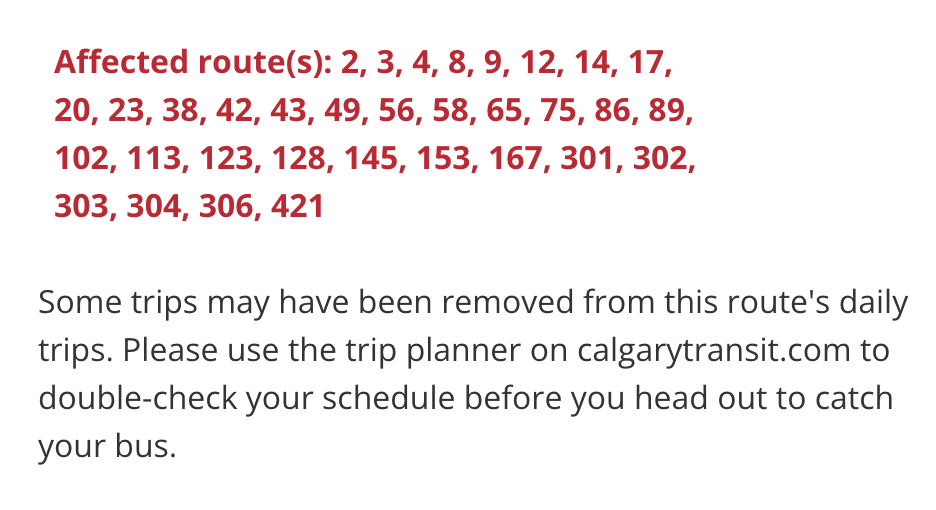
On Calgary Transit’s website, by pulling up your route you can see if your bus has been nixed or not (it still appears in the schedule but with the times crossed out). The Transit55 realtime bus tracker can also be a handy tool—for this and other uses—with cancelled buses appearing as greyed out “ghost buses.”
But not all riders have easy internet access to dig for whether or not their bus has been cancelled, says Alex Williams of the advocacy group Calgary Transit Riders. He notes that some seniors (and others) don’t have smartphones and are at the mercy of whenever the next bus arrives.
“It's not such a bad deal if all of our buses had 10 minute service [between arrivals],” Williams said. “But when we don't have that level of service, we need better ways of getting information to riders.”
‘We have a massive service demand gap’: Calgary Transit
The missing buses are part of a much bigger problem, one that Calgary’s new city council started grappling with this week.
“This is a result of chronic underfunding of transit that we have experienced for decades in Calgary, especially as we continue to grow,” said Williams. “We can't just not fund transit, and we also can't fund the bare minimum of transit, because the bare minimum of transit isn't a quality service.”
City admin more or less said the same thing to council on Friday during budget deliberations.
“We have a massive service demand gap we’re trying to fill with limited resources,” Fleming told council, noting that Calgary Transit is “significantly underfunded” compared to other Canadian cities such as Toronto, Vancouver and Montreal—and Calgary is “falling behind” on transit as the city grows.
The proposed 2026 budget, which council will tweak and vote on next week, includes a $14 million boost to increase transit frequency. But this is only for “fast and frequent” routes on the primary transit network, including MAX lines. It’s not for base service, the more infrequent routes in the rest of the city.
Much of what city hall refers to as the primary transit network is still not a real primary transit network, according to the city’s own definition: trips every 10 minutes, 15 hours a day, 7 days a week. Fleming told council that only the CTrain lines meet this criteria; no bus routes do. This has been the case for years. (For more backstory, check out the 2022 Sprawlcast episode “Game Over: How Calgary Killed Its Primary Transit Network.”)
We want to increase [transit]. We want to make it better for residents.
Improving base service—just to get every neighbourhood to 30 minutes between buses—is even more challenging with Calgary’s sprawling footprint. “We say the primary transit network would require $150 million over 10 years,” Fleming told council. “You're probably looking at almost a similar investment for the base network to meet that [30 minute] expectation.”
And that’s just operating costs. Keeping up with growth will require $45 million annually for new buses, Calgary Transit has said, plus some $500 million for a new storage and maintenance facility. The list goes on.
In the meantime, frustration abounds.
“If you're not giving a base service to people to get to the primary transit network, that transit network is of no use, in my opinion,” said Ward 5 Councillor Raj Dhaliwal. “Because if they can't get there, they don't have that service.”
This is a result of chronic underfunding of transit that we have experienced for decades in Calgary.
In Ward 1, new councillor Kim Tyers voiced frustration that the city is soon phasing out six express bus routes that run only at peak times—including #70 - Valley Ridge Express, which currently has a petition to save it. “This is disappointing at a time when we’re trying to get more people to take transit,” Tyers said, adding that this is a “very transit-oriented council.”
“We want to increase it,” Tyers said. “We want to make it better for residents.”
Councillor DJ Kelly, newly elected in Ward 4, said he’s happy the $14 million budget increase will improve the primary transit network but is “really disappointed” it won’t boost base service. “It's all about reliability and efficiency,” said Kelly. “If that bus isn't there when you're looking for it, it's not going to make much of a difference for you.”
Kelly and other council members say Calgarians should expect transit to be tackled more substantially in the next four-year budget cycle, which this council will set in 2026. (They are currently adjusting the final year in a four-year budget cycle set by the previous council.)
If that bus isn’t there when you’re looking for it, it’s not going to make much of a difference for you.
Mayor Jeromy Farkas says the current plight is one Calgary can’t solve without support from other levels of government. Calgary Transit currently gets about 35% of its operating revenue from fares. The other 65% comes from property taxes.
“Calgary's transit system right now is a lot of bread, not enough butter,” Farkas told reporters.
“Just because you have a fancy new train line or bus routes doesn't mean anything unless there's actual operators in those buses or trains to be able to make them go. So we're going to have to challenge the provincial and federal counterparts to be able to do their share.”
Councillor Andre Chabot agreed “we surely could benefit from the province helping us to increase our levels of service.”
“I know everyone wants us to increase service, but there's only two ways that we can actually pay for that: either we increase taxes or we increase fares,” said Chabot.
Jeremy Klaszus is founder and editor of The Sprawl.
Support independent Calgary journalism!
Sign Me Up!The Sprawl connects Calgarians with their city through in-depth, curiosity-driven journalism. But we can't do it alone. If you value our work, support The Sprawl so we can keep digging into municipal issues in Calgary!