Illustration by Chris Pecora
Spread thin: How urban sprawl is stretching Calgary Transit to the max
A new city council tackles an old problem.


Sprawlcast is Calgary’s in-depth municipal podcast. Made in collaboration with CJSW 90.9 FM, it’s a show for curious Calgarians who want a deeper understanding of the city they call home.
A lightly-edited transcript of this episode is below, for those who would rather read than listen. You can hear this episode wherever you listen to podcasts. Make sure to subscribe so you get new episodes as soon as they drop!
If you value The Sprawl’s independent journalism, support our work so we can do more stories like this one.
The short version
- With 40+ new communities in development on Calgary’s outskirts, city hall is struggling to reach them all with services. Calgary Transit says it’s dealing with a $17M shortfall because of new communities that were previously approved without operating funds for transit (that has since changed; now communities are approved with transit funding).
- In 2009, city hall set a 60-year goal of 3.7 transit service hours per capita, up from a baseline of 2.2. But this number has gone down, not up, as the city grows both in size and population—sliding from 2.4 service hours per capita in 2011 to 1.8 in 2024.
- In 2023, under the previous city council, Calgary Transit prioritized the primary transit network (fast and frequent routes) over base service (infrequent routes in most of the city). Only about 10% of Calgarians live within 400m of the primary transit network.
- With transit service in most of the city stretched thin, the new city council voted to put an extra $5M into base service in 2026, along with $15M more into the primary transit network, to maximize Calgary Transit’s existing fleet.
- Describing the CTrain downtown as “arguably a safe injection site” and a missed revenue opportunity, Councillor Andre Chabot moved to eliminate the free fare zone during budget deliberations. Chabot's motion was narrowly defeated 8 - 7.
- City hall has already been assessing whether or not to keep the free fare zone. Calgary Transit says there are 6,000,000 free fare trips each year and estimates that if the free fare zone was eliminated, about 25% of today’s users would keep using the train—with the rest changing travel mode.
The full version
COUNCILLOR KIM TYERS: I've been hearing from my residents about the cancellation of this route.
COUNCILLOR DJ KELLY: The Calgary Transit trips on time figure is declining year over year.
COUNCILLOR MYKE ATKINSON: We're quite a sprawling city and that also has impacts in terms of operating and stretching our fleet.
MAYOR JEROMY FARKAS: If we didn't deliver on freezing fares on transit, we have to step up with better quality of service.
JEREMY KLASZUS (HOST): Just over a month after the municipal election, Calgary’s new city council found itself grappling with an old problem: the city’s growth.
Every November, when council adjusts city hall’s budget for the following year, a parade of departments go before council and talk about how they’re strained by how big Calgary has become.
DOUG MORGAN: As the city grows, all of the services that Calgarians rely on incrementally—we continue to spread our peanut butter a little bit thinner. And we are hearing from communities that that is starting to show...
KLASZUS: This is operational services GM Doug Morgan.
MORGAN: And you'll see in the in the budget, we're trying to address that. But it continues to be a challenge to have those services keep up with 40 new communities all happening at the same time. It's as mundane as can we get out there with our plows in those new areas and making sure we're providing the services.
KLASZUS: One of those services is transit. And the strain isn’t just on the outskirts.
COUNCILLOR HARRISON CLARK: I've got a number of places in the ward that have complaints about long wait times...
KLASZUS: Here’s new Ward 9 Councillor Harrison Clark, followed by Calgary Transit director Sharon Fleming.
COUNCILLOR CLARK: They're not necessarily on main corridors, but they're waiting 45 minutes sometimes for a single bus—or it's an hour wait.
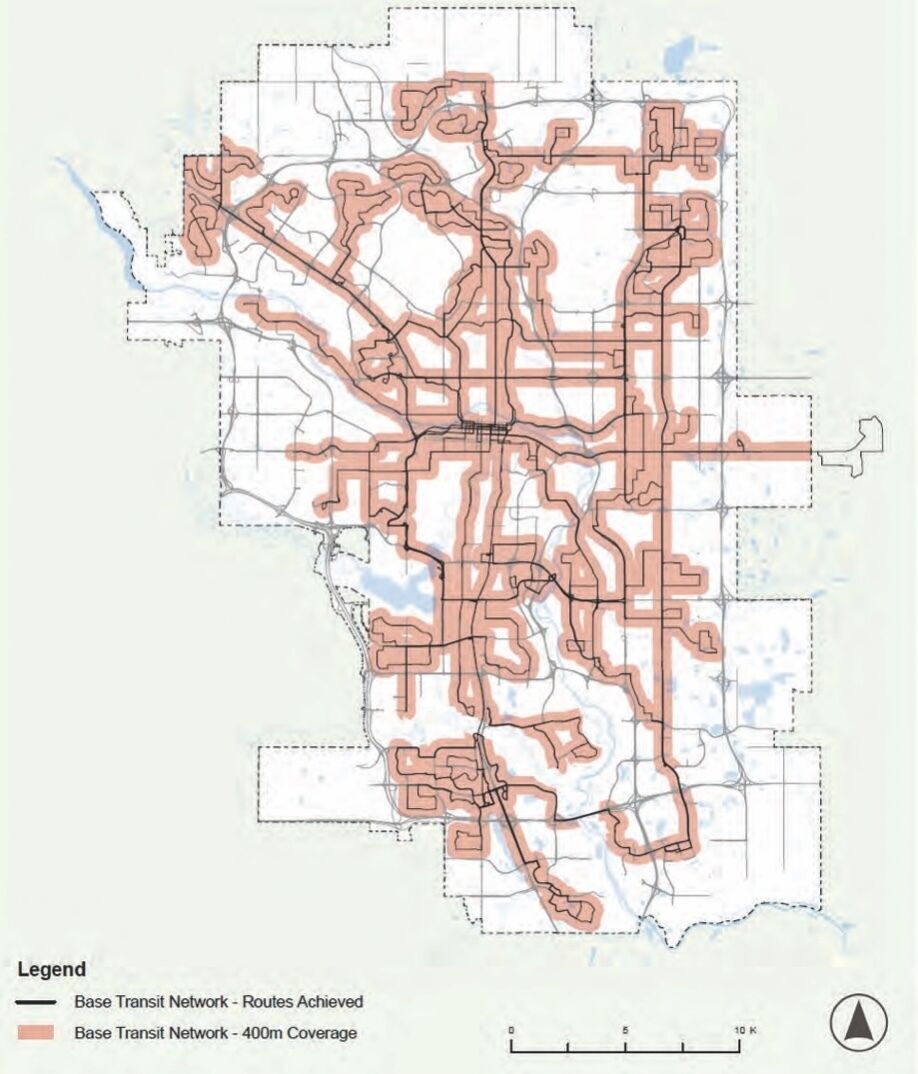
SHARON FLEMING: Yeah, if you're seeing that kind of wait time, you're probably talking about some of our base network service. That service, we're trying to get everyone up to 30 minutes service across the city. We're a far stretch from that. At this point we're lucky to have 60% of households within 400 meters of service at all.
KLASZUS: Here’s how Mayor Jeromy Farkas put it.
MAYOR FARKAS: Calgary's transit system right now is a lot of bread, not enough butter. So we have to attack it a number of different ways.
KLASZUS: In this episode, we’ll look at how the new city council is tackling this challenge. They jacked up fares to $4 for a regular adult rider. They boosted the budget for transit service by $20 million. And they came within a hair of eliminating the CTrain free fare zone downtown—which, by the sounds of it, might not be around for much longer.
Let’s get into it.

A decision to prioritize 'fast and frequent' routes
To understand the current predicament, we need to go back before the election. In May of 2025, Calgary Transit updated the previous city council on RouteAhead, city hall’s 30-year transit strategy. And city admin outlined some challenges...
FLEMING: More people are choosing to use Calgary Transit when they move here. But we require funding to increase the vehicle fleet to support today's service. For reference, more than more than 90,000 people moved to Calgary in 2024... Today, we're recommending council approve a one time investment of $3 million to respond to growth pressures.
KLASZUS: Council approved that three million. But there’s a lot more catch-up to do.
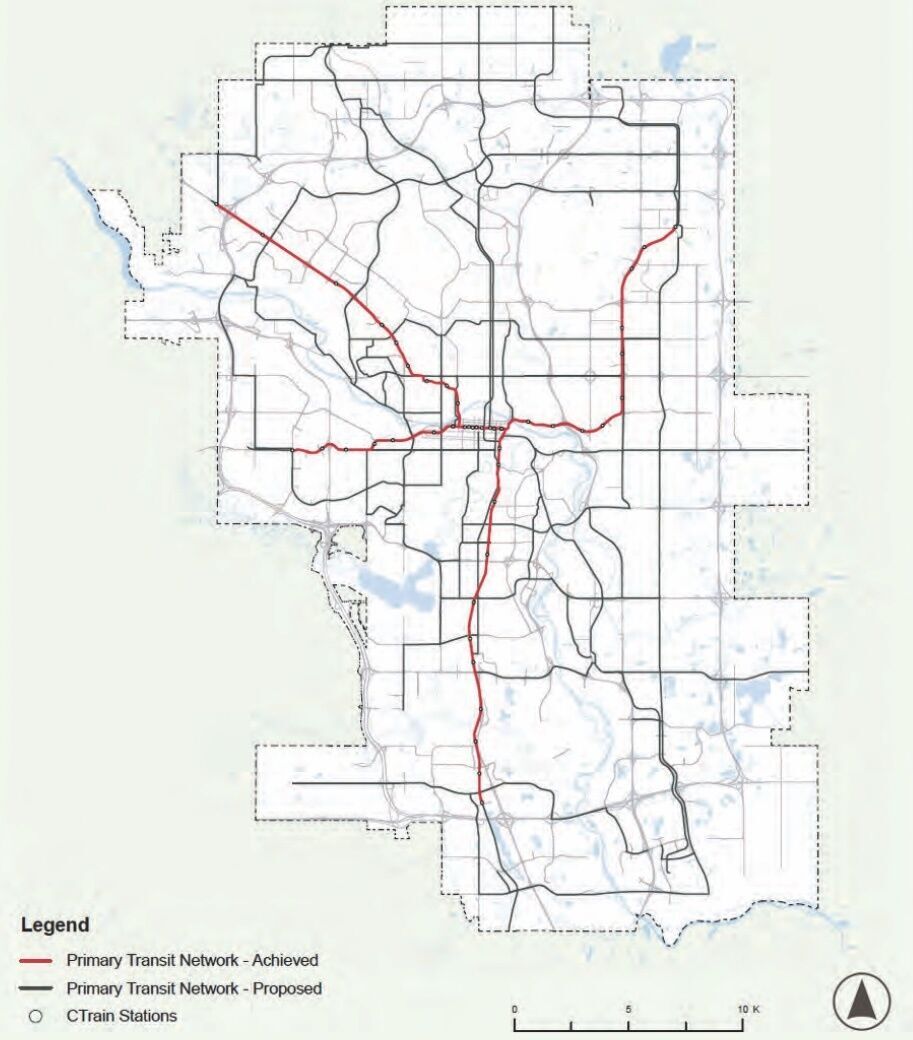
When you think of Calgary’s transit system, there are two types of service. The first is what city hall calls the “primary transit network.” These are fast and frequent main routes like the CTrain lines, crosstown MAX buses and busy bus routes like the #3 on Centre Street and Elbow Drive.
And then there is “base service”—which is the service everywhere else. The less frequent bus routes in most of the city.
In 2023, under the previous city council, Calgary Transit decided to focus on the primary transit network.
By the city’s definition, the primary transit network is supposed to have trips every 10 minutes, 15 hours a day, 7 days a week. But today only the CTrain meets that level of service, and it’s been that way for years.
FLEMING: Today there are no bus routes, including the bus rapid transit routes, that can provide that level of service. The result: only 160,000 Calgarians can easily access fast and frequent transit service from their homes. That's 10% of the current population and 8% of Calgary at two million.
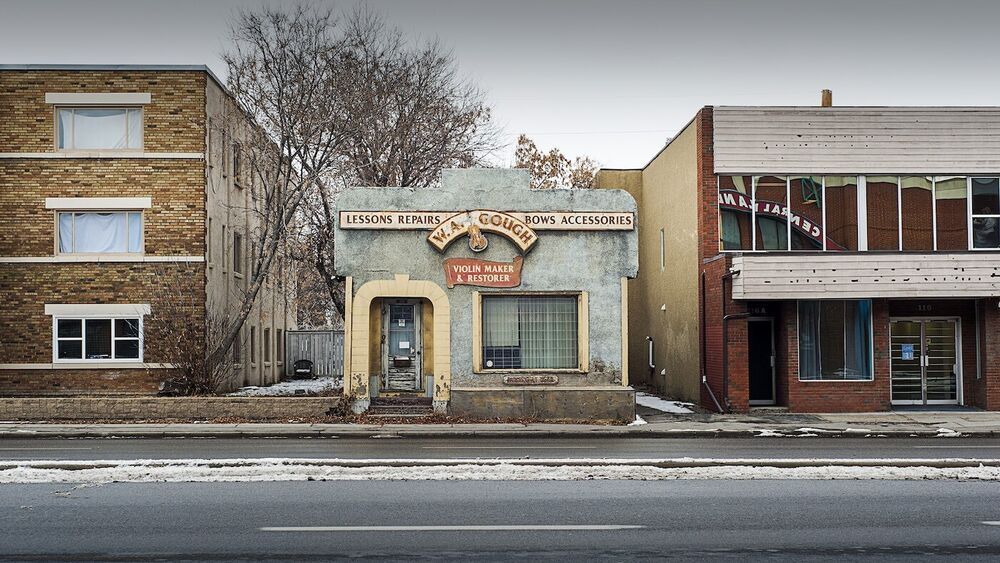
It continues to be a challenge to have those services keep up with 40 new communities all happening at the same time.
KLASZUS: In the meantime, there’s frustration in the rest of the city.
COUNCILLOR RAJ DHALIWAL: There was a shift in RouteAhead. We went from catchment to the frequency. But my question is, if you're not giving a base service to people to get to the primary transit network, that transit network is of no use, in my opinion—because if they can't get there, they don't have that service.
KLASZUS: And this is the situation that the new city council walked into.
COUNCILLOR ANDREW YULE: Where are we seeing the most ridership?
FLEMING: So we do have a data on every route in the city, and we can see where the ridership is. There is a risk, though, in chasing that ridership. If we continue to pour transportation dollars into the same corridors, we're going to see more riders—because they're getting the fast and frequent service that people want, at the expense of other neighbourhoods who haven't had a chance to receive that fast and frequent network.
So we're trying to find a balance between meeting the expectations of the high demand areas with actually giving an opportunity to the other parts of the city that would like to see frequency. And that's the tension we have. Without investment, we're torn between base service for Calgarians and communities that are underserved—and more service in communities that are very well served.
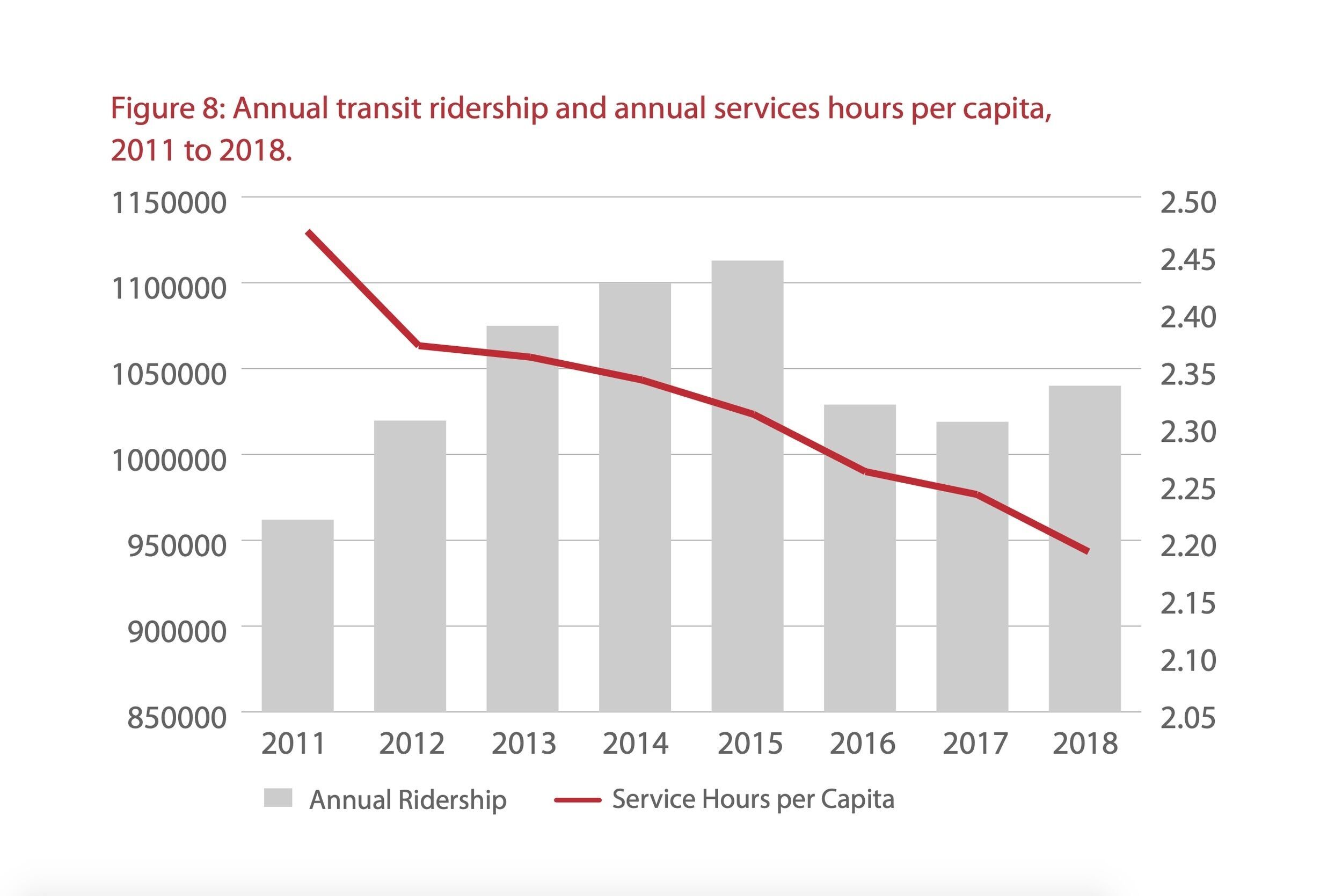
KLASZUS: Back in 2009, city hall set a long-term goal of boosting the number of transit service hours per capita. The 60-year goal was to go from 2.2 transit service hours per capita up to 3.7 hours.
But instead of increasing, that number has gone down as the city has grown in size and population. Transit service hours have decreased from 2.4 service hours per capita in 2011 to 1.8 in 2024—even though ridership rebounded from the plunge it took during the pandemic.
That number was going down well before 2020.
‘Why is transit not accessible to everyone?’
In 2025, you can see signs of strain all over the place. Since September, there have been 33 routes in the city where peak-hour bus trips are regularly cancelled because of a budget and driver crunch.
ALEX WILLIAMS: I'm Alex Williams, and I'm with Calgary Transit Riders. It's kind of the beginning of the doom spiral that transit in some places, especially American cities, tend to see. When you start cutting service, then suddenly the perception of it is less. People say, "Well, I better make plans to get around without transit," and then the fare revenue is less, and then city council uses that as the excuse to cut service, because nobody's using it.
This is a result of chronic underfunding of transit that we have experienced for decades in Calgary, especially as we continue to grow. We can't just not fund transit, and we also can't fund the bare minimum of transit, because the bare minimum of transit isn't a quality service.
KLASZUS: Some bus routes are being cut altogether, like the No. 70 Valley Ridge Express bus that runs only at peak times.
COUNCILLOR KIM TYERS: I'm wondering if the current stance of Calgary Transit is to cancel all express bus routes in the city.
FLEMING: As part of RouteAhead, we revisit the types of service that we provide, and express routes in particular are a legacy of when Calgary was a much smaller city. We don't provide that level of service consistently across the city. There are only six remaining routes, and as we transition to provide service more balanced across our city, we are slowly beginning to cancel those routes.
KLASZUS: These cancellations haven’t gone over well, as Councillor Tyers made clear.
COUNCILLOR TYERS: Transit riders have signed a petition expressing their disappointment in this decision, and they told me very clearly that their commute is going to almost double in length as a result... And I think this is disappointing at a time where we're trying to get more people to take transit. We're a very transit-oriented council. I think we want a lot of investment in transit. We want to increase it. We want to make it better for residents.
This is a result of chronic underfunding of transit that we have experienced for decades in Calgary, especially as we continue to grow.
KLASZUS: The 2026 budget originally had a $14M boost for the primary transit network—but no boost for base service in the rest of the city.
COUNCILLOR TYERS: I'm just curious why we're punishing people for living out in the suburbs who don't ride it as much. Why? Why is transit not accessible to everyone? Why is it only accessible to to people in the main routes?
KLASZUS: It’s the age-old question of the Calgary Transit rider: why?! Whyyyyy?!!
But one of the things that happens at budget time is that councillors move to fill in a few of the missing budget gaps, a choreography that happens every year.
COUNCILLOR MYKE ATKINSON: What could we actually invest in this year to sort of help with those routes in these outlying areas?
FLEMING: So because buses take about two years to purchase, we wouldn't be able to utilize any new buses this year for this purpose. But we can find some efficiencies in the way our buses are used, and put out an additional probably $5 million in base service with our existing resources.
COUNCILLOR ATKINSON: So $5 million extra for base and $1 million for the primary network, on top of what's currently in here, would bring it up using our existing fleet to sort of maximum capacity.
FLEMING: That's correct.
KLASZUS: And that’s what council did. We’ll get to the debate on that. But first I want to stay with the suburbs—because there was an interesting bit of information. Council heard that Calgary Transit has a $17 million gap because of how new communities were previously approved. Here’s Jon Lea of Calgary Transit.
JON LEA: We were providing service to those new communities without the equivalent operating dollars from council. So that's where we got spread really thin.
FLEMING: That's what why you see service being spread across the city in a way that maybe doesn't make everybody happy, but we're trying to absorb that $17 million in service—which you know you can't do, but spread it around as much as we can.
KLASZUS: Nowadays when council approves a new neighbourhood, the cost of running buses is factored in.
I think this is disappointing at a time where we’re trying to get more people to take transit. We’re a very transit-oriented council.
More revenue sources: Chabot moves to raise fares, cut free transit for kids
Now let’s get into the transit amendments that the new council decided on. Councillor Andre Chabot put forward three proposals. Proposal one: eliminating free transit for kids ages 6 to 12. Proposal two: eliminating the free fare zone. And proposal three: increasing fares. They were already set to increase 10 cents, and Chabot’s proposal would nudge it up another 10 cents.
COUNCILLOR ANDRE CHABOT: If you want to increase the levels of service, and you want more cleanliness and better security, somehow you have to raise money to actually do that. So that's the reason for the proposal on the fare increase.
COUNCILLOR HARRISON CLARK: I just want to highlight the fact that $4 a ride is probably one of the most expensive in the country, if not North America. It's a very expensive ride, and while we have some supports available to residents in the city yet. I don't know that it's maybe heading in the right direction here to start cutting away at access points for potentially our lowest income Calgarians.
COUNCILLOR NATHANIEL SCHMIDT: So we just decreased taxes for Calgarians, but with this move, we're going to eliminate any benefit of that... for the ones who need it the most. We are eliminating three things here that allow people who don't have enough money to afford a vehicle to get around our city.
If you want to increase the levels of service, and you want more cleanliness and better security, somehow you have to raise money to actually do that.
KLASZUS: Operational services GM Doug Morgan, who has worked at city hall for over two decades, also warned caution about the fare increase.
MORGAN: This is my 19th fare increase since I've been here. And I have to be honest with council, it's a very painful thing for the community. Even small fare increases. I think what we have in the budget is 2.4%—we didn't hear much from the public about fare increases because it was quite modest. But if all of this goes in, a regular adult market rider is going to pay $8 more a month... that's about 6.7% more for transportation costs for them.
So I just wanted to make sure council knows that these are really painful for customers, right from the poorest—the $5 passes—all the way up to the mom and pop that are coming downtown to work, coming down to do cleaning. They may not be able to qualify for the low-income pass, but it is impactful for them. So just want you to know that you will hear about it.
KLASZUS: Council approved the fare increase 8 - 7. If you want to see how council members voted, check out The Sprawl’s 2026 budget tracker, which breaks down this and other votes.
Then it was time to decide on free transit for kids ages 6 to 12. Transit has long been free for kids five and under, but in 2023 council expanded it to 12 and under. But this has been a headache for drivers.
COUNCILLOR CHABOT: What we've heard from transit operators is this has created a real problem for them, because there's people up to the age of arguably, maybe even 40 is what I've heard from some transit operators, claiming to be under 12.
COUNCILLOR ANDREW YULE: Being a dad that has had kids take advantage of this 12 and under—12 years old is Grade 7. It's a great opportunity to learn transit, and having my son learn transit in Grade 7 and not having to pay is really helpful.
COUNCILLOR MYKE ATKINSON: I don't support these... we are trying to get more kids on transit.
KLASZUS: Council voted it down 8 - 7. And this brings us to the free fare zone.
This is my 19th fare increase since I’ve been here. And I have to be honest with council, it’s a very painful thing for the community.
Have we reached the end of the free fare zone?
In November, LiveWire Calgary broke news that TD has pulled out of its sponsorship agreement for the free fare zone two years early.
COUNCILLOR CHABOT: We heard that we lost funding for the downtown free fare zone. And again, this is opportunity for arguably a safe injection site for the downtown core. We see a lot of homeless people getting onto the train, and once they're on, they utilize it as as their method to, I guess, be monitored while they they do some of their drugs.
And this emanates out into the surrounding areas. It goes out into into the outlying areas. My communities in particular, severely impacted by folks that get on the train downtown and go out to those outlying areas. And once they're on, it's kind of hard to force them off the system.
KLASZUS: Councillor Chabot also sees the free fare zone as a missed revenue opportunity.
COUNCILLOR CHABOT: I know it does have some significant benefit to the downtown folks that utilize it. Again, it's a significant loss in revenue, and we want to increase the levels of service and the increased safety on our transit system. Somehow we have to pay for it.
KLASZUS: City admin gave a not very enthusiastic recap of the free fare zone’s history. It’s been there since the CTrain opened in the early ’80s.
FLEMING: The free fare zone was part of a 1966 downtown master plan that included a pedestrian mall, a ring of highways and parkades on the edges. So in 1981 it came into effect. We are in the process of already investigating or assessing the free fare zone.
[The free fare zone] is opportunity for arguably a safe injection site for the downtown core.
KLASZUS: Council heard that the free fare zone makes fare enforcement difficult. Here’s community safety director Iain Bushell.
IAIN BUSHELL: At the moment, a peace officer can't get on the train downtown and say: Can you show me your ticket? Because they're in a free fare zone. So they're not actually lawfully placed to execute that sort of authority. As director Fleming pointed out, we then end up stationing peace officer catch zones on the outside of the free fare zone, and have to intercept more people.
So this way, we would be able to ask for fares across the system all the time. So theoretically, at least in practice, we believe we will actually reduce fare evasion because of the reduction the free fare zone.
COUNCILLOR DHALIWAL: Okay, I know the safety is very important, but at the same time convenience is also important. And making it easier for people to to move around our city, especially in the downtown core—that's what's important.
I know the safety is very important, but at the same time convenience is also important.
KLASZUS: Calgary Transit says there are about six million free fare trips each year. City hall estimates that if the free fares were eliminated, about 25% of today’s users would keep using the train. The rest would change mode.
FLEMING: So what that means is they may or may not take a car, but they may also choose to walk. So that would create ridership capacity on our train system, which would enable more people to get on downtown during peak periods.
KLASZUS: Councillor Jennifer Wyness liked the sound of that.
COUNCILLOR JENNIFER WYNESS: When you look at the fare free zone, council invested a bunch in transit peace officers in the last budget cycle, and it's not working. So yes, if we have people getting off the CTrain in the downtown core, that's more people on the streets. That's more activation. That is a better way to use non-policing measures to help make our city safer, because you cannot enforce your way out of this.
And so I know some of my colleagues on the other side do not want to continue to see police budgets growing, and yet here you have an opportunity, through just adding a fare, that people will choose to walk around the downtown core and get around to where they want to be. Because you can't have it both ways. And it's not, because other major cities actually have this working and it's helping. So I just want to get council to think about that. If you think this is so horrible and you want to put more and more money into transit peace officers, you're not going anywhere.
KLASZUS: On a side note, city admin says the last council’s 2024 investment into transit security is working. That was $15 million and included more than 50 new peace officers.
BUSHELL: We have seen approximately a 20.5% reduction in crime and disorder on transit.
If we have people getting off the CTrain in the downtown core, that’s more people on the streets. That’s more activation.
KLASZUS: In any case, if the free fare zone gets eliminated and has fewer downtown riders, Fleming said Calgary Transit could potentially redirect service hours by tweaking CTrain frequency...
FLEMING: ...from perhaps five minutes to six minutes, and then reallocate those dollars to other parts of the city that actually don't have transit today.
KLASZUS: None of this was going over well with Ward 8 Councillor Nathaniel Schmidt.
COUNCILLOR SCHMIDT: This is particularly punishing inner-city wards, where we have 30,000 people living in the Beltline who rely on this transit every single day, have come to rely on these systems.
So what message are we sending to the country and to those who want to come visit Calgary if we are draining things from our downtown? The real narrative here is that we are not funding transit effectively, because if our solution is cutting these beneficial programs, then that is not a solution.
KLASZUS: Here’s new Ward 4 Councillor DJ Kelly asking a question of Calgary Transit director Sharon Fleming.
COUNCILLOR KELLY: It sounded to me, correct me if I'm wrong, like based on the knowledge that you have at this point, that on behalf of transit, you're advocating for eliminating the free fare zone. Is that correct?
FLEMING: Along the lines with some of the equity conversations we've had earlier, this is an example of whether or not we need to re-examine our legacy solutions.
COUNCILLOR KELLY: I appreciate the needle you threaded there. Well done. My only concern, council, in terms of this one is this is a pretty significant change to suddenly be making on the fly. I'm not arguing that it's not a good idea. I'm just arguing that I haven't really seen enough information yet to know if it's a good idea.
This is particularly punishing inner-city wards… If our solution is cutting these beneficial programs, then that is not a solution.
COUNCILLOR JOHN PANTAZOPOULOS: I believe that having a closed system would make it safer 100%. We can actually have enforcement etcetera. I just think that I echo councillor Kelly's comments that a [it's a] pretty material change—not engaging with Calgary Tourism, Calgary business owners, just to understand. I think that would be prudent for us, and we can always come back and re-examine that once we talk to Calgarians. So I will be voting against that particular one.
KLASZUS: In an 8-7 vote, council voted against eliminating the free fare zone—for now. But they did vote to put $9 million more into transit safety at afternoon peak times with an amendment put forward by Councillor Pantazopoulos.
COUNCILLOR PANTAZOPOULOS: When fully operational, this pilot will see 30 transit peace officers—that's important—providing safety for Calgarians. By having more transit peace officers, this will free up remaining officers and security personnel to do their jobs and make everyone's ride home safe and enjoyable. This is the Calgary Transit system Calgarians want.
KLASZUS: Here’s Mayor Jeromy Farkas.
FARKAS: It's really important for us as a council if we're going to be asking Calgarians to pay a modest amount more for the service that we really step up with better transit. And transit means a bunch of things. It means reliability, which the service hours provides. It means affordability, which will have elements of the low income transit pass. But it also means safety.
So if we can prove out the value of transit to more people over this next year, and be able to really attack with gusto one of the greatest impediments that Calgarians have told us is to their use of transit is not feeling safe on transit. So if we can remove that barrier to using transit, we can overall enter into much more of a virtuous cycle where more people on transit makes transit safer.
If we can remove that barrier… we can overall enter into much more of a virtuous cycle where more people on transit makes transit safer.
'A step forward': Council puts $5M more into base service
KLASZUS: Fresh off the fare increase, Councillor Myke Atkinson made an amendment to put $6 million more into better transit service—$5 million into base service and $1 million into the primary transit network, bringing the total transit service boost for 2026 to $20 million.
COUNCILLOR ATKINSON: Yesterday we had a an increase that, while I'm not a fan of the 10 cent increase, it does give us an opportunity to pay for some of these improvements. And as long as we provide service in conjunction with an increase, we can see ridership go.
COUNCILLOR MIKE JAMIESON: If you're a councillor in a far-reaching area of the city where you have a lot of new communities, you would have heard this campaigning—that they need service, and they need more service. And frankly, they need more service than we can provide for them right now. But this is a step to enhance the quality of the base network. And given that we did increase the fares yesterday, then essentially this is an added value that they're getting for that increase. And to me, it makes a lot of sense, if you think of how many people do need to be reached at the far edges of the city.
COUNCILLOR YULE: This is a step forward to our next four-year budget, where we really need to do a major investment. I know there was a lot of concern over the weekend about the the phasing out of express buses. I think this is a direction forward to really help that that base network to make such a phase out in the future less of an impact on Calgarians.
COUNCILLOR KELLY: Right now, this is about efficiency. We have a fleet that needs to be maximized. This does that.
To me, it makes a lot of sense if you think of how many people do need to be reached at the far edges of the city.
KLASZUS: Council approved it 13 to 2.
The next day, Atkinson tried to get council to approve $45 million from reserves to buy about 45 new buses over the next three years.
COUNCILLOR ATKINSON: We also heard yesterday that we have hit maximum capacity in terms of the buses that we can run on the roads. So if we are actually going to try and continue to grow our operational capacity in transit, we need to start making some capital investments in terms of getting new buses out on the road.
KLASZUS: But this one hit a wall, as council had already spent heavily from its reserves for other projects.
COUNCILLOR CHABOT: This is not the time to make these huge changes to our our projected operational needs for the future. This is something that's more appropriately done through a four-year business strategic planning session...
What's not included in this motion is the operational implications of this capital expenditure. And as you've heard in the last little while, cost recovery from the users of transit system is only 35%. And 65% is funded through property taxes. Add more buses, you're going to have to increase taxes to pay for the operators to actually run those buses.
We need to start making some capital investments in terms of getting new buses out on the road.
KLASZUS: Chabot moved to defer the three-year bus buy until council sets the next four-year budget in 2026, and council approved the deferment. But then Councillor Dhaliwal proposed just doing one year at $11.25 million.
DHALIWAL: Being reactive always cost us more money. It's never beneficial.
COUNCILLOR FLEMING: If we order them in 2026 they will not show up until late 2027 at the earliest.
MAYOR FARKAS: And are we likely going to need more buses in 2027?
FLEMING: Absolutely.
MAYOR FARKAS: I will support this.
KLASZUS: Council narrowly approved the bus buy, 8-7.
An unfinished LRT tale
So there you have it. Now you have a better understanding of why transit service in Calgary is like butter scraped over too much bread, to quote Bilbo from The Lord of the Rings.
Speaking of fantasy…
COUNCILLOR YULE: Yeah, just want to chat about Green Line north leg...
KLASZUS: The Green Line is a whole other saga for another day!
Jeremy Klaszus is founder and editor of The Sprawl.
Support independent Calgary journalism!
Sign Me Up!The Sprawl connects Calgarians with their city through in-depth, curiosity-driven journalism. But we can't do it alone. If you value our work, support The Sprawl so we can keep digging into municipal issues in Calgary!