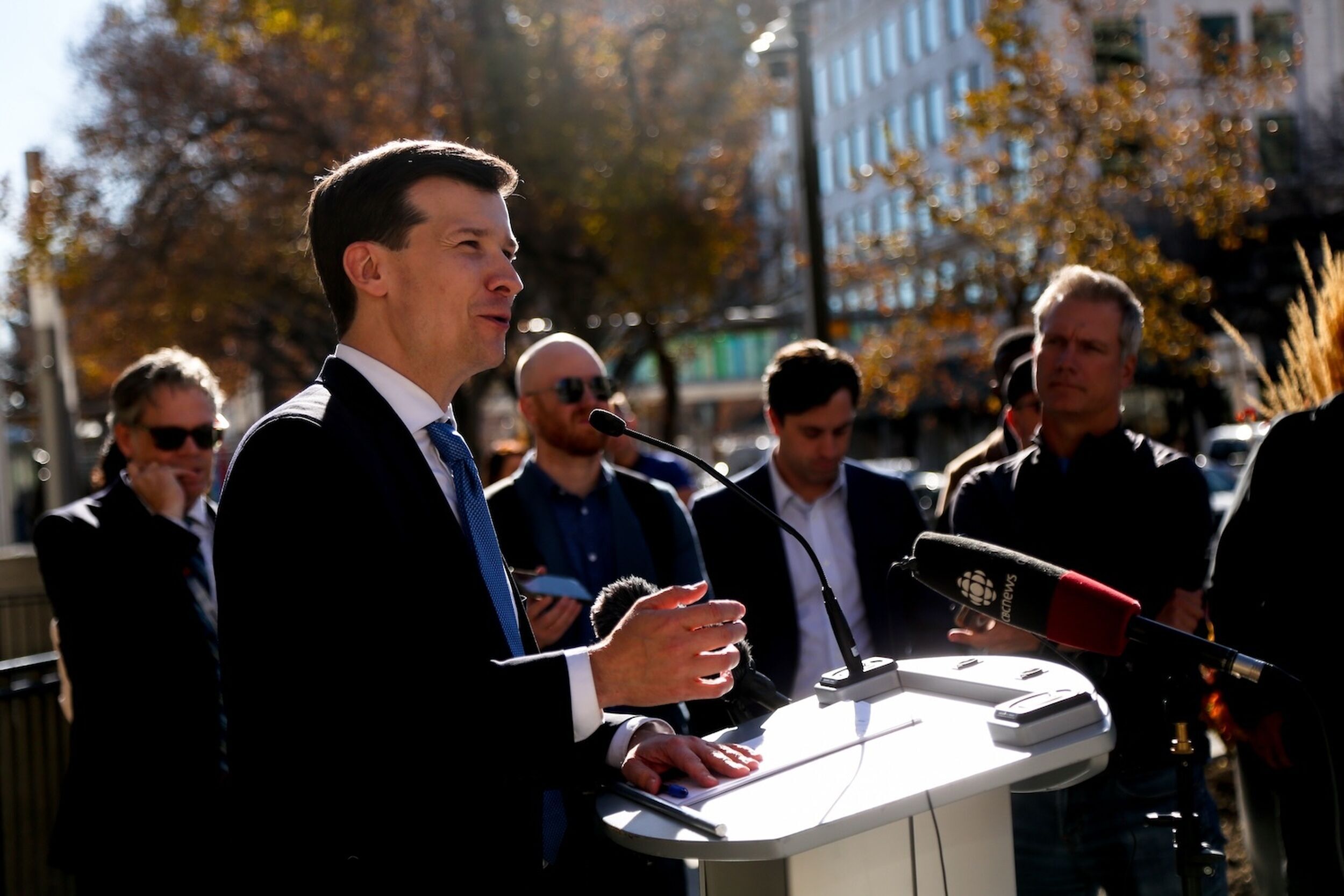
Jeromy Farkas speaks with media in front of old city hall on October 21, 2025. Photo: Asad Chishti
Calgary’s bizarre low-turnout, high-turnover election
Relatively few Calgarians made big changes.

In 2021, when he lost to Jyoti Gondek in the race to become Calgary’s mayor, Jeromy Farkas got just under 116,700 votes from Calgarians.
Four years later, with the city’s population having grown by some 200,000 people, his support slid down to just over 91,000 votes.
But it was enough, in a low-turnout election where many Calgarians were unenthusiastic about their choices, for Farkas to be elected as Calgary’s 38th mayor, alongside 10 new councillors and only four incumbents.
This was the first election since the UCP’s major changes to municipal elections in Alberta and there was little ambiguity from Alberta Premier Danielle Smith’s office about what it hoped to see.
“Tomorrow’s Alberta municipal election is our shot to reclaim local leadership from big-government chaos,” wrote Bruce McAllister, executive director of the premier’s office, on X the night of October 19. He urged the Alberta municipal voter to “rise as a proud Albertan patriot.... Our province soars when conservatives lead EVERY level, rooted in our Alberta spirit.”
Election Day wasn’t marked by soaring, however, but slowdowns. Lineups at many voting stations were jammed thanks to new paperwork requirements, introduced by the UCP in Bill 20 last year, which caused delays that deterred many from voting.
A big stick in the wheel was Form 13, which had election workers writing out addresses and birthdates by hand when voters requested a school board ballot—even if the voter was already on the election register. With a hand count, workers also had to fold and initial three individual ballots, rather than handing voters the single composite paper ballot that was used in 2021 for tallying by tabulators.
“Once the trustee ballot was requested, you had to rewrite the entirety of the voter’s information even though they already have a voter ID,” one election worker told The Sprawl. “If I were a more cynical person I would say this reeks of voter suppression. Make it longer and harder to vote for everyone involved.”
There were reports of it taking between two and a half and five minutes to process each voter. “All those individual little steps did add to the additional processing times,” said city returning officer Kate Martin.
Lines crawled. Some Calgarians gave up and left. Others heard of the delays and didn’t go at all.
How many Calgarians intended to vote Monday but were deterred? It’s impossible to say. What we do know is that it added up to a lousy 39.04% voter turnout, the lowest in nearly two decades. As Sam Hester noted in her recent election comic series in The Sprawl, voter turnout in Calgary has plummeted over the past decade.
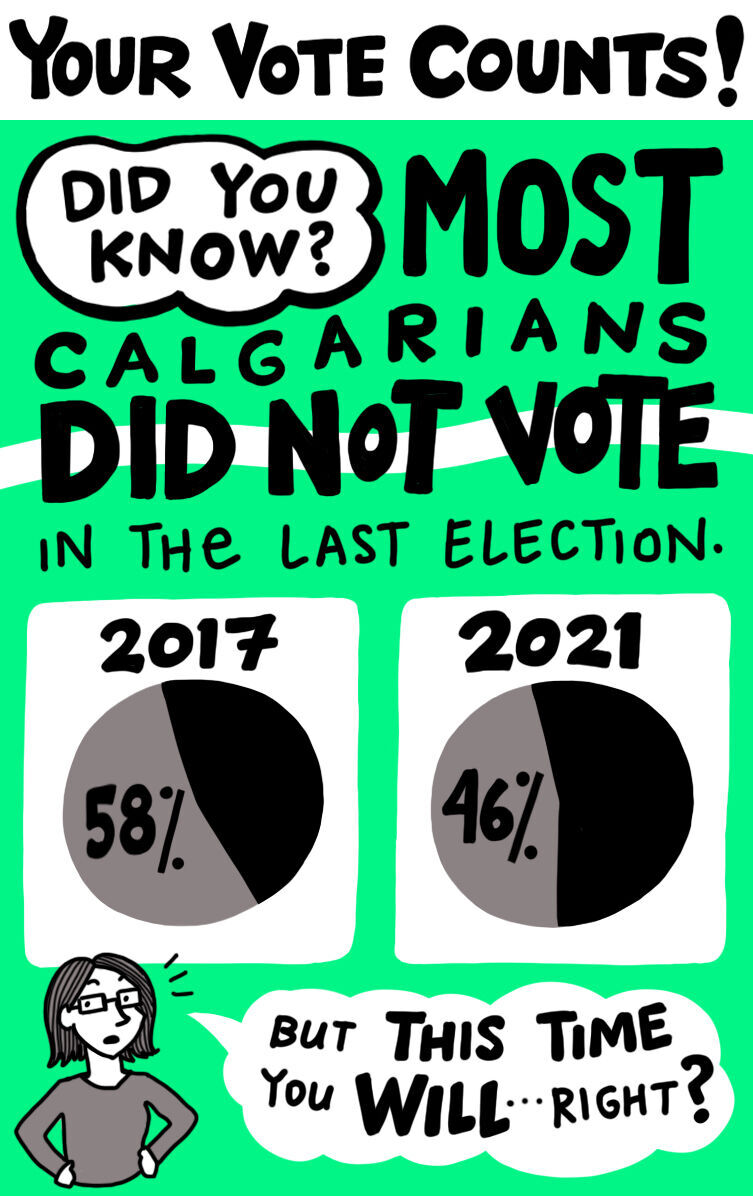
In each one of Calgary’s 14 wards, fewer Calgarians voted than in 2021, despite population growth.
You have to go back a quarter-century, when Calgary’s population had yet to crack a million, to find a mayor elected with so few votes: Dave Bronconnier in 2001. And his portion of the popular vote (28%) was higher than Farkas’s (26%).
The last Calgary election to have worse turnout was 2007. (In 2013, voter turnout was almost but not quite as bad, at 39.4%.) But the 2007 election featured a relatively popular mayoral incumbent in Bronconnier and numerous incumbent councillors who easily won re-election.
The 2025 election, by contrast, featured an unpopular mayoral incumbent in Gondek, whose support plunged by more than 100,000 votes, and eight council seats without an incumbent—meaning most of council was up for grabs.
Even so, a weak and uninspiring field of mayoral candidates largely failed to ignite public interest. And even those who were interested were dissuaded from voting.
When the government introduced Bill 20 last year, it said the point was to increase confidence in municipal elections. “Unfortunately it has accomplished the opposite,” said MRU political scientist Lori Williams. “We’re hearing stories of people being in line for up to two hours, and that some people left the line and didn’t vote at all because the process was too onerous. That’s terrible for democracy.”
You have to go back a quarter-century to find a mayor elected with so few votes: Dave Bronconnier in 2001.
The new municipal parties, a pilot introduced by the province in Calgary and Edmonton (and only Calgary and Edmonton, not elsewhere) found limited success. Voters in both big cities clearly preferred independents.
Calgarians elected nine independent councillor members, ranging from Myke Atkinson in Ward 7, on the progressive side, to Landon Johnston, who led the recall Gondek petition, in Ward 14.
Of the three municipal parties in Calgary, Communities First fared best with four councillors elected: Kim Tyers in Ward 1, Andre Chabot in Ward 10, Rob Ward in Ward 11 and Dan McLean in Ward 13.
A Better Calgary Party narrowly got one win: Mike Jamieson in Ward 12, who defeated Sarah Ferguson of The Calgary Party by 59 votes, confirmed after a Thursday recount.
The Calgary Party raised and spent the most of the three parties by far in the first half of 2025, according to financial disclosures. It spent over $288,000 from January to July but got only a single council member elected: DJ Kelly in Ward 4.
With Kelly losing by only 100 votes in the 2021 election, it’s likely he would have won without the party affiliation—or possibly even garnered more support as an independent candidate.
Meanwhile, voters gave two incumbent councillors the boot: Terry Wong in Ward 7 and Kourtney Penner in Ward 11. Penner lost by more than 12,600 votes.
The new council has only two women: Kim Tyers and Jennifer Wyness.
Third-party advertisers also found their influence and power curtailed this election since the UCP capped donations to these groups at $5,000. In 2021, flush with $1.7 million donations from city unions, Calgary’s Future endorsed 13 council candidates and nine won. This year, the group endorsed 15 council candidates but only five won.
Calgary’s Future fared better on the CBE trustee level, where four of its six endorsees won. Parents for Choice in Education, meanwhile, endorsed five CBE school trustee candidates (the ones with similar campaign materials The Sprawl reported on in September) but none of them won.
Bottom line: This was a very strange election. Jeromy Farkas is set to be sworn in as mayor next week with about 1 in 10 eligible voters having cast a ballot for him. Meanwhile Sonya Sharp, who lost to Farkas by just 581 votes, has requested a recount, which Elections Calgary will begin on Monday morning.
Yesterday I joined Kathleen Petty on CBC’s West of Centre podcast, together with Lori Williams and the Edmonton Journal’s Keith Gerein, to discuss whether democracy was helped or hindered by the province’s overhaul of municipal elections. You can listen to our conversation here.
The voter turnout numbers are a real drag. But The Sprawl's numbers from the past couple months are not! As I wrote last week, we recorded debates in all 14 wards so Calgarians could see and hear their candidates. Now that we’ve had a chance to catch our breath a bit, I’ve been able to run the numbers and they are very good news.
Since September 1, The Sprawl has seen:
- $21,000+ (and counting!) in donations
- 1,570+ newsletter subscriptions
- 1,050+ YouTube subscriptions
Our website was also viewed more than 288,000 times during that period. We are blown away by all the support and interest. If you valued The Sprawl's election coverage, support our independent journalism so we can keep digging into Calgary municipal issues. This isn’t the end—it’s just the beginning of our coverage of this new city council!
Local democracy is damn hard work, as we’ve learned in recent weeks. But it’s worth fighting for.
Jeremy Klaszus if founder and editor of The Sprawl.
CORRECTION 10/25/2025: This story originally stated that Calgarians elected nine independent councillors; in fact, they elected nine independent council members—eight councillors plus Farkas.
Support independent Calgary journalism!
Sign Me Up!The Sprawl connects Calgarians with their city through in-depth, curiosity-driven journalism. But we can't do it alone. If you value our work, support The Sprawl so we can keep digging into municipal issues in Calgary!